
In today’s competitive landscape, visibility in local search isn’t just lovely; it’s critical. And local SEO tools are powering the growing visibility needs.
With 80% of U.S. consumers searching online for local businesses every week and 18% of mobile local searches leading to a purchase within 24 hours, being found online directly impacts your bottom line.
For brick-and-mortar businesses in 2025, staying ahead means using the right tools to support your Local SEO strategy.
From managing your Google Business Profile to tracking local rankings and collecting reviews, specialized software simplifies the process and delivers measurable results.
Based on performance data, user feedback, and real-world impact, we’ve selected five Local SEO tools that consistently help businesses improve their visibility and outperform the competition in local search.
What Should You Look for in a Local SEO Tool?
Before exploring the tools, it’s important to understand what makes a strong local SEO solution.
It should feel like it was built for local businesses, because your needs differ.
1. Multi-location management capability
Got more than one storefront? You’ll want a tool that can handle that without making you juggle a million tabs.
Whether it’s two shops or twenty, look for features like one dashboard for everything, bulk updates, and the ability to see how each location is doing individually. It should feel easy, not overwhelming.
2. Google Business Profile integration
It falls short if a tool doesn’t connect directly with your Google Business Profile (GBP).
You should be able to respond to reviews, post updates, and see your Performance without logging into another platform. GBP is where your local visibility lives, so your SEO tool needs to speak that language.
For businesses in competitive metros — say, a restaurant group in Tennessee working with a Nashville digital marketing agency — that direct integration means the agency can manage and optimize GBP activity across all locations from one place, without constantly switching platforms.
3. Local citation management
It is one of those behind-the-scenes features that makes a big difference. The best tools help you find places to get listed online, fix any wrong info, and keep all your business details consistent.
Why does that matter? Because even minor errors, like an old phone number, can confuse search engines and hurt your rankings.
4. Scalability matters
Even if you’re starting with one location, think long-term. What happens when you open a second shop or a fifth? Your tool should grow with you.
The last thing you want is to outgrow your platform and deal with switching tools, retraining your team, and losing data down the road.
Comparison Criteria
I evaluated these tools based on four key areas: functionality, ease of use, pricing value, and integration capabilities.
- Integration capabilities: Look at how easily each tool connects with platforms like Google Analytics, CRMs, and schedulers. Top tools integrate seamlessly without needing technical skills.
- Performance metrics: Measures how effectively tools track local rankings, manage citations, monitor reviews, and generate clear, actionable reports.
- Cost versus benefits: Compares price, setup time, features, and long-term value. Affordable tools aren’t always cost-effective if they drain time or lack automation.
- User reviews: Based on honest feedback from local businesses, service providers, and multi-location brands. Reviews help cut through marketing claims to show actual performance.
The Top 5 Local SEO Tools
1. Revijet – The Review Automation Powerhouse
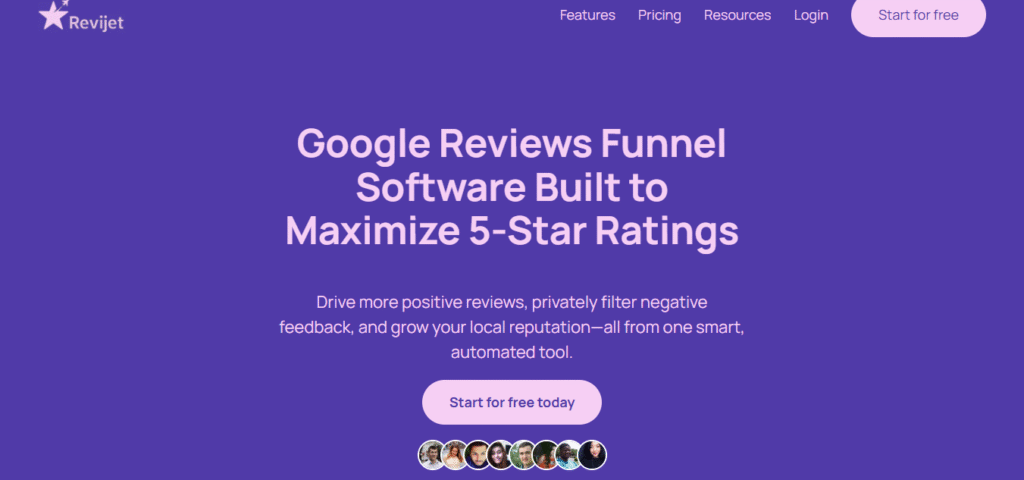
Revijet is a review automation tool that helps local businesses boost and manage Google reviews through smart funnels, multi-channel requests, AI-generated replies, and a dashboard with analytics for multiple locations.
Key Features:
- Automated review requests via Email, SMS, QR code, and WhatsApp (coming soon)
- Smart review funnel: directs 4–5★ reviews to Google, 1–3★ to private inbox
- AI-generated review reply suggestions (up to 200 on the Pro plan)
- Centralized review dashboard with location filtering
- Analytics for opens, clicks, star ratings, and conversion rates
- Website widget to showcase the latest 5-star reviews
Pricing: Revijet offers a Free Plan with 5 email requests and 5 AI replies for 1 location, and a Pro Plan at $10/month (or $96/year) with 100 multi-channel requests, 200 AI replies, and support for extra locations at $6/month each.

Why It Stands Out:
Revijet focuses on the most influential local SEO factor: Google reviews. It’s smart funnel helps protect your public rating by automatically filtering low ratings to a private inbox while showcasing glowing reviews.
Minor Drawbacks:
It’s primarily focused on review generation and feedback management, so you’ll still need other tools for broader SEO tasks like keyword tracking or citation building.
2. BrightLocal – The Local SEO Specialist
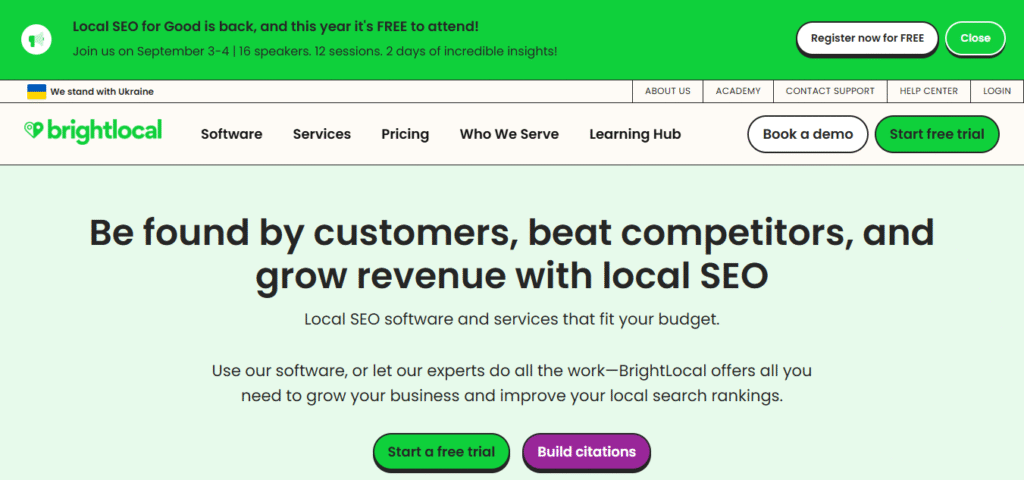
BrightLocal earned the top spot by doing one thing exceptionally well: local SEO. While other platforms try to be everything to everyone, BrightLocal focuses exclusively on helping businesses dominate local search.
Key Features:
- Local rank tracking across Google, Bing, and Apple Maps
- Google Business Profile management and optimization
- Citation builder with access to 60+ directories
- Local SEO audit tool with actionable recommendations
- Review monitoring and response management
- White-label reporting for agencies
Pricing: Starts at $39/month for one location. Manage and Grow plans begin at $49 and $59/month. Higher tiers available (e.g. $79/month for 6–10 locations). It includes a 14-day free trial, so no credit card is needed.

Why It Stands Out:
BrightLocal customizes citation recommendations based on business category and region. Their submission process is manual or semi-automated and includes progress tracking.
Minor Drawbacks:
One thing to note is that you can’t schedule Google Business Profile posts directly through BrightLocal right now. Also, some users say reports can be a bit slow to load at the beginning of the month, but it’s not something that gets in the way of day-to-day use.
3. Moz Local – The Citation Authority
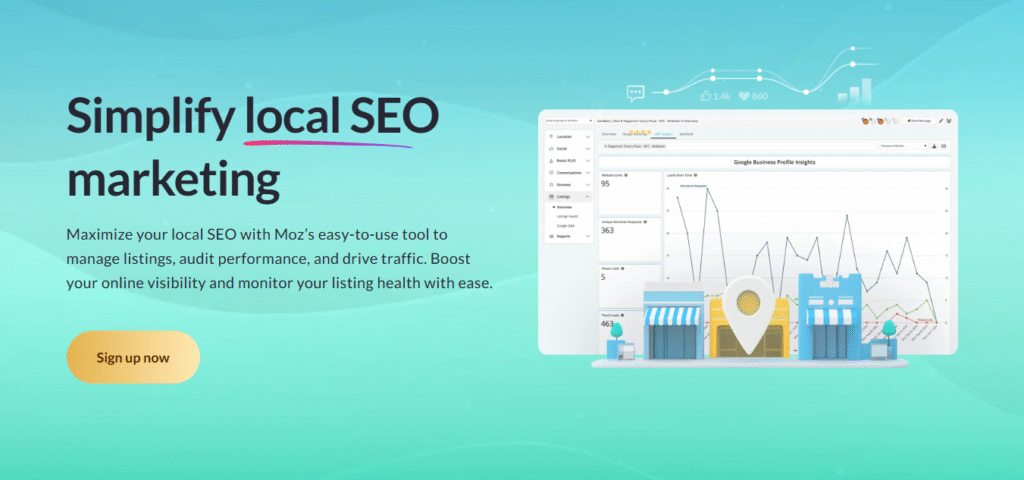
Moz Local takes a different approach, focusing heavily on citation management and local listing accuracy. Their strength lies in ensuring your business information is consistent across the web.
Key Features:
- Automated citation building and monitoring
- Duplicate listing detection and suppression
- Review monitoring across 10+ platforms
- Local visibility scoring
- Competitive benchmarking
- Integration with Moz Pro SEO tools
Pricing: Starts at $16/month per location, with higher-tier plans offering additional features like review management and data aggregator distribution. Discounts may apply for annual billing or multiple locations.

Why It Stands Out:
Moz Local partners with trusted data aggregators like Data Axle (formerly Infogroup), Neustar Localeze, and Foursquare.
When you update your business info on Moz Local, it gets pushed to hundreds of directories automatically, saving hours of manual work and reducing the risk of inconsistent citations.
Minor Drawbacks:
While Moz Local is excellent for listing accuracy and review monitoring, it doesn’t offer the advanced keyword tracking, backlink audits, or comprehensive local SEO reporting tools found in platforms like SEMrush or BrightLocal.
4. Whitespark – The Citation Building Specialist

Whitespark excels at managing citations and local visibility. Its tools help you discover, build, and monitor listings while offering localized rank tracking, which is ideal if consistent directory presence is your top priority.
Key Features:
- Local citation finder with 300,000+ sources
- Citation building campaigns with progress tracking
- Local rank tracking with heat maps
- Review monitoring and alerts
- Local search audit tool
- Citation cleanup services
Pricing: Plans start at $14/month for the Local Rank Tracker and $33/month for the Local Citation Finder, with rates increasing based on campaign size, location volume, or feature tier.
Why It Stands Out:
Whitespark’s Citation Finder has one of the most thorough databases available, spotting citation opportunities most tools miss.
Its Visibility Heat Map rank tracking shows where in your metro area your business ranks best, perfect for service areas with geo-specific targeting.
Minor Drawbacks:
Whitespark is citation-focused. It doesn’t provide keyword research, backlink auditing, or full-site local SEO analysis like BrightLocal or SEMrush.
Screw driving? It handles direction. Building complex campaigns? You’ll need other tools.
5. Yext – The Enterprise Solution

Yext is a local SEO tool built for large businesses with multiple locations. It helps keep business information accurate and consistent across many platforms like Google, Apple Maps, and Facebook.
Key Features:
- Knowledge management across 100+ platforms
- AI-powered content optimization
- Multi-location analytics and reporting
- Advanced workflow automation
- Integration with major CRM and POS systems
- Enterprise-level security and compliance
Pricing: Yext offers annual plans from $199 to $499 per location for small businesses, while larger firms with advanced needs typically pay $500 or more monthly for custom enterprise solutions.

Why It Stands Out:
Yext automates listing updates across platforms, making it ideal for businesses with dozens or hundreds of locations. It ensures consistent local data and branding without manual effort.
Minor Drawbacks:
Expensive and built for scale. Small businesses may be better off with simpler tools like Moz Local or BrightLocal.
How to Implement Local SEO Tools for Maximum ROI
Choosing the right tool is just the beginning. Success requires strategic implementation that aligns with your business goals and operational realities.
1. Setting Clear Goals and KPIs
Start with measurable, specific goals, not vague ones like “improve local SEO.” Instead, aim for targets like “increase Google Business Profile views by 40% in 90 days” or “rank on page one for five local keywords in six months.”
Focus on metrics that impact your business, calls, visits, and sales, not just rankings. Set up conversion tracking to connect SEO efforts to real outcomes.
Track leading indicators (like citation completion or review response time) and lagging ones (like traffic and rankings) to get a complete performance picture.
2. Training Staff for Success
Even the best local SEO tools are only as effective as those using them.
Assign a local SEO lead to manage tools like BrightLocal, Moz Local, or Whitespark. They’ll handle setup, troubleshooting, and team support.
Then, use built-in tutorials and templates to create clear workflows for updating listings, responding to reviews, or tracking rankings. Including screenshots ensures consistency.
Finally, schedule monthly check-ins using the tool’s reporting features. Reviewing metrics like citation accuracy and keyword trends helps refine your strategy.
3. Consistent Monitoring and Adjustment
Local search results shift constantly due to algorithm updates, competitor moves, and evolving customer behavior. As a result, regular monitoring is essential.
Use tools like Local Viking or GeoRanker to track rankings, citation accuracy, and listings to do this effectively. Instead of reacting to daily fluctuations, focus on weekly or monthly trends. These reveal meaningful patterns and guide smarter decisions.
Moreover, some industries experience seasonal spikes. Platforms like Semrush or Google Trends help you spot them early so that you can adjust your content or campaigns in advance.
4. Utilizing Analytics for Continuous Improvement
Connect your local SEO tools to platforms like Google Analytics and Google Business Profile to measure what’s working.
This integration links actions like listing updates or keyword tweaks to real results such as calls, website visits, or conversions.
For instance, if replying to reviews increases calls or a new description boosts click-through rates, the data will show it, helping you refine your strategy.
Roll out one change at a time when testing updates like new images or business categories. Then, monitor Performance for 4–6 weeks before adding more.
Final Thoughts on Choosing a Local SEO Tool
The right tool can turn local SEO into a competitive edge. Revijet, for instance, simplifies review generation and response with AI, helping businesses boost Google reviews and protect their reputation, which are key factors in local rankings.
Meanwhile, BrightLocal offers an all-in-one toolkit with rank tracking, citations, audits, and review monitoring that is ideal for complete control over local SEO.
Other tools have niche strengths: Moz Local focuses on citation management, Whitespark excels at discovery and rank tracking, while Yext is best for large enterprises managing complex location data.
However, tools alone aren’t enough. Choose based on your goals and use them consistently; strategy matters more than software.
Ultimately, local SEO takes focus and persistence. With 80% of consumers searching locally each week, wise investment beats falling behind.