Last Updated on September 23, 2026 by Click Raven
Posting consistently is one of the biggest challenges for influencers today. Creating ideas is usually not the hard part; the real challenge is turning them into production.
Filming, editing, adding captions, resizing videos, and posting across multiple platforms takes a lot of time.
TL;DR: Many creators are starting to use AI video tools. AI tools speed up editing, generate visuals faster, and turn one idea into multiple pieces of content.
Some of the AI Video platforms are making this easier by combining multiple AI video models and creator tools into one workflow.
Why Posting Consistently Gets Hard for Influencers
Audiences only see the finished video. They do not see the production process behind it. Producing a single short-form video often includes:
- finding an idea
- writing hooks
- filming content
- editing scenes
- adding subtitles
- exporting multiple versions
- posting on different platforms
Doing these becomes difficult when creators post daily across different platforms like TikTok, Instagram Reels, and YouTube Shorts. Additionally, many creators work alone without editors or production teams. Over time, the workload creates burnout and slows content production.
This is why consistency is often difficult to maintain. The problem is rarely creativity; it is usually a lack of time.
How AI Video Tools Change the Creator Workflow
AI video tools reduce the gap between an idea and a finished video. They help reduce repetitive production work so creators can focus more on content direction and audience growth.
Instead of manually building every scene, creators can generate visuals using prompts, reference images, or existing footage.
This speeds up several parts of the workflow:
- scene creation
- B-roll generation
- transitions and effects
- captioning
- video refinement
Faster Content Creation
The biggest benefit to using AI video tools is workflow efficiency.
Many creators now batch-produce content instead of creating videos one by one. For example, creators can generate multiple video concepts in a single session and refine them later.
Prompt reuse is another common strategy. Creators save successful prompts and modify them slightly for future videos. This helps maintain visual consistency while reducing editing time.
AI also improves speed during experimentation. Creators can quickly test different hooks, scene styles, transitions, visual pacing, and thumbnail concepts. This matters because short-form platforms reward experimentation. Creators who test more formats often learn faster.
Instead of spending hours creating every variation manually, AI reduces the production load significantly.
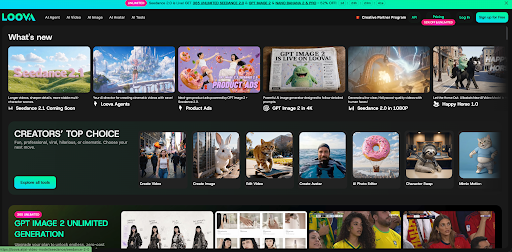
Platforms like Loova AI help streamline this workflow because creators can access multiple AI video models in one place.
Scaling For Small Creators
AI video reduces production barriers for smaller creators. A solo creator can now produce content that previously required a production team.
AI also improves creative testing. Instead of spending hours rebuilding the same concept, creators can quickly generate multiple variations and compare them. This allows smaller creators to compete more effectively in crowded social platforms.
The creators growing fastest today are often the ones with efficient production systems, not necessarily the biggest teams.
AI helps reduce the gap between small creators and larger influencer brands.
Step-by-Step AI Video Workflow For Creators
Most influencer AI workflows follow a similar structure.
- First comes the idea. This may come from a trend, script, meme format, or content niche.
- Next, creators generate scenes and visuals using AI video tools. Some creators use text to video workflows or image to video workflows to maintain character or visual consistency.
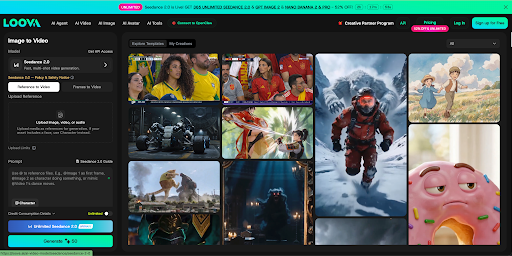
- After generations, creators refine the video using AI editing tools.This may include: improving motion, adding transitions, adjusting pacing, refining scenes and adding captions. They can also upscale video with AI to enhance resolution, improve visual clarity, and make existing footage more suitable for different platforms.
- Finally, the content is exported for TikTok, Instagram Reels, and YouTube Shorts.
This process is much faster than traditional editing because creators are not building every asset manually. The workflow becomes much faster and easier to scale.
Many influencers now use AI to:
- create multiple hooks
- generate different visual styles
- repurpose one idea into several videos
- adapt content for different platforms
Why Multi-Model AI Platforms Matter
Different AI models produce different results. Some models are better for realism. Some are stronger at cinematic motion. Others generate stylized visuals faster.
Because of this, creators increasingly use multiple AI models during production:
- Seedance 2.0 for realistic scenes
- Grok Imagine for fast social content
- Vidu for stylized visuals
- Kling O1 for video refinement
The issue is workflow fragmentation: switching between separate tools slows production and increases complexity.
This is why multi-model systems are becoming increasingly useful.
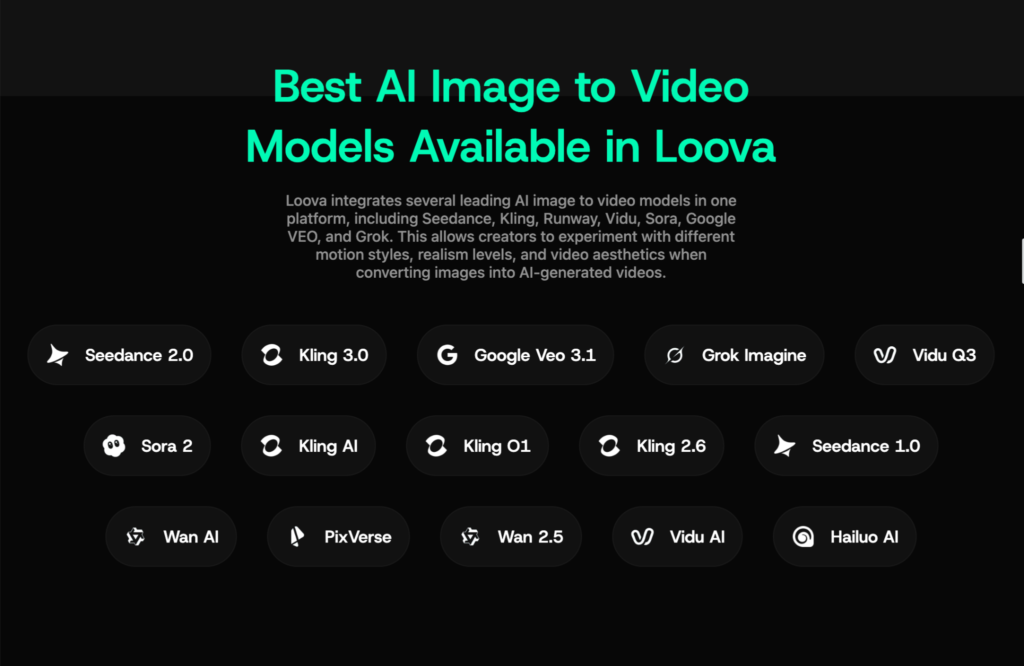
Loova AI integrates multiple AI video models into one workflow so creators can compare styles, refine outputs, and test ideas faster.
How Different Influencers Use AI Video
Influencers use AI video in different ways depending on their content style.
- Short-form creators use AI for TikTok videos, Instagram Reels, and YouTube Shorts. AI helps generate visuals and speed up editing.
- Faceless creators use talking avatar, AI-generated scenes, motion graphics, and cinematic visuals to create content without having to film themselves.
- Lifestyle creators often use AI-generated B-roll and aesthetic visuals to improve storytelling.
- Gaming creators use AI for stylized effects, animated sequences, and visual enhancements.
- Many creators also use AI for sponsored content because it helps them produce ads faster without large production setups.
Common Mistakes Influencers Make When Using AI Video
AI video tools are powerful, but poor workflows still create weak content.
- Generating generic visuals – weak prompts often lead to repetitive content that looks similar to other AI videos online.
- Overusing effects – too many transitions and visual tricks can make videos feel distracting instead of engaging.
- Poor storytelling – some creators focus too much on visuals and ignore storytelling. Good pacing, hooks, and structure still matter more than effects.
- Workflow overload – using too many disconnected tools slows production instead of improving it. This is why integrated platforms are becoming more popular. Creators want fewer workflow interruptions and faster iteration.
The Future of AI Video for Influencers
AI video is becoming part of the standard creator workflow.
In the future, creators will likely automate more parts of production:
- generating visual variations
- adapting content for different platforms
- testing multiple hooks
- creating personalized content formats
This does not reduce creativity; it simply changes where creators allocate their time. Instead of spending hours on repetitive editing, creators can focus more on storytelling, strategy, and audience growth.
Loova AI is already moving toward this type of integrated creator workflow.
FAQs
How do influencers use AI video tools?
Influencers use AI tools for editing, video generation, visual effects, short-form content creation, and faster production workflows.
Can AI help influencers post more consistently?
Yes. AI reduces editing and production time, which helps creators publish content more regularly.
What are the best AI video tools for creators?
The best tools usually combine video generation, editing, and multiple AI models in one workflow.
Is AI video useful for TikTok and Instagram Reels?
Yes. AI video tools work especially well for short-form content because they support fast testing and rapid content production.
Why are creators using multiple AI video models?
Different AI models create different styles and strengths. Many creators combine models for realism, speed, and cinematic quality.
What is Loova AI?
Loova AI is an AI creative platform that integrates multiple AI video and image generation models into one workflow.