Category: AI Marketing

  • How AI Video Tools Improve Creator Consistency in 2026

    How AI Video Tools Improve Creator Consistency in 2026

    Posting consistently is one of the biggest challenges for influencers today. Creating ideas is usually not the hard part; the real challenge is turning them into production.
    Filming, editing, adding captions, resizing videos, and posting across multiple platforms takes a lot of time.

    TL;DR: Many creators are starting to use AI video tools. AI tools speed up editing, generate visuals faster, and turn one idea into multiple pieces of content.

    Some of the AI Video platforms are making this easier by combining multiple AI video models and creator tools into one workflow.

    Why Posting Consistently Gets Hard for Influencers

    Audiences only see the finished video. They do not see the production process behind it. Producing a single short-form video often includes:

    • finding an idea
    • writing hooks
    • filming content
    • editing scenes
    • adding subtitles
    • exporting multiple versions
    • posting on different platforms

    Doing these becomes difficult when creators post daily across different platforms like TikTok, Instagram Reels, and YouTube Shorts. Additionally, many creators work alone without editors or production teams. Over time, the workload creates burnout and slows content production.

    This is why consistency is often difficult to maintain. The problem is rarely creativity; it is usually a lack of time.

    How AI Video Tools Change the Creator Workflow

    AI video tools reduce the gap between an idea and a finished video. They help reduce repetitive production work so creators can focus more on content direction and audience growth.

    Instead of manually building every scene, creators can generate visuals using prompts, reference images, or existing footage.

    This speeds up several parts of the workflow:

    • scene creation
    • B-roll generation
    • transitions and effects
    • captioning
    • video refinement

    Faster Content Creation

    The biggest benefit to using AI video tools is workflow efficiency.

    Many creators now batch-produce content instead of creating videos one by one. For example, creators can generate multiple video concepts in a single session and refine them later.

    Prompt reuse is another common strategy. Creators save successful prompts and modify them slightly for future videos. This helps maintain visual consistency while reducing editing time.

    AI also improves speed during experimentation. Creators can quickly test different hooks, scene styles, transitions, visual pacing, and thumbnail concepts. This matters because short-form platforms reward experimentation. Creators who test more formats often learn faster.

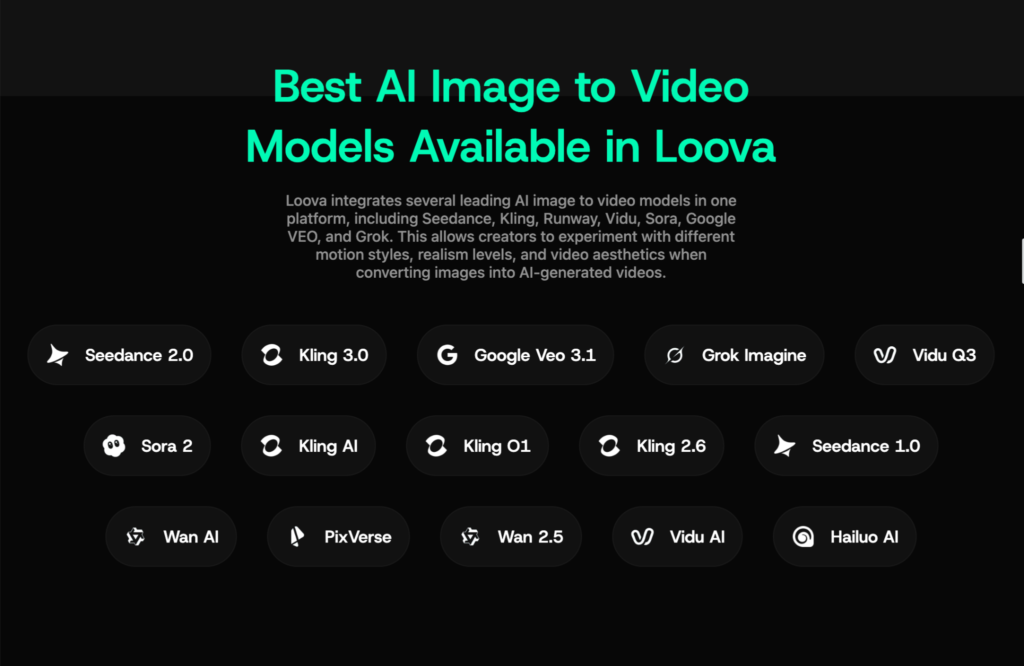
    Instead of spending hours creating every variation manually, AI reduces the production load significantly. Platforms like Loova AI help streamline this workflow because creators can access multiple AI video models in one place.

    Scaling For Small Creators

    AI video reduces production barriers for smaller creators. A solo creator can now produce content that previously required a production team.

    AI also improves creative testing. Instead of spending hours rebuilding the same concept, creators can quickly generate multiple variations and compare them. This allows smaller creators to compete more effectively in crowded social platforms.

    The creators growing fastest today are often the ones with efficient production systems, not necessarily the biggest teams.

    AI helps reduce the gap between small creators and larger influencer brands.

    Step-by-Step AI Video Workflow For Creators

    Most influencer AI workflows follow a similar structure.

    • First comes the idea. This may come from a trend, script, meme format, or content niche.
    • Next, creators generate scenes and visuals using AI video tools. Some creators use text to video workflows or image to video workflows to maintain character or visual consistency.
    • After generations, creators refine the video using AI editing tools.
    • Finally, the content is exported for TikTok, Instagram Reels, and YouTube Shorts.

    This process is much faster than traditional editing because creators are not building every asset manually. The workflow becomes much faster and easier to scale.

    Many influencers now use AI to:

    Why Multi-Model AI Platforms Matter

    Different AI models produce different results. Some models are better for realism. Some are stronger at cinematic motion. Others generate stylized visuals faster.

    Because of this, creators increasingly use multiple AI models during production:

    • Seedance 2.0 for realistic scenes
    • Grok Imagine for fast social content
    • Vidu for stylized visuals
    • Kling O1 for video refinement

    The issue is workflow fragmentation: switching between separate tools slows production and increases complexity.

    This is why multi-model systems are becoming increasingly useful.

    Loova Multi-modal AI Video tool

    Loova AI integrates multiple AI video models into one workflow so creators can compare styles, refine outputs, and test ideas faster.

    How Different Influencers Use AI Video

    Influencers use AI video in different ways depending on their content style.

    • Short-form creators use AI for TikTok videos, Instagram Reels, and YouTube Shorts. AI helps generate visuals and speed up editing.
    • Faceless creators use talking avatar, AI-generated scenes, motion graphics, and cinematic visuals to create content without having to film themselves.
    • Lifestyle creators often use AI-generated B-roll and aesthetic visuals to improve storytelling.
    • Gaming creators use AI for stylized effects, animated sequences, and visual enhancements.
    • Many creators also use AI for sponsored content because it helps them produce ads faster without large production setups.

    Common Mistakes Influencers Make When Using AI Video

    AI video tools are powerful, but poor workflows still create weak content.

    • Generating generic visuals – weak prompts often lead to repetitive content that looks similar to other AI videos online.
    • Overusing effects – too many transitions and visual tricks can make videos feel distracting instead of engaging.
    • Poor storytelling – some creators focus too much on visuals and ignore storytelling. Good pacing, hooks, and structure still matter more than effects.
    • Workflow overload – using too many disconnected tools slows production instead of improving it. This is why integrated platforms are becoming more popular. Creators want fewer workflow interruptions and faster iteration.

    The Future of AI Video for Influencers

    AI video is becoming part of the standard creator workflow.

    In the future, creators will likely automate more parts of production:

    • generating visual variations
    • adapting content for different platforms
    • testing multiple hooks
    • creating personalized content formats

    This does not reduce creativity; it simply changes where creators allocate their time. Instead of spending hours on repetitive editing, creators can focus more on storytelling, strategy, and audience growth.

    Loova AI is already moving toward this type of integrated creator workflow.

    FAQs

    How do influencers use AI video tools?

    Influencers use AI tools for editing, video generation, visual effects, short-form content creation, and faster production workflows.

    Can AI help influencers post more consistently?

    Yes. AI reduces editing and production time, which helps creators publish content more regularly.

    What are the best AI video tools for creators?

    The best tools usually combine video generation, editing, and multiple AI models in one workflow.

    Is AI video useful for TikTok and Instagram Reels?

    Yes. AI video tools work especially well for short-form content because they support fast testing and rapid content production.

    Why are creators using multiple AI video models?

    Different AI models create different styles and strengths. Many creators combine models for realism, speed, and cinematic quality.

    What is Loova AI?

    Loova AI is an AI creative platform that integrates multiple AI video and image generation models into one workflow.

  • AI Marketing Assistants and Virtual Support: Strategy, Workflows, and Use Cases

    AI Marketing Assistants and Virtual Support: Strategy, Workflows, and Use Cases

    Generative AI is reshaping how marketers research, produce, and distribute content. Assistant value shows up only when it ties to measurable business outcomes and runs within clear guardrails. 

    Use this guide to define the role of AI marketing assistants, align them with KPIs, design an operating model, and implement workflows that accelerate content while protecting brand and compliance.

    McKinsey estimates generative AI could add $2.6 to $4.4 trillion in annual economic value, with roughly 75 percent concentrated in customer operations, marketing, sales, software engineering, and research. 

    Google began rolling out AI Overviews to U.S. users in May 2024 and expects to reach over a billion people by year-end. Adobe Analytics reported traffic to U.S. retail sites from generative-AI sources rose 1,200 percent by February 2025, with 12 percent more pages per visit and 23 percent lower bounce rates than other traffic.

    What Is an AI Marketing Assistant

    An effective AI marketing assistant turns repeatable marketing tasks into structured, reusable workflows instead of one-off chatbot conversations.

    An AI marketing assistant is a reusable workflow combining prompts, tools, and memory to complete a bounded marketing task with quality gates. It is not a single ad hoc chat session. You need to respect this difference to avoid treating assistants as magic chatbots rather than productized services.

    Core terms matter here. An LLM is a large language model that generates or transforms text. RAG stands for retrieval-augmented generation that grounds the model with your documents. An agent is an autonomous tool-using assistant executing multi-step goals. HITL means human-in-the-loop checkpoints for review and approval.

    Increasingly, specialised assistants such as an AI interview assistant help marketing teams streamline hiring workflows, conduct structured candidate assessments, and integrate recruitment insights into broader operational systems.

    Assistant types map to common work patterns. On-demand copilots help with drafts and analysis when you prompt them. Event-driven automations trigger from CMS or CRM events automatically. Goal-oriented agents plan, research, draft, and QA to a defined acceptance criterion without constant supervision.

    Design Principles for Useful Assistants

    • Scope the job narrowly, such as drafting an SEO outline with citations and an internal link plan
    • Give the assistant tool access for retrieval, analytics pulls, and CMS operations where appropriate
    • Log all tool actions for transparency and debugging
    • Enforce HITL checkpoints for facts, brand, legal, and deliverability before publishing

    For example, a demand generation team might use an assistant scoped only to build SEO briefs from target keywords. It pulls top-ranking pages, extracts headings, suggests internal links, and outputs a draft outline for a marketer to refine.

    The Business Case Leadership Cares About

    Leaders back AI marketing assistants when they see direct impact on revenue, efficiency, and risk rather than experimental novelty.

    Tie assistants to KPIs your leadership already tracks to win budget and maintain support. These include content velocity measured in assets per week, SEO and AI visibility measured by rank plus inclusion in AI engines, MQL quality based on fit and intent, CAC and LTV ratios, and sales cycle time.

    HubSpot reports marketers save approximately three hours per content asset and two and a half hours daily using generative AI. Salesforce finds 51 percent of marketers already use or test generative AI, expecting around five hours saved weekly, while accuracy and trust remain top concerns.

    Here is a simple ROI model you can adapt. Calculate hours saved multiplied by loaded hourly rate, add incremental pipeline multiplied by close rate multiplied by average selling price, then subtract AI tooling costs plus QA time plus storage. Cost drivers to account for include model inference tokens, vector storage and retrieval, orchestration and monitoring, and SME review time.

    Assistant Operating Model

    A clear operating model turns AI assistants from side projects into reliable services that your marketing team can depend on every day.

    Treat assistants like productized services with clear owners, SLAs, and change management rather than one-off experiments, especially when coordinating cross-functional support teams such as bookkeeping virtual assistants alongside AI workflows.This mindset shift separates teams that scale successfully from those whose pilots stall.

    Define these roles clearly. A Product Owner from marketing ops manages the roadmap and SLA. A Prompt and Workflow Designer handles patterns and guardrails. An SME Reviewer ensures domain accuracy. A Data and Governance Lead manages sources, access, and compliance.

    Cadence and Artifacts

    • Weekly: run a retro with incident review covering hallucinations and policy flags, plus backlog triage
    • Monthly: evaluate prompts versus quality KPIs, test alternative models and toolchains, refresh training examples
    • Quarterly: conduct a roadmap review linking use cases to content velocity, GEO visibility, MQL quality, and revenue assists

    Data Foundations and Brand Safety

    Strong data foundations and brand controls keep assistants from hallucinating, going off-voice, or putting your compliance posture at risk.

    Great assistants rely on a curated brand brain that grounds every output in accurate, approved information. This foundation prevents hallucinations and ensures consistency across channels and campaigns.

    Your brand brain should include product sheets, personas, voice and style guides, a claims library with citations, compliance lists of what to avoid, approved examples, and competitive intelligence. Build a retrieval index with metadata covering topic, funnel stage, last updated date, owner, citations, and risk flags.

    Brand and Compliance Controls

    • Maintain an authoritative claims library with evidence sources and expiration dates
    • Require claims IDs in all outbound content
    • Create refusal rules for regulated content and auto-escalation to legal when triggered
    • Log all assistant decisions and preserve inputs and outputs for audit

    As regulations evolve, your governance lead can update refusal rules and claims in one place so that every assistant, and every supporting Wing Assistant marketing specialist, automatically inherits the latest standards.

    Core Workflow Pattern

    A consistent pipeline across use cases makes AI outputs predictable, reviewable, and easier to measure against quality benchmarks.

    Follow a six-stage pipeline that is reused across use cases to ensure predictable quality. The stages are Intake, Draft, Enrich, QA, Publish, and Measure. This pattern works whether you are producing blog posts, emails, or ad copy.

    Your intake template should capture goal, audience, channel, CTA, KPIs, constraints including claims and compliance flags, must-use sources, internal links, and deadlines. Measure with dashboards that track cycle time, errors by type, inclusion in AI engines, organic and referral lifts, and outcome metrics like MQLs and pipeline.

    Use Cases by Funnel Stage

    Focusing on a small set of high-impact use cases builds quick wins and creates proof points you can reuse across the organization.

    Start with three to five use cases where assistants can save time and improve outcomes, then measure against baselines and a control group. These use cases can also extend beyond marketing, for example into hiring workflows supported by AI recruiting tools. Prioritize based on time savings potential and strategic importance to pipeline and retention.

    Pick at least one use case in each stage of the funnel, such as top-of-funnel research, mid-funnel nurture content, and bottom-of-funnel sales enablement assets. AI sales enablement focuses on equipping sales teams with AI-driven content, insights, and tools that support closing deals more effectively. That spread helps stakeholders see value across the journey instead of viewing AI as a niche SEO experiment.

    Research and Analysis

    Assistants excel at audience synthesis from CRM notes and surveys, competitor page and messaging comparisons, and SERP and AI snippet audits. Deliverables include insight briefs with citations, gap analyses, and prioritized question clusters.

    Content Production

    Assistant-generated outlines, first drafts, and repurposed assets work well when you enforce acceptance criteria. Require claim IDs to be present, quotes to be attributed, and schema suggestions to be included in every deliverable.

    SEO Accelerators

    Internal linking suggestions by topic cluster, schema generation for FAQ and HowTo markup, and FAQ expansion for snippet inclusion all deliver measurable results. Output must include target intents, evidence snippets, and anchor placement notes.

    GEO in Practice

    Generative Engine Optimization positions your content so AI systems can confidently quote, cite, and recommend your brand in their synthesized answers.

    Generative Engine Optimization positions your brand to be included, cited, and recommended in AI systems and Google Overviews. This emerging discipline requires specific content patterns and measurement approaches.

    Identify assistant-friendly questions covering how, why, and comparison topics. Build concise, citation-backed answer pages that engines can ingest. Google reports that Overview links can attract more clicks than traditional blue links for covered queries.

    Page Patterns That Win Inclusion

    • Concise answers of 40 to 120 words placed high on the page with citations and expandable depth below
    • Schema and anchor linking to related FAQs and How-tos
    • Author bios with credentials and revision dates
    • Clear product and credibility markers including feature tables and customer quotes

    Email Deliverability Guardrails

    AI-generated emails need strict deliverability controls so speed gains never come at the cost of sender reputation or compliance.

    Assistants must never ship non-compliant emails, and deliverability must be protected by default. Enforce Gmail bulk sender requirements including SPF and DKIM authentication, DMARC alignment, one-click unsubscribe for promotional emails, and keeping spam rates under 0.3 percent.

    Add pre-send QA covering seed testing across inbox providers, broken link checks, brand voice compliance, accurate headers and footers, and list hygiene rules. Implement a do-not-send circuit breaker when complaint rates spike or domain reputation dips.

    Build Versus Buy Versus Hybrid

    Choosing between building, buying, or mixing approaches depends on your risk tolerance, internal skills, and how fast you need measurable impact.

    Build when you have strict data constraints, security needs, and engineering capacity to maintain orchestration. Buy when speed to value, governance tooling, and support matter more. Choose hybrid when you want to customize orchestration but use off-the-shelf components.

    Cost out inference, storage, orchestration, and QA headcount for each path. Plan SLAs for latency, uptime, and review turnaround. Consider that MIT Project NANDA reports roughly 95 percent of enterprise pilots had no measurable profit and loss impact due to integration and workflow gaps.

    When to Augment with Human Capacity

    Typical triggers include quality dips in fact-checking during launches, prospecting backlogs, or multi-locale content requiring fast adaptation. Core reviewers should handle claims and brand while flex capacity executes repeatable tasks alongside AI workflows.

    When launches compress timelines and QA backlogs emerge, many teams pair their assistant with additional human capacity to handle repeatable QA, research, and prospecting tasks so editors can focus on approvals and campaign strategy. Instead of hiring full-time headcount immediately, they often tap an external partner such as Wing Assistant, using a virtual marketing assistant to execute structured checklists, monitor outputs across channels, and surface issues for marketing leaders to address. This pattern preserves quality and speed without burning out your core team.

    Thirty-Sixty-Ninety Day Rollout Plan

    A structured 90-day rollout proves value fast while building the governance, training, and measurement practices you need for scale.

    A pragmatic twelve-week plan demonstrates value quickly while building governance and measurement muscle. Start lean and expand based on evidence.

    Days zero to thirty: baseline metrics, pick two use cases, define prompts, connect data sources, set QA gates, secure email deliverability controls, and define GEO hypotheses. Days 31 to 60: pilot with assistant versus control, fix failure modes, enrich the brand brain, add GEO checks, and start AI visibility tracking. Days 61 to 90: scale to a third use case, publish an internal playbook, instrument dashboards, and present ROI versus baselines.

    Common Failure Modes

    Most AI marketing failures trace back to vague scopes, weak governance, or treating assistants as side projects instead of core workflows.

    Frequent failure modes include poor workflow integration with no CMS or CRM hooks, weak governance with no claims library or QA gates, and chasing novelty over KPIs. Design your operating model to avoid these traps from day one.

    Fixes include narrowing the job to be done, integrating assistants with existing systems, adding HITL review, training teams on prompts and brand safety, and retiring low-impact use cases after timeboxed tests. If QA becomes the bottleneck, add flex human capacity or reduce scope rather than compromising quality.

    Conclusion

    Effective AI marketing programs treat assistants as governed, measurable services that pair automation with the right level of human oversight.

    AI marketing assistants deliver durable value only when they are embedded in operations, governed by clear rules, and measured against business KPIs. Start with two scoped use cases, stand up governance and deliverability guardrails, and track AI visibility alongside organic and pipeline metrics. Teams that invest in GEO-ready content, robust QA, the right blend of automation and Wing Assistant human support, and disciplined measurement will capture outsized gains as discovery shifts toward generative engines.

  • Why Humanized AI Content Is the Future of SEO and How to Create It

    Why Humanized AI Content Is the Future of SEO and How to Create It

    AI has reshaped SEO by making content production faster and more scalable than ever before. Marketers can generate full articles in minutes, target new keywords quickly, and expand their reach without increasing workload. But speed alone no longer guarantees results. Search engines now evaluate depth, usefulness, and authenticity, not just keyword presence or publishing frequency.

    Humanized AI content solves this shift. It combines AI efficiency with human judgment, clarity, and intent. This approach produces content that answers real questions, earns trust, and performs consistently in search. As SEO continues to evolve, humanizing AI output has become essential for visibility, authority, and sustainable growth.

    Why Traditional AI-Generated Content Is Losing SEO Effectiveness

    AI made content creation faster, but speed exposed a critical weakness. Many AI-generated articles appear complete on the surface, yet fail to perform in search. They provide information but lack precision, intent, and clarity. Search engines now evaluate how well content serves readers, not just whether it exists. Generic output struggles to compete because it does not demonstrate meaningful value.

    • Predictable Sentence Patterns: Repetitive phrasing makes content easier to identify as automated. This weakens credibility and reduces reader engagement.
    • Surface-Level Explanations: AI summarizes widely available information without adding specificity or depth. Readers leave when the content does not fully answer their questions.
    • Weak Search Intent Alignment: Generic output fails to reflect the user’s actual goal. This disconnect reduces relevance and limits ranking potential.
    • Lack of Contextual Awareness: AI struggles to prioritize what matters most to a specific audience. Content becomes broad instead of purposeful.
    • Poor Engagement Signals: Low retention, shorter session duration, and higher bounce rates signal limited usefulness to search engines.

    What Humanized AI Content Means In Modern SEO

    Humanized AI content combines automation with deliberate human refinement. AI generates structure, accelerates research, and improves efficiency, but human editing ensures clarity, intent, and relevance. This process transforms raw output into content that communicates naturally and addresses real user needs. The goal is not to hide AI use but to humanize AI in a way that improves clarity, relevance and engagement.

    Many creators revise AI drafts to improve flow, remove mechanical phrasing, and strengthen relevance. This refinement becomes especially important when adjusting tone, adding specificity, and ensuring the content can bypass AI detection while maintaining authenticity and search performance. Human input introduces judgment, prioritization, and context that automation alone cannot replicate.

    Humanized AI content focuses on usefulness rather than volume. It anticipates reader questions, delivers clear answers, and maintains logical progression. This alignment helps search engines recognize the content as valuable and helps readers trust the information. As SEO shifts toward quality signals, humanized AI content provides the balance between efficiency and effectiveness.

    Why Search Engines Favor Humanized AI Content

    Search engines evaluate how well content satisfies user intent. Humanized AI content performs better because it delivers clear answers, logical progression, and meaningful depth. Readers stay longer when content communicates naturally and addresses their specific concerns. Strong engagement signals indicate usefulness, which supports higher rankings and broader visibility.

    Humanized content also reflects stronger semantic relevance. Human refinement ensures that topics connect logically, supporting comprehensive coverage rather than fragmented explanations. This structure helps search engines understand context, relationships, and authority. Content becomes easier to index and more competitive across related queries.

    How Humanized AI Content Builds Trust And Authority

    Readers recognize authenticity quickly. Humanized AI content communicates with clarity and purpose, which makes information easier to understand and apply. When content reflects real intent instead of generic phrasing, readers stay longer and explore more pages. This sustained engagement strengthens credibility and supports long-term visibility.

    Authority grows when content consistently delivers useful, relevant insights. Human refinement ensures accurate prioritization, logical structure, and meaningful explanations. These qualities signal expertise to both readers and search engines. Over time, trustworthy content earns higher rankings, more repeat traffic, and greater influence in competitive search environments.

    How Humanized AI Content Supports Scalable SEO Growth

    Scalability depends on producing consistent, high-quality content without sacrificing relevance. Humanized AI content makes this possible by combining efficiency with editorial control. AI accelerates research and drafting, while human refinement ensures clarity, usefulness, and alignment with search intent. This balance allows teams to publish more content without lowering standards.

    Humanized workflows also strengthen topical authority. Consistent quality helps search engines recognize expertise across related subjects. As more valuable content accumulates, rankings improve across entire keyword clusters instead of isolated pages.

    Key Elements That Make AI Content Sound Human

    Humanized AI content succeeds because it reflects deliberate choices in structure, tone, and clarity. Raw AI output often communicates efficiently but lacks nuance and intent. Human refinement introduces specificity, improves flow, and ensures content aligns with reader expectations.

    • Natural Sentence Variation: Human editing breaks repetitive patterns and introduces varied rhythm. This makes content easier to read and more engaging.
    • Contextual Specificity: Adding relevant examples and precise explanations improves clarity. Readers understand how information applies to real situations.
    • Clear Logical Progression: Strong structure guides readers from one idea to the next. This improves comprehension and strengthens topical authority.
    • Conversational but Purposeful Tone: Content communicates directly without sounding mechanical. This balance improves trust and readability.
    • Audience-Focused Prioritization: Human refinement ensures content addresses what readers need most. This alignment improves relevance and engagement.

    Step-By-Step Process To Create Humanized AI Content

    Humanized AI content requires a structured workflow that combines automation with intentional human refinement. AI accelerates early stages, but human judgment ensures clarity, accuracy, and relevance. This process transforms raw output into content that aligns with search intent and reader expectations. 

    • Start with Strategic AI Drafting: Use AI to generate outlines and initial drafts quickly. Focus on structure and topic coverage rather than final quality.
    • Refine Tone And Clarity: Edit sentences to improve flow, remove robotic phrasing, and ensure ideas connect logically. You can use an ai humanizer tool to smooth out the initial text, but manual editing is what introduces true, natural readability.
    • Add Unique Insight And Context: Include examples, explanations, and perspectives that AI cannot generate independently. This strengthens authority and usefulness.
    • Align Content With Search Intent: Ensure each section answers real user questions clearly. Content must solve problems, not just present information.
    • Perform Final Quality Review: Evaluate readability, coherence, and value. Confirm the content communicates naturally and supports SEO goals.

    Wrapping Up 

    AI alone cannot win modern SEO. Success depends on how well content connects, informs, and earns trust. Humanized AI content delivers that advantage by combining efficiency with clarity and intent. Businesses that refine AI output create stronger authority, better engagement, and lasting visibility. The future of SEO belongs to those who make AI content genuinely useful and human.

  • Winning the Zero-Click Era: A Guide to Answer Engine Optimization

    Winning the Zero-Click Era: A Guide to Answer Engine Optimization

    Answer engines are changing the way people find information online. Traditional search engines used to provide a list of links for users to click. Now, tools like ChatGPT and Google Gemini provide direct answers to complex questions. This means brands must now adapt their content to feed these new systems. Success in this era requires a strategy that goes beyond simple keyword rankings. Many brands are now investing in answer engine optimization services to improve how they appear across AI-driven search experiences

    The Rise of Artificial Intelligence in Search

    The way people interact with the web is moving toward conversation. Instead of typing short phrases, users now ask full questions to AI assistants. This change has led to a massive increase in zero-click searches. A recent report indicated that 83% of marketers see better performance when they integrate AI into their SEO efforts. Brands that ignore this trend risk losing visibility as these bots become the primary gatekeepers of information.

    Traditional SEO focused on getting a person to visit a website. Modern strategies focus on getting an AI to summarize your data for the user. Winning in such a space means providing clear and structured information. If an AI cannot parse your site easily, it will not use your content as a source.

    How Answer Engine Optimization Works

    Answer Engine Optimization (AEO) is the process of making content easy for AI models to digest. These models look for authority, accuracy, and clear formatting. You want your brand to be the one the AI trusts when it provides a response.

    High-quality AEO SEO services help businesses navigate these technical requirements to maintain their digital presence. Finding the right balance between human readers and machine crawlers is the new standard for success.

    Most AI engines prefer content that answers a specific question directly. This means your headlines and opening sentences should get straight to the point. Long intros that delay the answer can hurt your chances of being cited.

    Understanding The Shift to Zero-Click Results

    A zero-click result happens when a user gets their answer on the search page. They never feel the need to click on a website link.

    Data from one study showed that AI search traffic grew 740% in just one year for some platforms. While this sounds scary for web traffic, it offers a new kind of brand awareness. Being the cited source in an AI answer builds immediate trust with the consumer.

    Companies must measure success differently than they did 5 years ago. Instead of just tracking clicks, they should track brand mentions in AI responses. If your name appears as the expert source, you are winning the zero-click race.

    Structuring Content for Machine Learning

    Machines read content differently than people do. They look for signals like schema markup and bulleted lists to understand context. Using headers effectively helps the AI map out the topics on your page.

    One industry blog noted that over 88% of AI-generated overviews appear for informational searches. Because of this, conducting thorough keyword research to target these specific queries is essential. If your content provides clear facts that answer these searches, it is far more likely to be featured.

    • Use H2 and H3 tags to organize your main points
    • Keep your sentences short and use simple language
    • Include a Frequently Asked Questions (FAQ) section on your pages
    • Use schema data to tell search engines exactly what your content is about

    This structure allows bots to pull snippets of your text into their answers. When the bot understands your structure, it can relay your information more accurately.

    Building Authority in AI-Powered Search

    Authority is the currency of the modern web. AI engines favor websites that are recognized experts in their niche. This concept is called E-E-A-T, which stands for Experience, Expertise, Authoritativeness, and Trustworthiness.

    A recent article noted that Gartner expects traditional search volume to fall 25% by 2027. This means the competition for the remaining search spots will be much tighter.

    Credibility comes from consistent and accurate reporting over time. If your site has a history of providing correct answers, AI models will keep coming back. Backlinks from other trusted sites still play a major role in this process.

    Optimizing for Specific AI Platforms

    Different AI engines have different “personalities” and sources. Each platform has its own way of choosing sources.

    ChatGPT uses a mix of licensed data and web crawling. Google Gemini relies heavily on the Google search index. Perplexity AI synthesizes answers inline and makes links optional for the user. According to a technical review, 93% of Perplexity answers synthesize data directly into the chat box.

    • Monitor how your brand appears on ChatGPT and Claude.
    • Check Google Search Console to see which pages trigger AI Overviews.
    • Optimize your local listings if you have a physical business.
    • Update your “About Us” page to clearly state your credentials.

    Staying active on various digital channels helps you stay visible across all of them.

    Final Thoughts

    The move toward answer engines is a major change, but it is also an opportunity. By focusing on clarity, authority, and structure, you can stay ahead of the curve.

    Search engines still have the same goal: giving users the best available information. If you provide that information, the engines will definitely surface your content. Start updating your top pages today to reflect these new standards. The zero-click era is here to stay, and your brand can lead the way.

  • How to Build Effective AI Marketing Workflows

    How to Build Effective AI Marketing Workflows

    Marketing teams face mounting pressure to ship more content faster while still protecting quality and brand safety. Many organizations get stuck in scattered AI experiments that produce inconsistent results and create more chaos than efficiency. The solution is not more tools, it is structured, repeatable workflows with clear checkpoints and measurable outcomes.

    This guide outlines a practical method for designing AI marketing workflows that actually perform in production. You will learn how to select your first high impact use case, set up the right infrastructure, and scale what works without sacrificing quality or search visibility.

    Understand Why AI Marketing Workflows Matter Right Now

    AI marketing workflows matter now because they turn ad hoc prompting into accountable, repeatable systems that leadership can trust.

    Structured workflows beat ad hoc prompting because they define owners, inputs, outputs, and success metrics. McKinsey reports 78% of organizations used AI in at least one function by late 2025, with marketing among the leading adopters. Gartner projects more than 80% of enterprises will deploy generative AI applications by 2026.

    Consumer behavior is shifting quickly. The St. Louis Fed found U.S. adult usage of generative AI jumped from 44.6% in August 2024 to 54.6% by August 2025. Your audience now expects AI informed experiences, and your competitors are already building the systems to deliver them.

    The risk of getting this wrong is significant. CMO surveys show 36% of marketing leaders expect headcount reductions in the next 12 to 24 months, due partly to AI efficiencies.

    Yet only 3% say AI is active across most marketing functions, so the gap between expectation and execution stays wide. That gap creates an opening for teams that build durable, governed workflows instead of chasing shiny demos.

    Define What Makes an AI Marketing Workflow Effective

    Effective AI marketing workflows turn clear inputs and guardrails into publishable assets with predictable quality and performance.

    An effective workflow management software transforms inputs into outputs through a repeatable sequence that combines automation, model calls, and human approvals at critical points.

    The core components include structured briefs and data as inputs, large language model (LLM) prompts with retrieval augmented generation (RAG) for processing, and publish ready content plus quality reports as outputs. Stepper can further enhance these processes by improving efficiency and reducing manual intervention.

    AI performs best in clearly scoped scenarios. High volume production with consistent patterns, such as SEO articles, ad variants, and lifecycle emails, benefits most from automation. Data to text work, like weekly performance summaries and structured transformations from outlines to drafts, also delivers strong returns.

    You should avoid or sharply limit AI for brand new strategy that requires fresh research, sensitive claims in medical or financial contexts without robust review, and situations involving sparse or highly proprietary data that you cannot safely share. Knowing where not to automate is as important as knowing where to deploy.

    Select One High-Impact Job to Start

    Starting with one high impact job keeps your pilot focused, measurable, and easier to socialize across the organization.

    Start with a single focused use case to avoid pilot fatigue and prove quick wins that build momentum. Score candidate jobs across five factors, including monthly output volume, data availability, legal or brand risk, approval complexity, and proximity to measurable KPIs.

    Use cases that typically score well include work such as:

    • SEO article pipelines, with a hypothesis to reduce cost per article by 25% to 40%
    • Ad variant generation targeting a 10% to 20% click through rate improvement
    • Lifecycle email refresh efforts aiming for three to five percentage point open rate gains
    • Weekly performance summaries that save two to four hours per manager

    Before you commit, confirm you have a single accountable owner, access to required data sources and brand guidance, and defined baseline metrics with a 90 day target. Without these elements, even well designed workflows struggle to prove their value.

    Set Measurable KPIs and Quality Standards

    Clear KPIs and quality standards turn AI content debates from opinion into measurable performance conversations.

    Measurable outcomes cut subjective debates about quality and define clear success criteria for your pilot. Tie your workflow to a primary KPI, such as cost per publishable article, ad click through rate uplift, or first pass acceptance rate. Track leading indicators like time to first draft and the number of review cycles.

    A sample 90 day target structure might look like this. Baseline cost per SEO article drops from $900 to $600. Cycle time from brief to publish shrinks from 10 business days to 5, and first pass acceptance rate climbs from 40% to 70%. These concrete targets make success unambiguous.

    Equally important are your guardrails. Auto fail any output where factual claims lack sources or contradict official documentation. Reject content that deviates from brand voice or includes banned phrases. Block publishing if spam policy risks are detected, such as scaled thin pages or unoriginal content patterns.

    Build Your Minimum Viable Stack

    A minimum viable stack gives you enough infrastructure to learn quickly without locking you into premature complexity.

    A lightweight stack that covers essential components prevents over engineering while still supporting iteration and learning. You need source of truth data from analytics and customer relationship management (CRM) systems, model access for text generation, prompt templates, a RAG store for grounding outputs, tool connectors, and basic logging.

    For your pilot architecture, assemble analytics data, product documentation, and brand guidelines in a central repository. Choose your LLM based on accuracy, cost, latency, and security requirements. Index trusted sources in a vector database with metadata and versioning, and use lightweight orchestration frameworks or simple scripts with queues to move work between stages.

    Keep vendor lock in manageable by mixing managed APIs with open source options, using standardized interfaces, and keeping your RAG store decoupled from your content management system (CMS). Track token usage and cost per output from day one, cache intermediate artifacts, and set soft limits with alerts to prevent budget surprises.

    Prioritize Data Quality and Governance

    Strong data quality and governance stop AI from amplifying noise, compliance risk, and outdated guidance at scale.

    Scaling noise destroys value faster than scaling quality content builds it, and the teams that move fastest are usually the ones where data team speed governance automation run together rather than in sequence.

    Catalog your data sources, including analytics, CRM, product documentation, FAQs, and brand voice guides, and assign clear owners. Define what data can flow to external models and implement allow and deny lists. SOC 2 compliance software can help organizations monitor security controls, manage audit readiness, and maintain stronger data governance standards.

    For RAG source curation, create a trusted source pack that contains product specifications, pricing policy, claims with citations, and case studies with outcomes. Version and date stamp these packs, and require owner re approval for major updates. Track coverage so top FAQs and policy statements are always retrievable.

    Your pre flight checklist should confirm the data inventory is complete and approved, personally identifiable information (PII) redaction is configured, RAG sources are curated and versioned, and policy risk checks are automated with clear escalation paths. This groundwork prevents the quality failures that often derail AI initiatives.

    Design Prompts That Scale Reliably

    Well designed, modular prompts behave like reusable components that you can optimize, test, and govern over time.

    Modular, versioned prompts create consistency across outputs and enable systematic improvement over time. Structure each prompt with role, objective, constraints, and examples. Enforce JSON outputs whenever machines will parse results.

    Proven patterns include draft then critique sequences, where a second prompt scores the draft against a rubric, few shot style mimicry with two or three brand approved snippets, and chain of density summaries for executive briefs. Document each pattern in a prompt card with inputs, success criteria, failure modes, and version history.

    Treat prompts like code. Store them in version control, track which models they have been tested against, and maintain a gold set of valid examples for regression testing. This discipline turns prompting from a loose art into an engineering practice.

    Wire the Workflow End to End

    End to end wiring turns isolated AI tasks into a governed pipeline that you can monitor and improve.

    A complete pipeline with testable gates at each stage becomes your template for all future channel workflows. The sequence flows from intake through planning with RAG, outline creation, drafting, fact checking, brand quality assurance (QA), SEO optimization, link hygiene, CMS formatting, approvals, publishing, and analytics annotation.

    At intake, use a structured brief form that captures audience, goal, offer, key messages, sources, call to action (CTA), and target keywords. During drafting, include explicit citation placeholders and run automated fact check passes against trusted sources. For quality assurance, verify tone, banned phrases, reading level, metadata, headers, and internal links.

    Define acceptance tests clearly. Auto fail any asset that contains unsupported claims, policy conflicts, or missing citations. A passing asset must cover the brief goals, cite credible sources, comply with brand voice, and maintain clean link hygiene. Return failures to drafting with reason codes to enable systematic improvement.

    Place Humans Where Judgment Matters

    Human reviewers add the most value when they focus on judgment, risk, and nuance rather than basic proofreading.

    Human in the loop checkpoints belong at decision points that require judgment, accountability, or domain expertise, not on every step. Define three gates. Outline approval happens within one business day, final draft review within two business days, and the publish decision within one business day.

    Assign clear reviewer roles. Editors check clarity, structure, and brand tone. Subject matter experts verify factual accuracy and product nuance. Legal or compliance reviewers handle regulated topics and required disclosures. Use standardized checklists to reduce subjective variance and speed approvals.

    Capture feedback with structured reason codes, such as F1 for factual issues, B2 for brand tone problems, and P3 for policy concerns. Aggregate these trends monthly to prioritize prompt or RAG updates. This feedback loop turns rejections into systematic improvements.

    Automate Quality Assurance and Evaluation

    Automation handles repeatable checks so human reviewers can spend time on higher value decisions and coaching.

    Automated checks shift review culture from subjective taste to evidence based verification, catching issues before human reviewers spend time on fundamentally flawed outputs. Some content teams also include an AI detector as part of their QA stack to verify that published assets meet authenticity standards before going live at scale. Implement linters for reading level thresholds, link hygiene, claim and source presence, and spam policy risk patterns.

    Build an evaluation set of inputs and outputs with pass or fail labels for regression testing. Track pass rate by template and model version, and alert on regressions. A and B test prompt variants, and measure both engagement metrics and acceptance rates to guide improvements.

    Complement automation with weekly random sampling of published pieces for deeper human review. Capture reviewer notes as structured feedback to refine prompts and RAG sources. This combination balances speed with sound judgment.

    Align with Search Quality Expectations

    Search visibility now depends on demonstrating usefulness, originality, and trust signals in every AI assisted asset.

    Google’s March 2024 update targeted low quality, unoriginal content and scaled content abuse, and it produced an estimated 45% reduction of such content in search results. Your AI marketing workflows must generate content that meets these quality standards or risk traffic loss and manual action.

    Google permits AI generated content when it is helpful and people first. Using automation primarily to manipulate rankings violates spam policies. Include first party insights, data, or interviews in your assets. Cite external sources consistently. Add author bylines with credentials, date stamps, and revision notes.

    Before publishing, validate meta and header structure, confirm experience, expertise, authoritativeness, and trustworthiness (E E A T) signals are present, audit internal links, and verify external links point to credible sources. Throttle publishing cadence to match quality assurance capacity, because volume without quality compounds your problems.

    Prove Value Within 90 Days

    A 90 day window forces focus on hard numbers, not vague impressions of AI efficiency.

    Track cycle time from brief to publish, cost per asset, and publish rate, and tie results to channel KPIs such as organic click through rate (CTR) and email open rates. HubSpot’s 2024 research found that generative AI saved marketers roughly three hours per content piece, which provides a useful external benchmark.

    Calculate time saved per asset as baseline cycle time minus current cycle time, multiplied by the fully loaded hourly rate. Compute cost savings in the same way. Return on investment (ROI) equals total savings minus program cost, divided by program cost over the 90 day period. Document assumptions and include a brief sensitivity analysis for leadership review.

    Report Results That Drive Action

    Tight, repeatable reporting makes AI results legible to leadership and easier to scale across teams.

    Standardized reporting artifacts make outcomes portable across teams and help leadership act quickly on insights. Create one page release notes for each asset that capture objective, audience, key changes, quality assurance results, and performance snapshots. Compile monthly rollup decks that show KPIs versus baseline, notable wins, experiments, and roadmap changes.

    Once your workflow can automatically assemble status decks from campaign briefs, experiment logs, and performance data across channels, many teams want a more detailed, hands-on example of what that process looks like end to end in practice. For a practical walkthrough of turning an outline into slides with AI, an AI slide generator guide can show a vendor neutral approach you can adapt to your workflow. Automate weekly highlights with top movements, hypotheses about causality, and action items with named owners. Standardize templates and store them in a shared repository for consistency.

    Execute the 90 Day Plan

    A simple 90 day roadmap keeps your AI initiative moving while you learn and adjust.

    Weeks 1 and 2 focus on mapping current processes, agreeing on your primary job to be done, setting baselines, and drafting governance requirements. Week 3 finalizes your first workflow with KPI targets and initial prompt cards. Weeks 4 and 5 focus on curating RAG sources, versioning prompt cards, and setting up automation for logs.

    Week 6 wires the complete pipeline and runs smoke tests. Weeks 7 and 8 automate quality assurance gates and establish your evaluation set. Week 9 runs a pilot that produces 10 to 20 assets end to end. Week 10 tests prompt variants in production. Weeks 11 and 12 scale volume, clone to an adjacent channel, and deliver an executive readout with ROI and next quarter plans.

    Start this week by selecting your job to be done and defining your KPI target. Stand up your minimum viable stack and governance checklist. Commit to a monthly executive rollup with decisions, deltas, and next actions. Operational excellence beats flashy demos, because baselines, quality assurance, governance, and tight feedback loops compound results over time.

  • AI Content vs. Human Content: Which Ranks Better in 2026? 

    AI Content vs. Human Content: Which Ranks Better in 2026? 

    Artificial intelligence has completely changed the way content is created online. From blog writing, email campaigns, product descriptions to social media captions, AI tools now help businesses publish content faster than ever before. But one question still dominates the SEO industry in 2026:

    Does AI content rank better than human content? The answer is more nuanced than a simple yes or no.

    Search engines have evolved significantly over the last few years. Google no longer focuses only on whether content was written by a person or generated by AI. Instead, it prioritizes content quality, originality, expertise, helpfulness, and user satisfaction.

    This means poorly written human content can fail just as easily as low-quality AI-generated content. At the same time, well-edited AI-assisted articles can outperform manually written posts if they provide better value to readers.

    Businesses are increasingly using AI humanizers and advanced editing tools to transform robotic drafts into natural, engaging writing. Many marketers now use AI to Human workflows to speed up production while preserving authenticity and search visibility.

    Platforms offering AI to Human content humanizer features have also become popular for refining AI-generated drafts into more readable and conversational content.

    What is AI Content vs. Human Content?

    AI content refers to text generated using artificial intelligence tools trained on massive datasets. These systems predict and generate language patterns based on prompts provided by users.

    Businesses can produce hundreds of articles quickly using AI tools, making them highly valuable for scaling content operations.

    Common examples include blog articles, product descriptions, email sequences, meta descriptions, landing page copy, and social media captions.

    Human content, on the other hand, is written manually using human expertise, personal experiences, critical thinking, and creativity. Human writers naturally understand context, tone, cultural references, and audience psychology better than machines.

    The biggest difference between the two lies in depth, originality, and emotional intelligence.

    The Strengths of Each Approach

    AI Content StrengthsHuman Content Strengths
    AI-generated content excels at:
    Speed
    Scalability
    Content structuring
    Repetitive writing tasks
    SEO formatting
    Summarization
    Repurposing existing information
    Human-written content is better at:
    Storytelling
    Personal experiences
    Expert insights
    Emotional connection
    Original analysis
    Industry authority
    Nuanced opinions

    How AI Impacts SEO and Google Rankings

    Google’s position on AI-generated content has matured over time. The search engine no longer penalizes content simply because AI was involved in its creation.

    Instead, Google evaluates helpfulness, relevance, accuracy, expertise,user engagement,originality and E-E-A-T signals (Experience, Expertise, Authoritativeness, Trustworthiness).

    This means AI content can rank well if it genuinely helps users. However, problems occur when publishers mass-produce low-quality articles without editing or fact-checking. Thin AI-generated content often suffers from:

    • Generic explanations
    • Repetitive phrasing
    • Lack of originality
    • Weak expertise
    • Factual inaccuracies
    • Poor user engagement

    Google’s algorithms are now extremely effective at identifying shallow content created only to manipulate rankings.

    Meanwhile, websites that combine AI drafting with human editing often perform exceptionally well because they benefit from:

    • Faster publishing speed
    • Better topic coverage
    • Improved SEO consistency
    • Enhanced content freshness
    • Human expertise and refinement

    Can AI Content Be Detected?

    Yes, to some extent. AI detection tools attempt to identify machine-generated writing patterns by analyzing sentence structure, predictability, phrasing repetition, and statistical language probability.

    However, AI detection is far from perfect. Even advanced detectors frequently misclassify:

    • Human-written content as AI
    • AI-edited content as human
    • Hybrid content inconsistently

    Google itself has stated that its focus is not primarily on AI detection but on content quality.

    Obvious AI-generated writing still leaves telltale signs: repetitive transitions, generic examples, surface-level explanations, predictable formatting, and a lack of real-world experience.

    Ultimately, detection matters less than usefulness. This is why many marketers use AI to human edit processes before publishing. Human editors refine the structure, improve tone, add insights and personal expertise.

    Where AI Content Delivers the Most Value

    AI content is most effective when used strategically rather than blindly. Here are the situations where AI provides the greatest advantages.

    Creating Commodity Content at Scale

    Some content types are highly repetitive and informational. Examples include: FAQ pages, product descriptions, location pages, category introductions, and basic glossary definitions.

    Writing these manually can consume enormous amounts of time. AI dramatically speeds up the process while maintaining reasonable quality. Human editors can then review and optimize the final output. This allows businesses to scale SEO operations efficiently.

    First-Draft Acceleration

    One of the biggest benefits of AI is eliminating the “blank page problem.” Writers can use AI to quickly generate initial outlines, topic ideas, intro paragraphs, supporting sections, and summary drafts.

    Instead of spending hours building a structure from scratch, creators can focus their energy on improving insights and adding expertise. This hybrid workflow often produces content faster without sacrificing quality.

    Content Repurposing

    AI is excellent for transforming existing content into multiple formats. A single webinar, for instance, can become blog posts, LinkedIn posts, email newsletters, Twitter threads, video scripts, and FAQ sections. This helps brands maximize the value of their original content assets.

    Multilingual Content Scaling

    Global businesses increasingly use AI translation and localization tools to expand into international markets. AI can help create multilingual drafts quickly, which human editors later localize for cultural accuracy and tone. This approach reduces costs while accelerating international SEO expansion.

    Informational and Low-Competition Keywords

    AI-generated content often performs reasonably well for straightforward informational searches with low competition such as definitions, basic tutorials, simple comparisons, and introductory guides.

    However, for highly competitive keywords involving finance, healthcare, law, or major purchasing decisions, human expertise becomes far more important.

    How to Combine AI and Human Creativity Effectively

    The best-performing content strategies in 2026 combine AI efficiency with human intelligence.

    Step 1: Human-Led Planning

    The content creation process should always begin with human strategy and planning. AI tools can assist with ideas, but humans should define the overall direction of the content.

    Key responsibilities during this stage include:

    • Identifying the target audience
    • Understanding search intent
    • Defining content goals
    • Establishing brand voice and tone
    • Choosing primary and secondary keywords
    • Planning content structure and user journey

    This ensures the content aligns with business objectives and audience expectations from the beginning.

    Step 2: Outline Creation (AI + Human)

    AI tools are excellent for generating quick outlines and topic suggestions. However, human editors should refine the structure to improve readability and uniqueness.

    This stage usually involves:

    • Using AI to generate section ideas
    • Reviewing competitor content
    • Adding unique angles and insights
    • Reorganizing headings for better flow
    • Removing repetitive or weak sections
    • Expanding areas that require deeper expertise

    A strong outline creates a better foundation for the final article.

    Step 3: Deep Research

    Human research is one of the most important parts of content creation because AI often lacks originality and real-world experience.

    At this stage, content creators should:

    • Gather reliable statistics and data
    • Include expert opinions and case studies
    • Add personal experiences where relevant
    • Analyze competitor content gaps
    • Verify facts and sources
    • Identify unique insights unavailable elsewhere

    This research phase helps strengthen E-E-A-T signals and improves overall content quality, and using a plagiarism checker at this point ensures the sourced material isn’t unintentionally duplicated in the final draft.

    Step 4: The First Draft (AI-Generated)

    AI can significantly accelerate the drafting process by generating the initial version of the article.

    Writers often use AI for:

    • Expanding outlines into paragraphs
    • Writing introductions and summaries
    • Creating supporting content sections
    • Generating FAQ ideas
    • Improving writing speed and productivity

    The first draft should always be considered a starting point rather than the final version.

    Step 5: E-E-A-T Injection (Human)

    Human editing is what transforms generic AI content into authoritative and engaging content that ranks well.

    During this stage, editors should:

    • Add personal experiences and insights
    • Improve emotional tone and storytelling
    • Include practical examples
    • Fact-check every important claim
    • Add expert-level explanations
    • Improve clarity and readability
    • Remove robotic or repetitive phrasing

    Step 6: SEO Optimization Pass (AI-Assisted)

    AI tools can greatly assist with technical SEO improvements after the main editing is complete.

    This optimization stage includes:

    • Improving keyword placement
    • Generating meta descriptions
    • Suggesting internal links
    • Optimizing headings and structure
    • Improving readability scores
    • Adding semantic keyword variations
    • Creating schema markup suggestions

    Step 7: Publish and Measure (Human-Decided)

    The final publishing and performance analysis decisions should remain human-driven because strategic thinking is essential for long-term SEO success.

    After publishing, teams should:

    • Monitor keyword rankings
    • Analyze traffic and engagement metrics
    • Track bounce rate and dwell time
    • Update underperforming content
    • Identify opportunities for expansion
    • Improve content based on audience behavior

    Human decision-making remains critical for interpreting data and continuously improving content strategy.

    Final Thoughts

    The debate between AI content and human content is no longer about choosing one over the other. AI delivers speed, scalability, and efficiency. Humans provide expertise, creativity, emotional intelligence, and trust.

    Google’s algorithms increasingly reward genuinely helpful content rather than focusing solely on how it was created. That means businesses using AI responsibly can achieve excellent rankings, especially when human editors refine and enhance the final output.

    The future of SEO belongs to hybrid workflows where automation handles repetitive tasks while humans focus on originality and authority.

  • AI Content Creation Workflows That Actually Scale Quality

    AI Content Creation Workflows That Actually Scale Quality

    AI can materially speed up production and improve first-draft quality, as long as you use it inside a disciplined system.

    One controlled experiment found access to ChatGPT cut time to complete workplace writing tasks by roughly 40% while raising output quality by 18%.

    Those results show the promise and the prerequisite: velocity without structure creates chaos, not content.

    Search is shifting fast as Google rolls out AI Overviews to all U.S. users, reaching more than 1.5 billion people monthly by Q1 2025.

    These summaries increasingly set user expectations before anyone clicks through, so your pages must outperform the overview to win the visit.

    You can roll out AI content creation workflows in 30 to 60 days by combining disciplined prioritization, grounded generation, and structured review.

    An effective plan uses Search Console data, retrieval-augmented generation (RAG) grounded in your sources, human review gates, and a quality harness that enforces factuality and intent match before anything ships.

    Define the Job to Be Done for SEO and Content Ops Leaders

    Define the outcome your team owns so you can scale AI-assisted content without diluting quality or breaking compliance.

    Your core job is to produce more high-quality articles and updates per month, measured by clicks, click-through rate (CTR), engagement, and conversions, without triggering spam risks or eroding brand trust.

    That framing matters because it puts quality and compliance at the center, not volume alone.

    Common constraints include reviewer bottlenecks, opaque ownership, thin or redundant articles, and performance decay that erodes gains after initial wins.

    Success looks like cycle times from brief to publish down 25–40%, acceptance rates up 20 or more points, fewer rewrites, stable or rising rankings, and durable CTR improvements on targeted search engine results pages (SERPs).

    Pain Points You Can Solve with Process

    Volume versus quality tradeoffs shrink when quality is operationalized and enforced with checklists and gates.

    Reviewer bottlenecks shrink when risk-tier routing and acceptance tests decide which work needs subject-matter expert (SME) or legal review versus editor only.

    You do not need heroics; you need a system that routes the right work to the right reviewer at the right time.

    Define, Score, and Enforce Quality at Scale

    Make quality concrete and measurable so every draft is judged against the same bar before it reaches production.

    Operationalize quality across six dimensions scored zero to five: search engine results page (SERP) intent match, evidence density, depth versus top competitors, Experience, Expertise, Authoritativeness, and Trustworthiness (E-E-A-T) signals, readability and structure, and on-page SEO hygiene.

    Target a composite score of at least 24 out of 30 before release, and add a pass-fail accuracy gate owned by an SME when claims carry risk.

    Benchmark top-three competitors on depth and evidence, using the current SERP as your reference point for each target query.

    If your draft is thinner, add sections or examples until it is clearly better for the query, then require inline citations for every non-obvious claim and aim for at least one primary source per major section.

    Set Guardrails That Keep You in Google’s Good Graces

    Treat search guidelines as product requirements so automation scales value for users instead of triggering spam classifications.

    Google’s guidance frames E-E-A-T as a helpful evaluation concept, not a direct ranking factor, and recommends clarifying who created content, how it was created including automation disclosures when relevant, and why it exists.

    The March 2024 core update added spam policies for expired-domain abuse, scaled content abuse, and site-reputation abuse, and automation becomes spam when its primary purpose is to manipulate rankings.

    Operationalizing Who, How, and Why

    Add visible authorship with relevant experience, and include editor and SME credits for higher-risk pieces.

    Write a brief ‘how we created this’ note if AI assistance materially shaped the draft or visuals, and keep logs of sources and review decisions for every page.

    Avoiding Scaled Content Abuse

    Do not generate mass pages solely for search manipulation; every page must serve a real user task and pass intent and evidence checks.

    Consolidate thin near-duplicates, and use canonicals and 301 redirects to resolve duplication instead of spinning variants.

    Architect an Operating System to Prioritize, Create, Review, and Measure

    Treat your AI content program as an operating system so every piece of work moves through clear, predictable stages.

    The operating system has four layers: prioritization, creation, review, and measurement.

    Prioritization uses a Google Search Console (GSC) driven backlog, creation uses prompt templates plus RAG plus visuals, and review uses editor, SME, and legal gates.

    Measurement uses dashboards tracking leading and lagging indicators, and each layer has explicit inputs, outputs, and acceptance tests to reduce rework and speed approvals.

    Use Search Data to Prioritize High-Impact Work

    Let real user behavior choose your backlog so AI accelerates impact on revenue and rankings instead of generating random content.

    Use GSC to source four work types: content decay with steady year-over-year declines, low-CTR pages with stable rank but CTR below benchmark, cannibalization clusters with overlapping URLs, and topical fragmentation with missing or weak hubs.

    Define trigger thresholds such as CTR under peer median by 30% or more, impressions up but clicks flat, more than two URLs ranking for the same head term, or decay for three consecutive months.

    Each backlog item includes a target query set, dominant intent, hypothesized cause, and success metric, so editors and SMEs understand why the work matters.

    Build a RAG Research Layer That Connects Drafts to Your Sources

    Ground AI outputs in your own documentation so drafts stay factual, current, and aligned with how your organization actually works.

    Retrieval-augmented generation (RAG) pairs a large language model (LLM) with a non-parametric memory such as a dense index, and the original RAG paper on arXiv demonstrated this approach produces more specific and factual language on knowledge-intensive tasks.

    Build a document store of product docs, specs, policies, SME notes, and past winners, then chunk content to 400–1,000 tokens and tag by topic, freshness date, owner, and country. Organizations handling sensitive internal information should also consider governance practices and expert-led AI security testing to help ensure proprietary data, workflows, and AI-assisted systems remain protected as content operations scale.

    Require inline citations with provenance IDs, prefer primary documents, and route Your Money or Your Life (YMYL) topics to SME review so you never publish them without human sign-off.

    Purge stale docs, mark freshness dates, and attach owners to source folders so SMEs can keep high-risk materials current.

    Create Prompt Systems, Not Ad-Hoc Prompts

    Turn prompts into reusable systems so every writer can get consistent, on-brand drafts instead of reinventing instructions in each session.

    Create prompt templates per content type that include objective, audience, style guide, sources allowed, must-include facts, forbidden claims, output schema, and a self-check list.

    Parameterize templates with variables like brand, product, persona, competitors, and region, and store them in source control with semantic versioning.

    Test variants against acceptance criteria and keep the best-performing versions, then require change logs when prompts are updated so you can track which changes improve results.

    Design Human Gates Around the Jagged Frontier

    Use humans where AI is weakest so experts focus on judgment, nuance, and accountability instead of rewriting low-risk drafts.

    Harvard and BCG field experiments with 758 consultants showed GPT-4 users did 12.2% more tasks, 25.1% faster, with over 40% higher-quality results on tasks within AI’s competence.

    Those same users were 19 percentage points less likely to be correct outside that jagged frontier, where problems differ from the model’s training distribution.

    Use AI for ideation, outlines, stylistic rewrites, summarization, and table drafting, and require SME ownership for data interpretation, causal claims, and original frameworks.

    Gate by risk tier: tier one covering YMYL, legal, and medical content needs two-person review, tier two covering product and technical SEO needs SME plus editor, and tier three covering evergreen tips can be editor-only.

    Ship On-Brand Visuals Without Stock Bloat

    Make every visual earn its place so images clarify concepts, reflect your brand, and meet accessibility standards instead of adding noise.

    Every image must add information that supports the user task, and you should provide clear alt text.

    Meet Web Content Accessibility Guidelines (WCAG) contrast thresholds for text overlays at 4.5:1 for normal text and 3:1 for large text to satisfy AA compliance.

    Mark purely decorative images with empty alt text per W3C guidance so assistive technology ignores them.

    Tooling and Batch Production

    Create a styleboard for color, typography, and component patterns, then generate three to five options and select and compress the best versions.

    Add captions and alt text with verbs, entities, and outcomes so images reinforce the narrative instead of repeating surrounding copy.

    Maintain a naming and versioning convention so alt text and captions stay synchronized across variants.

    Design and content teams often juggle multiple campaigns, stakeholders, channels, and formats while trying to keep visuals on-brand, performant, and accessible across devices and regions. When design teams need brand-consistent hero graphics or explanatory diagrams fast, under tight deadlines and with limited specialist support on overlapping projects and launches across teams, an AI art generator can help you create unique visuals you can batch-produce, version, and annotate with alt text so images carry meaning, not bloat.

    Tools can work well for this category, especially when you apply your brand system, including colors, type, and iconography before export.

    Use a Quality-Evaluation Harness to Score Before You Ship

    Automate basic checks and standardize human review so only drafts that clear your quality bar ever reach a publishing queue.

    Run automated checks before human review for broken links, reading grade, heading structure, image alt coverage, link density, and schema validity.

    Apply the human rubric scoring SERP intent, evidence density, depth versus the top three competitors, clarity, accuracy, and page experience, and target at least 24 out of 30 plus SME pass when required.

    Conduct factuality sampling by randomly auditing roughly 10% of claims against sources, and target fewer than one factual error per 1,000 words.

    Record sample results to improve prompts and retrieval over time so the system learns where it tends to drift.

    Measure Performance and Run Experiments

    Instrument your workflow so you can prove AI’s impact with data and keep improving based on controlled experiments.

    Track leading indicators such as cycle time, acceptance rate, revisions per draft, and reviewer load by role.

    Track lagging indicators such as clicks, CTR, average position, conversions, and revenue by cohort including new, refreshed, and consolidated content.

    Run one change at a time in experiments, prioritizing title tests for CTR, intro rewrites for engagement, FAQ additions for long-tail coverage, and image swaps for comprehension.

    Unify GSC and analytics into one view that ranks opportunities by expected impact so your next sprint is obvious.

    Execute a 30-60-90 Rollout to Prove Value Fast

    Stage your rollout so you earn quick wins in the first month while building the assets and habits that make the system durable.

    Days zero to 30: build the backlog from GSC, stand up the RAG corpus, ship prompt templates for two formats, and pilot the rubric on 10 URLs.

    Days 31 to 60: expand to three or four formats, stand up the visual pipeline, start title and intro experiments, and publish change logs on updated pages.

    Days 61 to 90: run a full refresh cadence, consolidate cannibalized pages, automate dashboards, target a 25% cycle-time reduction, and raise acceptance rates by 20 or more points.

    By day 30 you should have a prioritized backlog and the first five refreshed URLs live, and by day 60 your visual pipeline should be in place.

    Build Once, Then Improve Every Sprint

    Treat the workflow as a product so each sprint removes friction, reduces risk, and compounds the value of every published page.

    Quality at scale is a system problem, not a talent problem, and prioritization, RAG grounding, prompt templates, human gates, and a quality harness make higher velocity safer.

    Manage to leading and lagging indicators such as cycle time, acceptance rate, reviewer load, clicks, CTR, rankings, and conversions, and refresh proactively on decay or cannibalization signals.

    Adopt the 30-60-90 plan, then run quarterly retros to prune steps and standardize what works.

    This week, stand up the backlog, draft two prompt templates, nominate an SME for tier-two reviews, and pilot the rubric on a single article.

    The workflow keeps getting faster without loosening standards when you treat it as a product you iterate on every sprint.

  • Text to Video for B2B Marketing: Practical Strategies

    Text to Video for B2B Marketing: Practical Strategies

    B2B (business-to-business) buyers have changed how they evaluate vendors, so your content strategy has to adapt. Gartner’s 2025 research shows 61% of buyers prefer a rep-free buying experience, while 6sense found 81% choose a preferred vendor before speaking with sales.

    These buyers self-educate through content that answers their questions directly. Short, clear video helps them evaluate complex concepts quickly, but only if you maintain accuracy and brand consistency throughout production.

    Most text-to-video advice ignores the realities of regulated, complex industries. B2B teams need a repeatable operating model that covers prompts, workflow, governance, distribution, and measurement. The goal is a practical system that ships videos quickly without sacrificing accuracy, brand integrity, or accessibility.

    Why Text-to-Video Matters for B2B Right Now

    Text-to-video matters now because it lets you win mindshare with self-directed buyers before they invite vendors into the conversation.

    The window for early-stage influence has shrunk, which makes video essential for shaping buyer preferences before competitors do. When prospects have already chosen a vendor before talking to sales, your content must deliver proof and differentiation instead of hype. Video accomplishes this faster than text because it combines visual demonstration with concise messaging.

    AI adoption has accelerated across enterprises. McKinsey’s 2024 research found 65% of organizations regularly used generative AI (systems that create content from prompts) in at least one function, and late-2024 surveys show that figure climbing to roughly 78% overall. Gartner’s Q4 2023 data identified generative AI as the most deployed AI type, with 29% of organizations using it.

    Yet demonstrating business value remains the top barrier. Text-to-video offers a visible path to outcomes because you can directly measure how video content influences pipeline and revenue.

    What Text-to-Video Actually Means in B2B

    In B2B, text-to-video usually means using AI to speed scripting and assembly, not to replace every frame with synthetic footage.

    Text-to-video in B2B splits into two distinct modes, and understanding the difference determines your success. Most teams should start with AI-assisted editing and assembly because it offers tighter brand control and lower intellectual-property risk than fully generated footage.

    AI-Assisted Editing and Assembly

    This mode takes your brief, key messages, claims with sources, and brand assets as inputs. The AI helps generate narration scripts, shot lists, suggested visuals, draft timelines, and caption files.

    Outputs work best for explainers, product walkthroughs, security updates, and enablement microvideos where accuracy matters more than cinematic flair. You maintain control over every claim and visual element.

    Model-Generated Footage

    Generative video tools create footage from prompts. This approach works for abstract concepts, illustrative transitions, and mood shots where live footage is not feasible. These tools can also be used alongside live video to enrich broadcasts with dynamic visual elements. In this context, cloud production platforms enable scalable remote workflows for managing and delivering high-quality video content. You can also leverage advanced models like Seedance 2.0 by higgsfield to generate high-quality AI-driven visuals for such use cases.

    However, risks include likeness and intellectual-property concerns, off-brand visuals, and hallucinated details. In regulated industries like healthcare, financial services, or cybersecurity, limit AI-generated footage to background B-roll. Keep product UI, data visuals, and claims in controlled motion graphics where you can verify accuracy.

    Brand and IP Considerations

    Maintain a brand motion system that includes lower-thirds, transitions, and color usage rules. Use internal or licensed asset libraries and verify that any AI-generated imagery passes rights and consent checks.

    Document model versions and prompts for auditability in compliance reviews. This documentation protects you during legal review and helps teams reproduce successful outputs.

    Use Cases Across the B2B Journey

    Different video types work best at different stages of the B2B journey, so format and length should match buyer intent.

    Different stages of the buyer journey require different video formats, and matching length to context determines engagement. Start by mapping your existing content assets to these categories to identify pilot opportunities.

    Awareness and Category Point of View

    Sixty-second category videos frame buyer pains and your unique approach. The first three seconds must hook viewers with a provocative stat or problem statement.

    Create 15-second social cuts with a single claim and proof point to drive traffic to watch pages. Measure success through reach and qualified traffic lift rather than raw impressions.

    Evaluation and Conversion Assets

    Thirty-second feature explainers focus on one capability and outcome with a single proof point. Ninety-second product walkthroughs use clean UI captures and motion callouts. LinkedIn recommends captions for sound-off viewing, so include them in every version.

    Sales enablement microvideos work as six-slide narrated sequences that reps embed in decks. Track watched percentage and follow-up actions to measure effectiveness.

    Post-Sale and Internal Use

    Customer-facing security updates explaining new controls work well at 45 seconds with links to documentation. Onboarding content should cover one task per video with knowledge checks integrated into your LMS (learning management system). Internal release recaps and enablement clips keep sales, support, and product aligned without lengthy meetings.

    Convert Your Brief into a Beat Sheet

    A beat sheet turns a long, dense brief into a sequence of on-screen moments that keep your story tight and provable.

    A structured beat sheet ensures every video has clear messaging anchored by proof before production begins. This discipline eliminates the rework that kills velocity and introduces errors.

    Standard Beat Template

    For a 35-second video, structure your beats as follows:

    • Hook (0–3s): Problem-framing headline or provocative stat
    • Context (3–8s): Define who’s affected and why now
    • Value (8–18s): Show how the capability solves the pain without jargon
    • Proof (18–28s): Quantified outcome or customer quote with source
    • CTA (28–35s): One clear next step

    Pull proof from whitepapers, case studies, and product telemetry. Convert measurable outcomes into on-screen callouts with lower-thirds. Maintain a claim registry with source, date, and approval status for compliance review.

    Prompting and Scripting Patterns That Work

    Prompt templates reduce variance in AI outputs, so your scripts stay on-brand and legally safe even as volume scales.

    Structured prompts preserve brand voice and legal requirements while accelerating first drafts. Without guardrails, you’ll spend more time fixing errors than you saved.

    Reusable Prompt Template

    Include these elements in every prompt:

    • Audience: Role, industry, region, and awareness stage
    • Intent: Educate, compare, or convert with primary CTA and metric
    • Claims: Each claim with source and date, specifying required callouts
    • Constraints: Brand lexicon, tone, banned phrases, region-specific legal text
    • Visuals: Required UI screens, motion style, aspect ratios, color contrast minimums

    Front-load required disclosures so they’re drafted with the script. Use a term bank for regulated language. The difference between “may help reduce risk” and “eliminates risk” matters enormously in compliance review.

    Where AI Fits in Your Tooling Stack

    Clarifying which tasks AI handles and which stay human-owned keeps your production workflow predictable and auditable.

    For teams with limited editing capacity, AI agents can convert a structured brief, key messages, and approved claims into a first-pass script, timeline, and shot list that still respects brand and compliance rules. If you want that workflow automated end to end, you can use Opus Pro’s AI workflow platform, the text to video agent, to assemble a rough cut your editor or motion designer then refines for accuracy and storytelling clarity.

    AI agents, editors, motion tools, and asset managers each play distinct roles in a production workflow. Understanding the handoff points prevents bottlenecks.

    AI Agents for Drafting and Assembly

    Use an AI agent to transform briefs into beat lists, scripts, and rough timelines with proposed visuals. The agent should support brand kits, lower-third templates, and caption presets.

    Modern text-to-video agents can auto-assemble a rough cut and shot list from your brief and key messages, which your editor or motion designer then polishes for brand accuracy and storytelling clarity. Hand off the first cut to human editors for accuracy review and maintain prompt and output logs for audits.

    Non-Linear Editor for Refinement

    Your non-linear editor (NLE) requires frame-accurate control, versioning, shared markers, and review comments. Set export presets for each channel, including aspect ratio, bitrate, and loudness normalization. Use adjustment layers for brand consistency and lock guides for title-safe areas.

    Motion Graphics and Asset Management

    Simple, legible animations explain flows and data transformations better than ornamental effects, an approach often used in animated video production services  to communicate complex business ideas more clearly. Create reusable transitions and callout presets as part of your brand motion system.

    Centralize masters, variants, captions, and source files with tags by use case and funnel stage. Maintain audit logs of claims, sources, and approval steps.

    Human-in-the-Loop QA Protects Truth and Brand

    Human review anchors your AI-accelerated workflow in verifiable facts and consistent branding.

    Two review loops catch errors before they damage credibility or create compliance risk. Skip them and you’ll pay in corrections, recalls, or worse.

    SME Accuracy Review

    Verify each claim with a source link and date. Align product terminology and version numbers.

    Have a subject matter expert (SME) check UI captures against the current release and remove any sensitive or customer-identifiable data. Confirm that risk language matches legal guidance.

    Brand and Accessibility Review

    Ensure lower-thirds, transitions, and color usage follow your motion system. Validate tone of voice against the brand lexicon. WCAG (Web Content Accessibility Guidelines) requires captions for prerecorded video at Level A compliance.

    Check color contrast and ensure no content flashes more than three times per second. Verify rights for any third-party assets.

    Distribution Strategy by Channel

    Treat each distribution channel as its own product, with cuts, formats, and hooks tuned to how that audience scrolls.

    Each channel has different consumption patterns that require format-specific optimization. Publishing the same cut everywhere wastes the effort you invested in production.

    LinkedIn

    Use 15–30 second cuts with strong hooks and captions in square or vertical formats. Bold on-screen text should deliver the value point within 8–12 seconds. Measure view-through rate at 25%, 50%, and 100% plus click-through to watch pages.

    YouTube and Website

    Sixty to 120-second deep dives work with chapters for key moments. Use vertical Shorts under 60 seconds to tease full explainers.

    On your website, silent 10–20 second hero loops aligned to headlines drive engagement. Link each to a stable watch page for analytics consistency.

    Video SEO and Implementation

    Search engines need structured signals to understand and surface your videos, no matter how strong the creative is.

    Structured data makes your videos discoverable across Google surfaces including Search, Images, Video tab, and Discover. Without proper implementation, your content remains invisible.

    Add VideoObject JSON-LD with name, description, thumbnailUrl, uploadDate, duration, contentUrl, and embedUrl. Provide a video sitemap with required fields. Use Clip or SeekToAction markup to enable chapters in search results.

    Publish each video on a stable, indexable watch page with valid thumbnails and transcripts. Test pages with Google’s URL Inspection and Rich Results tools before launch.

    Measurement That Connects to Revenue

    Measurement only matters if it ties video engagement to qualified pipeline and closed revenue, not just view counts.

    Track three levels to prove value: Attention, Engagement, and Impact. Views without downstream action don’t justify continued investment.

    Attention metrics include impressions, views at various completion points, and average watch time. Aim for a 25–50% view-through rate on assets under 60 seconds. Engagement covers CTA (call to action) clicks, watch-page dwell, and next-content consumption.

    Impact connects to demo requests, qualified meetings, pipeline created, and revenue influenced. Standardize event names and UTM (Urchin Tracking Module) parameters so multi-channel data rolls up cleanly into your CRM.

    Your 10-Day Pilot Blueprint

    A short, tightly scoped pilot proves what works with AI-driven video before you commit budget and stakeholder trust.

    A time-boxed pilot proves value from one source asset with governance built in from day one.

    • Days 1–3: Convert source text into beat sheet, draft script with prompts, generate first cut
    • Days 4–6: SME and legal review, brand polish, produce 15s, 30s, and 60–120s variants
    • Days 7–10: Build watch page with schema, final QA for captions, launch with UTMs, baseline report

    Define threshold metrics for Attention, Engagement, and Impact before you start. Schedule a postmortem to decide whether to scale, pivot, or retire the approach. Operationalize your term bank, claim registry, and motion system so every new asset ships faster and safer than the last.

  • Why Content Engineers Matter in AI Search

    Why Content Engineers Matter in AI Search

    The SEO landscape is shifting fast. Traditional tactics like keywords, backlinks, and on-page optimization no longer guarantee visibility.

    AI-powered tools such as ChatGPT, Perplexity, and Google’s Search Generative Experience (SGE) are changing how content is accessed.

    These systems favor structured, machine-readable data, making way for a new expert: the Content Engineer. This hybrid role builds scalable content systems optimized for search engines and AI.

    What is a Content Engineer?

    A Content Engineer designs and structures digital content systems to ensure they are scalable, easy to find, and ready for AI.

    Unlike traditional content roles, they don’t just create content; they build the framework that allows content to be understood and used by machines.

    To better understand their role, it helps to compare it with others. While there’s some overlap, a Content Engineer uniquely blends content strategy, technical skills, and systems thinking.

    • Content Marketer: Focuses on content strategy, branding, audience engagement, and promotional efforts. A Content Engineer ensures AI can process the marketer’s brilliant ideas.
    • SEO Specialist: Traditionally concentrated on ranking factors like keywords, link building, and site performance. While a Content Engineer deeply understands SEO, their focus extends beyond clicks to direct AI answers and programmatic scale.
    • Technical Writer: Specializes in creating clear, concise documentation for technical audiences. Content Engineers draw on technical writing principles but apply them to broader content systems for AI consumption. Platforms like Coursiv demonstrate how structured educational content can be optimized for both human learners and AI systems, bridging the gap between traditional instructional design and machine-readable formats.
    • Web Developer: Builds and maintains websites and applications. Content Engineers collaborate heavily with developers, often leveraging their coding skills to implement content systems rather than building entire sites from scratch.

    A Content Engineer is the person who ensures that your content isn’t just on the internet, but ready for the intelligent internet.

    Why the Role is Emerging Now

    The emergence of the Content Engineer is not coincidental; it’s a direct response to fundamental shifts in how information is consumed and processed online.

    A. Generative AI is Changing Search Behavior

    AI tools like ChatGPT, Perplexity, and Google’s AI Overviews replace traditional search results with direct answers. As AI-generated content increases, ensuring the authenticity of AI-powered content becomes critical for long-term credibility.

    When AI Overviews appear, organic click-through rates can drop by as much as 34.5%, highlighting the rise of zero-click searches. Meanwhile, Perplexity sends 96% less traffic to publishers than traditional search engines.

    Content must be structured for AI using schema markup, clear formatting, and machine-readable elements to remain visible. If not, these systems are unlikely to surface or cite it.

    B. Programmatic & Structured Content is Scaling

    Manual creation can’t keep up as content demands grow more specific and personalized. Programmatic content strategies solve this by automating the generation of structured, scalable content. Content Engineers build systems that can create and manage thousands of variations efficiently.

    For instance, an e-commerce site may need different product descriptions for each feature or color variant. A travel platform might require localized “things to do in [city]” pages across thousands of locations. These tasks are handled through structured templates and automation, ensuring consistency and accuracy at scale.

    C. AI Search Feeds on Structured Data

    ChatGPT, SGE, Perplexity, and other AI models thrive on structured data. They interpret schema markup, tables, FAQs, and clean information architecture more efficiently than unstructured text.

    As BrightEdge notes, properly implemented schema isn’t just about rich results anymore; it’s about explicitly signaling your content’s meaning to search engines and, by extension, to knowledge graphs that feed AI.

    Research indicates that while an AI search engine won’t “parse” your JSON-LD verbatim, schema makes your content more digestible to crawlers, increasing the likelihood that your information will be included or cited by AI overviews and answer engines.

    Structured content is no longer a “nice-to-have” for SEO; it’s rapidly becoming AI’s fundamental language to understand and deliver information.

    Key Responsibilities of a Content Engineer

    A Content Engineer focuses on structuring, organizing, and optimizing content for humans and machines. Here are the key responsibilities that define the role:

    1. Content Modeling

    This foundational step involves identifying the content types a system will manage, mapping out their relationships, and specifying the required structured fields.

    For example, a job listing model might include fields like “job title,” “location,” “salary range,” “responsibilities,” and “qualifications.” Structuring content this way ensures consistency and makes it reusable across systems..

    2. Structured Data & Schema Implementation

    This is where technical expertise becomes essential. Content Engineers implement schema markup (such as JSON-LD), Open Graph tags, and other metadata to help AI and search engines interpret content accurately.

    They ensure these signals are consistently applied and maintained across dynamic pages, improving visibility and discoverability.

    3. Headless CMS & Automation

    Content Engineers use headless CMS platforms like Sanity, Strapi, or Contentful to manage content independently from its presentation.

    They design flexible systems that automate the generation and deployment of large-scale content variants, streamlining workflows and increasing efficiency.

    4. Programmatic SEO Execution

    Programmatic SEO uses structured templates and data to efficiently generate large pages. Content Engineers define these templates and work with developers to build systems that automate page creation.

    For example, a system might dynamically generate location-based or product comparison pages using live data, allowing for consistent and scalable content delivery.

    5. AI Visibility Optimization

    This forward-looking role focuses on structuring content so AI can easily understand and surface it.

    Techniques include breaking content into digestible segments, crafting concise fact statements, and formatting them for embeddings, as well as numerical representations used by language models.

    The goal is to make content easily retrievable, cite-worthy, and usable by LLMs as reliable data. To optimize this integration, understanding how multi LLM systems coordinate tasks can help improve overall accuracy and efficiency.

    How Content Engineers Work with Other Teams

    The Content Engineer doesn’t operate in a silo. Their role is inherently cross-functional, requiring close collaboration with various departments:

    • SEO Teams: They work hand-in-hand to ensure the structured content aligns with overall keyword strategies, search engine guidelines, and evolving algorithm requirements.
    • Developers: Collaboration with development teams is constant, as Content Engineers often rely on developers to implement the automation scripts, deploy content templates, and ensure the technical infrastructure supports the content systems. In some cases, structured content can also be extended into application experiences through a website to app converter, allowing the same content systems to be reused across different platforms.
    • Design/Product Teams: Content Engineers ensure that the structured content supports user experience (UX) goals and product functionality, providing clean, organized data for designers to build intuitive interfaces.
    • AI/ML Teams (if applicable): In organizations with dedicated AI or machine learning teams, Content Engineers play a vital role in ensuring that the content is clean, structured, and relevant for training models, and that it’s easily retrievable for AI-powered applications.
    How Content Engineers collaborate with SEO, dev, design, and AI teams

    Real-World Examples of Content Engineering

    Several prominent companies are already demonstrating the power of practical content engineering:

    • Zapier: uses programmatic SEO to generate thousands of integration pages like “Connect Gmail to Slack.” This approach drives over 16.2 million organic visitors and 1.3 million keyword rankings, according to SEOMatic—results that would be impossible to scale manually.
    • Notion: Structures help docs in a clear, logical way. AI models like ChatGPT often reference them due to their discoverability.
    • NerdWallet: Uses templates and schema for credit cards and loans, making pages rich in data and optimized for both users and search engines.
    • Canva: Generates thousands of landing pages for design templates (e.g., “free Christmas card template”) using programmatic SEO to capture search traffic.

    Skills Needed to Be a Great Content Engineer

    A Content Engineer must blend technical expertise with strategic thinking to succeed in the evolving world of AI-driven content. These skills help creators structure content effectively and optimize it for user experience and machine readability.

    Professionals looking to build these capabilities often start with structured training programs such as IT courses in Singapore, which combine technical foundations with real-world application.

    • Technical Foundations: A solid understanding of HTML, JSON-LD, and basic JavaScript is crucial for implementing structured data and working with content APIs.
    • CMS Expertise: Familiarity with modern headless CMS platforms (e.g., Sanity, Strapi, Contentful) is essential for managing and delivering structured content.
    • SEO Fundamentals (Deep Dive): While distinct from a traditional SEO specialist, a Content Engineer needs a firm grasp of technical SEO, programmatic SEO, and how search engine algorithms interpret content signals.
    • Content Modeling Proficiency: The ability to design and maintain robust content models that support scalability and machine-readability is paramount.
    • API & Automation Experience: Familiarity with APIs, webhooks, or static site generators (like Next.js, Hugo) is key to building automated content pipelines.
    • Bonus: AI/ML Concepts: Experience with AI embeddings, vector stores, or Retrieval-Augmented Generation (RAG) demonstrates a forward-thinking approach and direct relevance to optimizing content for advanced AI models.

    Why Every Company Will Need One

    AI search is changing how people find and engage with content, now rewarding structure, accuracy, and machine-readable formats.
    Content engineers are key; they help businesses stay visible to AI, not just traditional search engines.
    As a result, companies that build structured content systems will stay ahead. Demand for this skill is rising fast, with roles growing 8.6% above average by 2033.
    At ClickRaven, we help software and service companies adapt to this shift, drive more traffic and conversions, and build content systems that thrive in AI-powered search.

    Conclusion

    The Content Engineer is no longer a specialized niche or a “nice-to-have” role; it’s rapidly evolving into a strategic necessity for any business serious about digital visibility and growth.

    In an era dominated by generative search and increasingly intelligent AI agents, organizations that fail to invest in the systematic structuring and scalable delivery of their content will inevitably fall behind.

    The future of online visibility belongs to those who can speak the language of AI, and the Content Engineer is the fluent translator.

  • How Performance Marketers use Competitive Price Analysis to Win in Google Shopping

    How Performance Marketers use Competitive Price Analysis to Win in Google Shopping

    Google Shopping has become one of the most competitive acquisition channels in ecommerce. Feeds are cleaner than ever, automation is everywhere, and most advertisers use the same bidding strategies. That means pricing is no longer just a commercial decision sitting with the pricing team. It directly shapes marketing performance.

    Performance marketers who consistently win in Google Shopping understand one thing very clearly. You cannot outbid the market if your prices are out of sync with competitors. This is where competitive price analysis stops being a nice to have and becomes a daily operating tool for growth.

    This article breaks down how experienced marketers use competitive price analysis to make smarter decisions around Google Shopping campaigns, budgets, and product prioritization.

    Why price matters more in Google Shopping than most marketers admit

    Google Shopping is not a typical auction. Yes, bidding matters. Feed quality matters. But price competitiveness influences almost every layer of performance, from impression share to conversion rate.

    When two products look similar in the Shopping carousel, price becomes the deciding factor for the user. If your product is consistently more expensive than comparable listings, Google sees lower click through rates and weaker conversion signals. Over time, that pushes your ads into less favorable positions or increases your cost per click.

    Many marketers try to solve this with higher bids. That works temporarily, but it creates a fragile setup. You end up paying more to compensate for weak price positioning, which drags down ROAS and limits scale.

    Competitive price analysis changes the conversation. Instead of asking how much more you should bid, you start asking whether the product deserves more budget at its current price.

    What competitive price analysis looks like in a Shopping context

    At its core, competitive price analysis means systematically tracking how your product prices compare to relevant competitors across the same products or close substitutes.

    For Google Shopping, this usually focuses on identical SKUs or highly comparable items. The goal is not to monitor every competitor in the market, but to understand your relative price position where it directly affects ad performance.

    A solid competitive price analysis setup answers questions like these. Are we priced above, below, or in line with competitors on our top selling SKUs. How often do competitors change prices. Which products are consistently uncompetitive. Where do we have room to push volume without hurting margins.

    When marketers have access to this data, Shopping optimization becomes far more precise.

    Using price data to prioritize the right products

    One of the biggest mistakes in Google Shopping is treating all products equally. Budgets get spread across thousands of SKUs without a clear view of which ones can realistically win auctions and convert.

    Competitive price analysis helps you segment products based on price position.

    1. Identifying natural winners

    Products that are priced competitively tend to convert better and scale faster. When you see that your price sits among the lowest in the market for a product, that SKU becomes a strong candidate for increased bids and budgets.

    Marketers who use competitor pricing data often create separate Shopping campaigns or product groups for these items. The logic is simple. If the market already favors your price, you want maximum visibility.

    For example, hypermarkets and large retail chains can be monitored for pricing trends, stock availability, and discount patterns. Walmart data scraper helps businesses collect real-time product listings, pricing changes, and competitor insights to improve retail and marketing decisions.

    2. Flagging budget drains early

    The opposite is equally valuable. Products that are consistently overpriced compared to the market often consume spend without delivering results. Without price context, these look like bidding or creative problems.

    With competitive price analysis, the diagnosis becomes clearer. The issue is not the campaign setup. The issue is that users see cheaper alternatives next to your listing.

    This insight allows marketers to pause spend, reduce bids, or escalate pricing discussions internally before more budget is wasted.

    Improving bidding decisions with real price context

    Smart Bidding works best when it receives strong conversion signals. Price competitiveness directly influences those signals.

    When your prices align with or beat the market, users are more likely to click and convert. That sends positive feedback into Google’s algorithms, which then reward your campaigns with better placements at lower costs.

    Competitive price analysis allows marketers to support Smart Bidding instead of fighting it.

    For example, if a product suddenly loses impression share, marketers often react by increasing bids. With pricing data, you might see that a competitor undercut the market overnight. In that case, bidding harder rarely fixes the problem.

    Instead, you can decide whether the product should be repriced, temporarily deprioritized, or excluded from aggressive bidding until price competitiveness returns.

    Feeding pricing insights into Google Shopping structure

    Price data becomes even more powerful when it shapes how campaigns are structured.

    Many advanced teams group products not just by category or brand, but by price competitiveness. Highly competitive products get their own campaigns with flexible budgets and aggressive targets. Less competitive products sit in controlled campaigns with conservative bids.

    This structure gives marketers control without fighting automation. Google still optimizes within each group, but the input signals are cleaner and more realistic.

    Over time, this approach creates more predictable performance. Budget flows toward products that can win in the market instead of being evenly distributed across the catalog.

    Competitive price analysis and promotions

    Promotions are a major lever in Google Shopping, but they often get planned in isolation from competitor behavior.

    With access to competitor pricing data, marketers can plan promotions with clearer intent. Instead of discounting blindly, you can identify exactly how much of a price adjustment is needed to regain competitiveness.

    Sometimes the insight is surprising. A small adjustment can move a product from above market average to clearly competitive, unlocking significantly better performance without heavy margin sacrifice.

    Other times, the data shows that even aggressive discounts would not be enough. In those cases, marketers can avoid running unprofitable promotions and focus attention elsewhere.

    Aligning marketing and pricing teams around shared data

    One of the most practical benefits of competitive price analysis is internal alignment.

    Marketing teams often feel the impact of pricing decisions first, through rising CPCs or declining conversion rates. Pricing teams, on the other hand, may not see these effects immediately.

    Shared competitor pricing data creates a common language. Instead of vague feedback like performance is down, marketers can point to clear market shifts. Competitors lowered prices on key SKUs. Our relative position changed. Shopping performance followed.

    This makes pricing discussions faster, calmer, and more productive.

    Why manual price checks do not scale

    Some teams still rely on occasional manual competitor checks or Google’s own price competitiveness reports. These can be helpful, but they rarely provide the full picture.

    Manual checks miss frequency and nuance. Prices change multiple times per day in many categories. By the time insights reach marketing teams, they are already outdated.

    Structured competitive price analysis tools provide continuous visibility across products and competitors. That consistency is what allows marketers to make confident decisions inside fast moving channels like Google Shopping.

    Turning competitive price analysis into a growth habit

    The strongest performance marketing teams treat pricing insight as a daily input, not a quarterly project.

    They review price competitiveness alongside search terms, feed diagnostics, and conversion data. They use it to explain performance shifts and to decide where to push harder or pull back.

    Over time, this creates a feedback loop. Better prices lead to better signals. Better signals lead to stronger campaign performance. Stronger performance makes pricing decisions easier to justify internally.

    In Google Shopping, where differentiation is limited and automation levels the playing field, competitive price analysis gives marketers one of the few levers that still delivers an edge.

    When pricing and performance work together, growth stops being reactive and starts becoming intentional.

  • AI and Data Science: Bridging Investment Banking and Digital Marketing Careers

    AI and Data Science: Bridging Investment Banking and Digital Marketing Careers

    Two industries that seem worlds apart—investment banking and digital marketing—are experiencing remarkably similar transformations. Both fields are data-intensive, both rely on strategic insights, and both are being fundamentally reshaped by artificial intelligence and data science. For professionals looking to build versatile, future-proof careers, understanding these parallel evolutions offers unexpected opportunities.

    The Convergence of Finance and Marketing in the AI Era

    Investment bankers analyze financial statements, market trends, and deal structures. Digital marketers analyze consumer behavior, search patterns, and campaign performance. While the end goals differ, the underlying skill sets are converging rapidly. Both professionals now need to:

    • Process and interpret large datasets
    • Make data-driven predictions
    • Leverage AI tools for efficiency
    • Communicate complex insights clearly
    • Balance automation with strategic judgment

    This convergence is creating a new category of professionals who can move fluidly between finance and marketing roles, or apply skills from one domain to solve problems in the other.

    How Investment Banks Use Digital Marketing and SEO

    Investment banks may not seem like marketing-heavy organizations, but they increasingly rely on digital strategies for:

    • Talent Acquisition and Employer Branding – Top banks compete fiercely for the best graduates. Their career pages, social media presence, and content marketing efforts now rival tech companies. SEO-optimized recruitment content helps them attract candidates searching for “investment banking careers” or “finance analyst positions.”
    • Thought Leadership and Brand Positioning – Banks publish research reports, market commentaries, and economic analyses. Optimizing this content for search engines extends their reach beyond existing clients to potential customers and industry influencers.
    • Deal Sourcing and Business Development – In an era where mid-market companies research advisors online, having strong digital visibility matters. Banks with well-optimized content about M&A advisory, capital raising, or sector expertise can generate inbound leads.
    • IPO Marketing and Investor Relations – When companies go public, digital marketing plays a crucial role in building awareness, managing narrative, and reaching retail investors. Banks advising on IPOs need teams who understand both financial communications and digital distribution.

    For professionals with an investment banking course background, adding digital marketing skills opens doors to corporate communications, business development, and fintech marketing roles within financial institutions.

    How Digital Marketers Serve Financial Services

    On the flip side, digital marketing agencies and in-house teams serving financial services clients need deep industry knowledge. A marketer working for a bank, asset manager, or fintech company must understand:

    • Regulatory compliance in financial advertising
    • Complex product offerings and their value propositions
    • Industry-specific search intent and keyword strategies
    • Trust-building in high-stakes financial decisions

    Marketers who can interpret financial data, understand market dynamics, and speak the language of finance bring strategic value that pure marketing generalists cannot match.

    Many advisory firms therefore partner with a financial advisor marketing agency to design compliant campaigns, improve digital visibility, and attract high-intent clients in competitive financial markets.

    In highly regulated and trust-sensitive industries such as banking and fintech, content formats that combine education, authority, and visibility deliver the strongest results. This is where the benefits of advertorials become especially apparent, as advertorial-driven campaigns allow financial brands to publish compliant, SEO-optimized content that builds credibility, supports complex decision-making, and improves long-term organic performance while maintaining full transparency with audiences.

    Many financial brands also benchmark their offerings against listings on a money comparison website, using those platforms to refine messaging, highlight competitive advantages, and address gaps in customer perception.  

    The Role of Data Science in Both Fields

    Data science is the common thread connecting modern investment banking and digital marketing. In investment banking, data science powers:

    • Predictive financial modeling and valuation
    • Risk assessment and portfolio optimization
    • Market trend analysis and forecasting
    • Automated due diligence and document processing

    In digital marketing, data science enables:

    • Customer segmentation and predictive analytics
    • Attribution modeling and campaign optimization
    • Search trend forecasting and content strategy
    • Personalization engines and recommendation systems

    Professionals who complete a data science course gain skills that transfer seamlessly between these domains. The ability to work with Python, SQL, machine learning libraries, and data visualization tools is valued equally in both industries.

    Generative AI: The Great Equalizer

    According to a recent industry analysis, global banks are already using generative AI to improve deal research, automate documentation, and enhance decision-making speed.

    Generative AI is transforming workflows in both investment banking and digital marketing, creating parallel skill requirements.

    In banking, AI tools are used for:

    • Summarizing earnings calls and financial documents
    • Generating initial drafts of pitch books and presentations
    • Analyzing market sentiment from news and social media
    • Automating routine financial modeling tasks

    In marketing, the same underlying technology powers:

    • Content creation and SEO optimization
    • Ad copy generation and A/B testing
    • Customer service chatbots and personalization
    • Competitive analysis and market research

    A generative AI course teaches professionals how these tools work, their limitations, and how to use them ethically and effectively. This knowledge is becoming non-negotiable in both fields, as organizations expect employees to leverage AI for productivity gains.

    Hybrid Career Paths: Finance Meets Marketing

    The intersection of these skills is creating entirely new career opportunities:

    • Fintech Marketing Specialists – Professionals who understand both financial products, concepts like preferred return, and growth marketing are highly sought after by digital banks, payment platforms, and investment apps.
    • Financial Content Strategists – Creating authoritative content about complex financial topics requires both domain expertise and SEO knowledge.
    • Data-Driven Investment Communications – Investor relations and corporate communications teams need people who can analyze data, craft narratives, and optimize digital distribution.
    • Growth Analysts in Financial Services – Roles that blend financial analysis, user analytics, and marketing strategy are emerging at the intersection of product, finance, and marketing teams.
    • AI Implementation Consultants – Advisors who can help both banks and marketing agencies adopt AI tools effectively, understanding the use cases in each domain.

    Building a Versatile Skill Set

    For aspiring professionals, the strategic approach is clear:

    • Start with a foundation – Whether through formal education in finance or marketing—such as pursuing a Baylor online marketing MBA —establishing core domain knowledge is essential for long-term career growth.
    • Add analytical depth – Data literacy is non-negotiable. Understanding statistics, databases, and analytical tools creates optionality.
    • Embrace AI fluency – Learn how to work alongside AI tools, prompt them effectively, and understand their capabilities and limitations.
    • Develop cross-functional awareness – Finance professionals should understand marketing fundamentals; marketers should grasp basic financial concepts.

    This combination makes you valuable in traditional roles while opening doors to hybrid positions that didn’t exist five years ago, especially when supported by flexible learning pathways such as Explore AIB’s Canadian MBA program, which helps professionals upskill while continuing their careers.

    What Employers Are Looking For

    Organizations across both sectors increasingly seek candidates who can:

    • Translate complex data into actionable insights
    • Navigate both quantitative analysis and creative strategy
    • Use AI tools to amplify their productivity
    • Communicate effectively with technical and non-technical stakeholders
    • Adapt quickly to new technologies and methodologies

    These are not separate skill sets for separate industries—they represent a unified competency profile for the modern knowledge worker.

    The Future Belongs to Versatile Professionals

    As AI and data science continue to evolve, the boundaries between industries will blur further. The skills that make you effective in investment banking—analytical rigor, attention to detail, strategic thinking—are the same skills that drive success in data-driven marketing. Similarly, the creativity, communication ability, and user-centric thinking valued in marketing enhance financial advisory and client relationship management.

    In global financial hubs like New York, firms navigating this shift often work with experienced HR consultants in New York to structure cross-disciplinary teams capable of operating across finance, marketing, and AI-driven functions.

    As professionals increasingly operate across borders and digital ecosystems, staying connected becomes essential to applying these cross-industry skills in real time. Reliable tools such as eSIM internet enable seamless global connectivity, allowing marketers, analysts, and financial advisors to access data, collaborate remotely, and make informed decisions without interruption in a fast-moving, tech-driven environment.

    The most successful professionals will be those who refuse to be boxed into a single domain, who see patterns across industries, and who build skill sets that create value wherever data-driven decisions matter.

    Conclusion

    AI and data science are not just transforming investment banking and digital marketing separately—they are creating a bridge between these fields. Professionals who invest in developing capabilities across finance, marketing, data analytics, and AI position themselves at the forefront of this convergence. Whether your background is in banking or marketing, the opportunity to expand your toolkit has never been greater, and the career possibilities have never been more diverse.

  • How to Leverage Marketing Technology to Improve Customer Engagement

    How to Leverage Marketing Technology to Improve Customer Engagement

    Connecting with customers is the main goal for any growing business. You need the right tools to reach them effectively in a crowded digital space. Using software to track interactions helps you understand what your audience wants. This approach makes your campaigns more personal and effective. You can build a brand that people trust by showing them you understand their needs. Modern solutions make this process easier for teams of all sizes.

    The Expanding World of Digital Solutions

    The number of software options for marketers has grown rapidly over the last decade. A popular industry chart recently showed that the market has grown 9% since last year to include 15,384 solutions. This massive selection allows teams to find specialized tools for every task. You can choose from small apps or giant platforms that handle everything.

    Choosing the right mix of these tools requires a clear plan. One market report predicts the total value of this industry will hit $591.57 billion by 2025. Investing in the right systems now prepares your brand for the future. You do not want to fall behind as your competitors adopt faster ways of working.

    Getting Started with Modern Platforms

    Your team needs to understand how different systems work together to share data. A basic intro to martech helps new teams build a roadmap for their journey. Following a proven framework prevents common mistakes during the setup phase. It is better to move slowly and get the setup right the first time.

    Starting small allows you to master one platform before adding more complexity. You should focus on the tools that solve your biggest pain points first. Clear goals will lead to better results as you grow your stack as the months pass.

    Creating Better Journeys with Data

    Using automation helps you send the right message at the right time. Statistics suggest that 79.3% of B2C marketers plan to invest more in these systems to improve user experiences. This investment helps teams keep up with rising customer expectations. Customers want to feel like you are speaking directly to them.

    Artificial intelligence plays a huge role in how these journeys unfold. One study found that companies using AI to manage customer paths see a 33% higher lifetime value from their users. You can use these insights to build stronger loyalty with every click. Loyal customers are the foundation of a stable business.

    Successful brands often focus on these areas:

    • Identifying drop-off points in the sales funnel
    • Automating email responses for new sign-ups
    • Segmenting audiences by their past purchases
    • Testing different headlines to see what works

    Artificial Intelligence and Personal Interaction

    AI is no longer just a futuristic idea for big corporations. Across sectors from retail to energy, AI is becoming the engine behind smarter operations — with tools like AI solar monitoring software helping energy businesses track performance, detect faults, and make data-driven decisions in real time. A recent report notes that brands see 3.5 times greater increases in satisfaction when they use AI effectively. These tools help you respond to needs before the customer even asks. It creates a seamless feeling that builds strong brand affinity.

    Smart systems now look at how people behave on your site. One article predicts that by 2025, systems will adjust messages and outreach based on what a user intends to do. This level of detail makes every interaction feel personal to the reader. You can stop sending generic messages that people usually ignore.

    You can scale your efforts without hiring dozens of new staff members. Technology does the heavy lifting so your team can focus on creative ideas. This balance allows your business to stay lean and profitable.

    Financial Growth in B2B Sectors

    The business-to-business market is spending more on digital systems than ever before. Research predicts the B2B market size will reach $20.44 billion by 2025. Companies are realizing that digital efficiency is the key to staying ahead. Old methods of manual tracking are becoming too slow for the modern world.

    Budgets are shifting to reflect this new reality. Data suggests that B2B firms will spend $10.11 billion on marketing systems in 2025. This 16% growth shows how much value these platforms provide to sales teams. You can track leads with more accuracy than ever before.

    Higher spending leads to better competition in the market. Every dollar spent on the right tool can save hours of manual work. Investing in your team means giving them the best resources available.

    Market Research and Insights

    Finding the right audience requires deep research into current trends. A survey discovered that 46% of marketers are already using smart tools to handle their market research. This speed allows brands to pivot their strategy quickly when things change. You can see what people are searching for in real time.

    You do not have to guess what your audience wants to see. Software can analyze thousands of data points in seconds to find patterns. This removes the risk of launching a campaign that misses the mark. Real data beats gut feelings every single time. It gives you the confidence to invest in new ideas.

    Scaling Content with Automation

    Producing enough content to stay relevant is a major challenge for many teams. An analysis indicates that nearly 90% of content creators plan to use smart systems this year. These platforms help with everything from brainstorming to final edits. You can keep your blog active without burning out your writers.

    Automation keeps your brand voice consistent across different channels. It helps you schedule posts for the times when your audience is most active as well. You can reach people across different time zones without staying up all night.

    Consider these benefits of automated content systems:

    • Faster turnaround times for blog posts
    • Consistent posting schedules on social media
    • Improved accuracy in data reporting
    • Lower costs for repetitive marketing tasks

    Consistency builds trust with your readers as you keep posting. Using tools to stay on track helps you maintain that trust. It shows your audience that you are a reliable source of information.

    Adapting to Change

    The digital world moves fast, and you must move with it. Staying updated on new features helps you get the most out of your software. You should review your stack every few months to see what is working. Some tools might overlap, and you can save money by cutting the extras.

    Retiring tools that no longer serve your goals is just as important as buying new ones. A lean stack is often more effective than a bloated one that confuses your team. Simplicity often leads to better execution of your core strategies.

    Learning how to use these systems is a continuous process. Your team will get better at using data as they gain more experience. Training sessions can help everyone stay on the same page.

    Managing a suite of digital tools is a big task for any marketing department. The results are worth the effort when you see your engagement numbers climb. Focus on the needs of your customers and let the technology support your vision. This balance leads to long-term success and better profits. You have the power to transform how your brand connects with the world through smart choices. Keep testing and learning to find the perfect mix for your specific business goals. Success comes to those who adapt and use every advantage at their disposal.

  • How to Build a Full-Funnel Retargeting System

    How to Build a Full-Funnel Retargeting System

    Most developers are comfortable building systems that live entirely in the digital world. APIs, webhooks, event triggers, database queries, that’s familiar territory. But what happens when a prospect visits your site, clicks through your ad, opens your email, and still doesn’t convert? You’ve done everything right digitally, and yet they’ve slipped away.

    Here’s the thing: the modern buyer doesn’t live only online. They have a physical address. They check their mailbox. And the brands that figure out how to reach people in both worlds are quietly winning the conversion game while everyone else is fighting over the same digital real estate.

    This article is a practical guide for developers who want to build a full-funnel retargeting system that connects digital ads, email automation, and physical direct mail into one cohesive, automated pipeline. No marketing degree required.

    What Is a Full-Funnel Retargeting System?

    At its core, a retargeting system is a way to follow up with people who expressed interest but didn’t take action. Most developers are familiar with pixel-based retargeting, where a user visits your site, gets cookied, and starts seeing your ads on other platforms.

    To maximize results, this approach works best when paired with full-service website design, ensuring that returning visitors are guided toward clear actions and higher engagement.

    But that’s just the top layer.

    A full-funnel retargeting system takes that same logic and applies it across every touchpoint a prospect might have with your brand: paid ads, email sequences, and yes, physical mail that lands in their actual hands.

    Think of it as a pipeline with three channels running in parallel, each one kicking in based on what the user did (or didn’t do) at the previous stage.

    Why Developers Should Care

    You might be thinking, “Isn’t this a job for the marketing team?” Fair question. But the infrastructure behind a multi-channel retargeting system is absolutely a developer problem.

    You need to:

    • Set up event tracking across platforms
    • Build or configure automation triggers
    • Connect CRMs to mail fulfillment APIs
    • Handle data normalization across systems
    • Ensure compliance around address data

    That’s engineering work. And if you understand how the pieces fit together, you become the person in the room who can actually build something that works end to end.

    The Three Layers of a Full-Funnel System

    Layer 1: Digital Ad Retargeting

    This is where most teams start, and for good reason. Platforms like Google Ads and Meta make it relatively straightforward to retarget website visitors using pixel tracking.

    Here’s the basic flow:

    1. A user visits your site (product page, pricing page, etc.)
    2. A tracking pixel fires and logs the visit
    3. The user is added to a custom audience
    4. Your ad campaign shows them relevant creatives across other platforms

    The technical setup involves placing the pixel on your site, defining audience segments based on URL patterns or events, and configuring ad campaigns to target those segments.

    One thing developers often overlook at this stage is the event schema. Make sure your pixel events are structured consistently. If you’re using Google Tag Manager, define a clean data layer. If you’re using a raw JS implementation, abstract your tracking into a utility function so you’re not scattering gtag() calls everywhere.

    Layer 2: Email Automation

    Once you have ad retargeting running, email is the natural next layer. The goal here is to reach users who are already in your system (leads who signed up, trial users who went quiet, cart abandoners) and bring them back through personalized, triggered messages.

    Common triggers for email retargeting include:

    • A contact opened an email but didn’t click
    • A user started checkout but didn’t complete it
    • A contact visited the pricing page three times in one week
    • A lead hasn’t engaged in 30 days

    Tools like HubSpot, Klaviyo, or Mailchimp let you configure these triggers visually, but if you’re working with a custom stack, you can replicate this logic with a webhook-based system. When a CRM event fires (contact updated, deal stage changed, tag added), your server receives the webhook and triggers the appropriate email sequence via your email provider’s API.

    Keep your email logic in a centralized place. A clean state machine approach works well here: define the states a contact can be in, the events that trigger transitions, and the actions (send email, wait, update CRM) associated with each transition.

    Layer 3: Direct Mail as a Retargeting Channel

    This is where things get interesting, and honestly, where most development teams haven’t ventured yet.

    Physical mail is counterintuitive to most developers. It feels slow, analog, and disconnected from the clean event-driven systems we’re used to building. But modern direct mail platforms have changed that. They expose REST APIs, support webhook-triggered sends, and integrate with the same CRM tools you’re already using.

    The logic is the same as your email automation layer, but instead of sending a digital message, you’re triggering the printing and mailing of a physical postcard or letter.

    Here’s what a trigger-based direct mail flow might look like:

    1. A contact in your CRM receives an email sequence and doesn’t engage
    2. After X days of no activity, an automation rule fires
    3. A webhook call is sent to your direct mail provider’s API
    4. A personalized postcard is printed and mailed to the contact’s address
    5. A delivery event is fired back to your CRM when the piece lands

    The reason this works so well as a third layer is timing and medium differentiation. By the time someone receives a physical piece of mail, they’ve already seen your brand digitally. The mail piece feels different. It’s tangible. It triggers a different part of the brain than an email or a banner ad.

    How to Connect the Layers Technically

    Using a CRM as the Central State Manager

    The cleanest way to build this system is to treat your CRM as the single source of truth for contact state. Every action a contact takes should update their record in the CRM, and every automation rule should be evaluated based on CRM state.

    This means:

    • Ad pixel events should update CRM contact properties (via API or through a customer data platform)
    • Email engagement events (opens, clicks, unsubscribes) should sync back to the CRM
    • Mail delivery and response events should also land in the CRM

    With HubSpot, for example, you can use the Contacts API to update properties, the Timeline Events API to log custom activities, and Workflow automation to trigger actions based on property changes.

    If you’re working with a more custom setup, something like Segment or RudderStack can act as an event router, forwarding the right events to the right downstream tools.

    Setting Up Webhook Triggers for Direct Mail

    Most direct mail APIs work by accepting a POST request with contact data and a template ID. When that request comes in, the platform handles printing, addressing, and mailing automatically.

    Here’s a simplified pseudocode version of what a direct mail trigger might look like in a Node.js environment:

    // Triggered when a CRM contact enters the "No Email Engagement" state
    
    async function triggerDirectMailForContact(contact) {
    
      const payload = {
    
        templateId: "postcard-reengagement-01",
    
        recipient: {
    
          firstName: contact.firstName,
    
          lastName: contact.lastName,
    
          address1: contact.address,
    
          city: contact.city,
    
          state: contact.state,
    
          zip: contact.postalCode
    
        },
    
        variables: {
    
          offerCode: generateUniqueOfferCode(contact.id),
    
          productName: contact.lastViewedProduct
    
        }
    
      };
    
      const response = await fetch("https://api.directmailprovider.com/v1/send", {
    
        method: "POST",
    
        headers: {
    
          "Content-Type": "application/json",
    
          "Authorization": `Bearer ${process.env.MAIL_API_KEY}`
    
        },
    
        body: JSON.stringify(payload)
    
      });
    
      return response.json();
    
    }

    The key fields here are the recipient address data (which needs to be clean and validated) and the personalization variables that get merged into your mail template.

    Handling Address Data Cleanly

    Address validation is something developers often skip, and it causes real problems downstream. Sending mail to a malformed or incomplete address wastes money and loses the opportunity.

    Most direct mail platforms offer address validation as part of their API, but you can also pre-validate using USPS’s address verification tools or a service like SmartyStreets before the data even hits your mail trigger.

    A few things to check for:

    • Missing apartment or suite numbers
    • Zip codes that don’t match the city/state
    • PO Boxes when your mail type requires a physical address
    • International addresses if you’re operating outside a single country

    Using Direct Mail Retargeting Specifically

    One of the strongest use cases for the third layer of this system is retargeting website visitors and social media followers through physical mail, based entirely on their digital behavior.

    Platforms built for this purpose handle the heavy lifting of matching digital activity to physical addresses. When someone visits your site, the platform can identify who they are and queue a mail piece based on their browsing behavior, all automatically.

    For example, Postalytics offers a dedicated direct mail retargeting tool that connects to your existing marketing stack and lets you trigger personalized postcards or letters based on digital behavior. The integration with CRMs and automation tools like Zapier means you don’t need to build the entire pipeline from scratch. You connect your existing tools, define your trigger conditions, and the platform handles fulfillment.

    This kind of approach is especially powerful for eCommerce: someone browses a product page, adds to cart, gets an email sequence, doesn’t convert, and then receives a postcard featuring that exact product with a discount code. That level of personalization across channels significantly increases the chance of bringing them back.

    Measuring the Performance of Your Full-Funnel System

    Digital Attribution

    For ads and email, attribution is relatively straightforward. Use UTM parameters on all links, connect your ad accounts to your analytics platform, and track conversions by source.

    For direct mail, measurement requires a bit more creativity. Common approaches include:

    • Unique promo codes printed on each mail piece
    • Personalized URLs (pURLs) that track when a specific recipient visits a landing page
    • QR codes that pass contact identifiers back to your analytics system
    • Call tracking numbers if your conversion involves a phone call

    Setting Up a Feedback Loop

    The real power of a full-funnel system is the feedback loop. When a contact converts via any channel, that event should update their CRM record and suppress them from ongoing retargeting sequences. Nothing damages trust faster than continuing to retarget someone who already became a customer.

    Build a simple suppression list mechanism: when a conversion event fires (purchase, signup, whatever your goal is), a tag or property is updated in the CRM that disqualifies the contact from future retargeting workflows.

    What This Looks Like Across the Physical and Digital World

    When developers build systems that cross the physical-digital boundary, something genuinely interesting happens. You’re no longer just sending data from server to server. You’re triggering real-world actions. A row in a database eventually becomes a piece of paper that a real person holds in their hands.

    That’s a different kind of impact than most software creates. And it’s achievable with the same tools and patterns you already know: REST APIs, webhooks, event-driven automation, and clean data management.

    The good news is that the tooling has matured significantly. Platforms purpose-built for direct mail retargeting are making cross-channel integration far more accessible, even for lean engineering teams working without a dedicated marketing ops function. What used to require a print vendor, a mailing house, and a data broker can now be configured in an afternoon with API credentials and a CRM workflow.

    Conclusion

    A full-funnel retargeting system isn’t just a marketing concept. It’s an engineering challenge with real architectural decisions, API integrations, data quality considerations, and measurement requirements.

    The three-layer approach covered here, digital ads, email automation, and physical direct mail, works because each layer reaches the prospect in a different context and through a different medium. Together, they create a persistent, personalized presence that’s harder to ignore than any single channel alone.

    Here’s the thought worth sitting with: as developers, we’re used to thinking of communication as digital by default. But the most sophisticated retargeting systems in the world have already crossed back into the physical. The question isn’t whether direct mail belongs in a modern marketing stack. The question is whether you’re the developer who builds the bridge between those two worlds, or the one who hands that opportunity to someone else.

  • 11 Leading AI Development Companies in the USA (2026)

    11 Leading AI Development Companies in the USA (2026)

    The market for AI development is expected to reach $1.3 billion in the next six years, according to statistics. This is due to AI’s ability to support business innovation and provide exceptional customer service.

    Additionally, as the need for AI technology solutions grows, selecting the appropriate AI development partner has become critical for companies across industries.

    The top 10 AI development companies in the United States will thus be covered in this guide. We will also discuss their unique strengths that help businesses utilize AI effectively.

    What to Look for in a Top AI Development Company?

    When it’s about choosing the right AI partner, then technical prowess isn’t the only thing to consider. It’s about finding a company that aligns with your goals and can deliver secure and impactful solutions. Some important qualities include:

    1. Technical Expertise

    It involves the capacity to incorporate machine learning systems and create AI models that are suited to business requirements. For instance, advanced models can be used to build a robust competitive intelligence program by Valona Intelligence that transforms raw market data into actionable strategic insights.

    1. Innovation

    Track record of working with technologies like generative AI. It also includes NLP and predictive analytics.

    1. Industry Experience

    Versatile problem solving is ensured by exposure to many industries, such as logistics and healthcare.

    1. Proven Results

    Businesses ought to have case studies and portfolio results that illustrate quantifiable business results.

    1. Support

    Ongoing support and the capacity to adapt solutions as data volumes increase.

    Top 10 AI Development Companies in the USA

    1. CodingCops
    CodingCops is a leading AI development company focused on delivering personalized solutions. With a strong emphasis on custom AI product engineering, CodingCops helps businesses build intelligent applications powered by machine learning and generative AI capabilities.

    Their services include AI integration and development. It also includes computer vision solutions and intelligent automation, all aligned with business objectives.CodingCops also prides itself on agile delivery and eliminating unnecessary third party expenses to keep projects efficient. Their commitment to documentation and quality engineering ensures organizations can scale AI systems with confidence.

    2. LeewayHertz
    LeewayHertz has built a strong reputation over the years for crafting AI solutions personalized to enterprise needs. Their expertise spans AI strategy consulting and custom machine learning model development.

    They work closely with organizations to assess existing capabilities and build scalable AI systems that transform operations. Their services also include data engineering and intelligent agent development. This makes them a full spectrum partner for digital transformation initiatives.

    3. Simform

    Digital engineering company Simform is well-known for its extensive AI and machine learning offerings. Simform provides AI solutions that prioritize data strategy and model development through collaborations with businesses in sectors such as enterprise technology and finance.

    Their offerings include generative AI development and cloud-native architecture. This enables businesses to build reliable AI systems rooted in strategic insight.

    4. GenAI.Labs

    AI consultancy GenAI.Labs focuses on creating generative AI solutions. They work with a group of researchers and engineers to assist businesses in transforming AI ideas into practical uses.

    Their skills include creating intelligent automation tools, scalable AI models, and natural language generation systems that help businesses get the most out of their AI investments.

    5. Radixweb

    Radixweb

    Radixweb provides custom AI development and agentic engineering for global enterprises, building autonomous solutions that turn static data into intelligent operational workflows. With 25+ years of expertise, they deliver a full-cycle development range, from bespoke multi-agent architectures and RAG-powered systems to complex enterprise software integrations.

    The company specializes in custom software solutions that embed generative AI into business logic, transforming applications into intelligent, action-oriented platforms. Their practice focuses on building scalable, high-performance digital products supported by data engineering pipelines that fuel high-accuracy machine learning. This holistic approach ensures AI is a deeply integrated layer within a company’s unique software infrastructure.

     6. Bigscal Technologies

    Bigscal Technologies is a leading software development company delivering custom AI development and advanced engineering solutions for global enterprises. They build intelligent systems that transform data into actionable insights, offering end-to-end services from AI strategy and architecture to seamless deployment and integration.

    The company specializes in embedding AI and machine learning into core business applications, enabling automation, predictive capabilities, and smarter decision-making. With expertise in generative AI, cloud, and enterprise software, Bigscal creates scalable, high-performance solutions that turn traditional platforms into intelligent, outcome-driven systems.

    7. Vention

    Vention assists companies in bringing AI products from concept to market by providing custom software development services powered by AI. Their teams provide advising and continuous assistance for everything from the development of AI prototypes to their complete production-ready deployment.

    Vention’s AI solutions combine sophisticated algorithms with market research to optimize processes and produce quantifiable commercial results.

    8. eSparkBiz

    eSparkBiz has become a trusted name in AI development and consulting, offering bespoke solutions that cover the entire AI lifecycle.

    Their services include generative AI consulting, adaptive AI development, machine learning applications, and AI integration for enterprise systems. eSparkBiz’s agile methodology and strong client focus have helped hundreds of companies modernize their operations.

    9. Markovate

    Markovate specializes in AI solutions that span machine learning and custom application development. It’s known for rapid prototyping and personalized development strategies. Furthermore, Markovate has delivered hundreds of solutions across industries such as healthcare and retail.

    Additionally, their AI proof of concepts assist businesses in rapidly verifying concepts and developing dependable full-scale systems that yield quantifiable business results. 

    10. IBM

    IBM has long been a leader in enterprise AI with its Watson platform, which offers advanced analytics and automation powered by AI. Large organizations rely on IBM for AI that integrates into complex business environments. This includes healthcare analytics and customer experience optimization.

    IBM’s decade of experience and deep research capabilities make it a go-to partner for organizations seeking scalable and secure AI systems that are tailored to mission-critical needs.

    11. NVIDIA

    NVIDIA makes a substantial contribution to the AI ecosystem by providing software frameworks and GPU optimized platforms that support AI research and production deployments.

    From AI libraries and inference platforms to deep learning acceleration, NVIDIA provides developers and companies with the resources they need to build high performance AI applications.

    12. TheNineHertz

    TheNineHertz is a multifaceted technology company that helps organizations overcome obstacles and spur innovation by providing generative AI development services that include modern algorithms.

    Custom AI creation, integration, fine-tuning, and industry deployment are among their strengths. This improves consumer experiences and helps organizations automate workflows.

    Conclusion

    For digital transformation to be successful, the right AI development partner is essential. These top firms help organizations use AI to boost productivity and long-term success by providing knowledge and scalable solutions.


  • How Brands Can Improve Visibility in LLM Search Results

    How Brands Can Improve Visibility in LLM Search Results

    Large language models (LLMs) are essential in the fast-changing digital field because of their ability to retrieve information and make decisions. LLMs are used in information-gathering processes in ways ranging from AI chatbots to virtual assistants. There is a different opportunity presented to businesses. Optimizing your brand’s online presence and understanding LLMs can help your brand differentiate from the competition in a market dominated by AI-based LLM usage.

    For companies looking to increase their AI-driven search performance, Dageno AI provides insights and strategies to ensure your brand is seen and recognized effectively.

    Recognizing LLM Search Engines and Their Implications

    LLMs search natural language based questions and choose relevant and credible data to provide answers. LLMs operate differently from “traditional” search engines, which perform keyword matching. They are capable of understanding a user’s “intent, meaning and context” LLMs search natural language based questions and choose relevant and credible data to provide answers.

    Simply having SEO knowledge is not enough. Sturdy, premium, adept and relevant data is more valuable than simply having noticeable, and well-structured data.

    LLMs are designed to recognize and process the following:

    • Relevant context in data
    • The credibility of the information presented
    • The recency of the data and updates
    • The organization and quality of the information

    In order to improve the chances of your brand being used in AI generated answers and suggestions, you can improve the quality of your brand data in AI generated answers and suggestions.

    Ways to Increase Brand Recognition

    Brand awareness is key for LLMs to promote products and services. Here are a few ways to improve brand awareness.

    1: High-quality and relevant content

    LLMs focus on high-quality content that is coherent and relevant to the query and the user. Write detailed content, guides and articles that discuss your niche and use a clear and logical structure to do so, with headings, bullet points, and a logical sequence for the content.

    • Automate your content while trying to match the user’s prompt.
    • Cover the whole context by covering the multiple facets of the topic.
    • Content should show the update to retain relevance and content accuracy.

    2: Metadata and structured data

    Data structuring allows LLMs to understand the covered content. They can improve prompts to search AI and integrate LLMs into products. Data structure and schema mark technical elements such as:

    • Product Data
    • Review and rating data
    • FAQ and how to tutorial
    • Event data

    If the meta data is properly implemented, AI prompts will consider and improve the content focus.

    3: Brand trust and credibility

    LLMs focus on reputable, credible and trustworthy sources. Brand trust and credibility impact AI recognition.  For teams producing AI-assisted content, running outputs through an AI detector before publishing can help the content meet authenticity standards that LLMs use as credibility signals.

    Relevant methods include:

    • Publishing original research
    • Reputable sources backlinks
    • Review
    • Reputable community social media engagement

    The reliability of the content is established by LLMs and helps gain LLMs recognition.

    4: Increase User Engagement

    Engagement metrics describe the relevance and usefulness. Over-the-top Language Models may consider user interactions as site visitors’ retrieved documents, and the AI system may focus on user interactions. Some of the ways we can achieve that include:

    • Straightforward and simple language
    • Content that is interactive, for example, quizzes and polls, and in the case of videos movement can be used to add interactivity
    • Navigation on the site, and the site’s engagement and responsive interface

    The engagement of human users is the direct positive impact but for AI systems, engaging your users signals that your brand is valuable.

    5: Track Performance and Optimize

    Keeping a regular feedback loop gives brands the opportunity to optimize their strategy regarding the analytical data. Focus on the reach of the content, the engagement, and the visibility of the content to the AI. Make modifications to the content, settings, and structure of your website. Additionally update the parameters in the documents to help your website align with the requirements of the LLM and user behavior.

    What Are The Positives When Prioritizing LLM Search Visibility?

    Optimizing LLM search results has a lot of positive outcomes.

    • Increasing brand awareness: Your brand appears in AI generated responses, even in the early stages of customer decision making.
    • Increasing trust and authority: LLM’s are capable of identifying trustworthy and reputable content. Recognized brands enhance their brand’s authority.
    • Increasing engagement: LLMs are designed to optimize content. This should increase customer engagement.

    Conclusion

    The increasing number of AI tools to drive search is a challenge and an opportunity. To remain relevant and useful to users, a search drive must be built on AI Optimized tools.

    Strategies to increase brand visibility in LLM search results. All powered tools driving search results will recommend, trust, and get business visibility and growth.

  • Beyond Content: Why Intent-First Mapping Wins the SaaS Race

    Beyond Content: Why Intent-First Mapping Wins the SaaS Race

    SaaS markets move fast today. Many founders think that writing more blogs is the secret to winning. They fill pages with words but see zero sales. Success happens when you stop guessing what people want to read.

    You need to know why they are searching in the first place. Your goals should match the path your customers take. Every word you publish should have a clear goal for your brand.

    The Problem With Volume Over Value

    Creating content for the sake of it rarely works. Many businesses spend thousands on writers without a clear plan for the buyer journey. A recent article noted that publishing random blog posts without proper funnel alignment is the primary reason SaaS programs fail to generate a pipeline.

    Companies often get stuck in a loop of publishing generic tips. These posts might get some traffic, but they never turn into customers. You need a path that leads a stranger to a demo. Without that path, your blog is just a hobby. 

    How To Use Leads For Growth

    Building a sustainable pipeline requires a focused approach to your marketing. If you use SaaS lead generation effectively, your team can spend less time chasing cold leads and more time closing deals. This method focuses on finding people who truly need your software right now.

    You must understand the pain points of your target audience. If your software solves a unique problem, every piece of content should highlight that solution. Focusing on intent helps you find the right people at the right time.

    Creating targeted campaigns ensures your message reaches the most relevant prospects. Using data analytics helps refine your strategy and improve conversion rates.

    Nurturing leads through email sequences or valuable content builds trust before the sale. Aligning marketing and sales teams ensures a smoother handoff and better results. 

    Intent Mapping Versus Keyword Stuffing

    Keywords are only a small part of the puzzle. Search engines have evolved to understand what a person is trying to find. A tech summit recently highlighted that context helps remove guesswork so that every output aligns with user intent.

    Instead of just targeting general terms, look for buying signals. Someone searching for a free trial has a different intent than someone looking for a simple definition.

    Mapping your pages to these stages keeps your messaging relevant. It prevents you from wasting resources on users who will never buy.

    This approach improves user experience by delivering content that matches expectations. It increases the likelihood of conversions because visitors find exactly what they need.

    Search engines reward this relevance with better rankings. Analyzing user behavior can further refine how you map intent to content. Focusing on intent leads to more meaningful and profitable traffic.

    Aligning Your Sales Funnel

    Your funnel needs to be a smooth experience for the user. Each stage should answer the questions a buyer has as they move closer to a decision. Since every user is at a different stage, your content must adapt to their needs.

    • Awareness: The user realizes they have a problem.
    • Consideration: The user looks for different ways to solve it.
    • Decision: The user picks the best software for their needs.
    • Retention: The user stays happy and keeps paying.

    Each of these stages needs a different kind of information. You cannot sell to someone who is still trying to understand their problem. Build trust first by providing value.

    Boosting Revenue Through Better Partnerships

    Marketing does not have to happen in a vacuum. Working with other companies in your niche can lead to massive growth. One publication recently suggested that smart co-marketing can account for 40% of revenue for SaaS firms and help them close bigger deals.

    These partnerships work well if both brands share the same audience. You can share costs and reach more people with less effort. It is a great way to build authority in a crowded market. When two trusted brands work together, customers feel safer making a purchase.

    Joint campaigns create more engaging content by combining expertise from both sides. Cross-promotions through email lists and social channels expand your reach quickly. Clear agreements ensure that both partners benefit equally from the collaboration.

    Measuring Your Progress

    Data should drive every decision you make in your marketing. If a specific page is getting traffic but no signups, the intent might be wrong. You have to be willing to change your plan based on what the numbers say.

    Track how users interact with your site. Look at how long they stay and where they click next. Continuous testing is the only way to stay ahead of the competition.

    Winning the SaaS race is about quality over quantity. Mapping your content to user intent makes sure that every dollar spent on marketing has a purpose. It stops you from shouting into the void and starts real conversations with buyers.

  • 6 Ways to Use AI Context Data to Improve Account-Based Marketing ROI

    6 Ways to Use AI Context Data to Improve Account-Based Marketing ROI

    ABM sounds straightforward until you actually try to scale it.

    You pick your accounts, tailor messaging, and go deeper instead of wider. That’s the idea. But once you’re in it, things get messy. 

    Data is incomplete. Timing is off. Messages don’t land the way you expected.

    And that’s usually where ROI starts to slip—not because the strategy is wrong, but because the signals you’re using aren’t telling the full story. It becomes less about effort and more about knowing what actually matters in the moment.

    That’s usually where context starts to matter more than volume.

    1. Focus on What’s Actually Changing

    A lot of data just sits there.

    Firmographics, job titles, company size—it’s useful, but it doesn’t tell you what’s happening right now. Context data is different. It shows movement.

    Someone visiting a pricing page. A spike in activity from a certain account. A shift in behavior.

    This is where tools tied into AI GTM come into play, helping surface those signals so you’re not guessing which accounts are actually active.

    You don’t need everything. Just enough to know something’s changed.

    2. Adjust Messaging Based on Timing

    Same message, wrong moment—it happens all the time. An account might be a good fit, but if they’re not in the right stage, it doesn’t land.

    Context helps you adjust that. If someone’s early, you stay broader. If they’re deeper in, you get more specific. This is something performance marketing has leaned on for years—timing matters just as much as the message itself.

    It’s not about rewriting everything. Just small shifts.

    3. Stop Treating Accounts the Same

    This is easy to fall into. You group accounts, build a sequence, and run it. It works to a point.

    But once you start seeing behavior differences, it makes less sense to treat them all the same.

    Some accounts are active and some aren’t. Some are close and others are just starting. Context lets you separate that without overcomplicating things.

    4. Use Engagement as a Filter

    Not every account needs attention at the same time. That’s where engagement signals help. Who’s opening, clicking, visiting, and coming back.

    You don’t need to chase everything. Just focus on what’s moving. It makes prioritization easier without needing a full scoring system.

    5. Improve Handoffs Between Teams

    This is where things usually drop.

    Marketing sees activity. Sales gets a name. But the context gets lost somewhere in between.

    What were they looking at? What triggered the outreach?

    When that’s clear, conversations are better. More relevant, less generic. Even a little context changes how those handoffs feel.

    6. Keep It Practical

    This is where people overdo it.

    Too many signals. Too many dashboards. Too much to track.

    You don’t need all of it. A few clear indicators—something changed, someone engaged, timing shifted—that’s enough to act on. The rest can come later.

    Don’t Rely on Perfect Data

    This is where people get stuck.

    They wait until everything looks complete before doing anything. Every signal lined up, every account fully mapped out. That usually doesn’t happen.

    Most of the time, you’re working with partial information. A few signals, maybe some engagement, maybe not. That’s still enough to move on.

    If you wait for perfect data, you end up reacting late. And by then, the moment’s already passed.

    It’s better to act on what you can see and adjust as you go. That’s usually how things improve anyway.

    What Actually Improves ROI?

    It’s not one thing.

    It’s small adjustments over time. Better timing and slightly more relevant messaging or focusing on accounts that are actually doing something.

    That’s what adds up. Once you start seeing those small shifts, it gets a lot easier to know where to focus next.

    If you’re looking for more practical ways to improve your marketing without adding unnecessary complexity, there’s more to explore across our site.

  • How to Map Search Console Data to Sales Stages

    How to Map Search Console Data to Sales Stages

    There are over 16 billion searches every day on Google, and a significant portion of those in the B2B space are buyers performing independent research long before they ever talk to your sales team. Mapping Google Search Console (GSC) data to your sales stages is the fastest way to stop guessing which content actually moves the needle and start treating your organic traffic like a predictable pipeline.

    Most marketers look at clicks and impressions as vanity metrics, but for a seasoned pro, every query in GSC is a digital fingerprint of a buyer’s mindset. By exporting your query data and clustering it by intent, you can align specific landing pages with your CRM stages to identify where you are losing prospects. If you aren’t mapping these queries to your funnel, you are essentially flying blind while your competitors pick off the high-intent traffic.

    Identifying The Intent Behind The Query

    The first step in this workflow is moving past the “top 10” obsession. You need to export your performance data from GSC and look at the “Queries” tab, specifically by filtering for keywords that indicate “commercial investigation” or “transactional” intent.

    Queries like “best [software category]” or “[competitor] vs [your product]” aren’t just traffic drivers; they are clear indicators of a buyer in the Consideration or Decision stage. When you map these to your sales stages, you create a feedback loop that tells your sales team exactly what questions their prospects are asking before they jump on a discovery call.

    Modern AI sales enablement software helps bridge this gap by automating how these insights reach your reps, but the foundational work starts with your search data. If you see a spike in queries related to “implementation time” or “API documentation,” you’ve found a pocket of prospects who are deep in the Decision phase and need reassurance on technical feasibility.

    Clustering Queries Into Funnel Buckets

    Once you have your data, you have to bucket it into Awareness, Consideration, and Decision stages to make it actionable. This isn’t about being academic; it’s about prioritizing where you spend your content budget.

    Awareness queries are typically broad “how-to” or “what is” questions. These are your top-of-funnel (TOFU) builders that introduce your brand but rarely result in an immediate demo request. Consideration queries involve comparisons, listicles, and category-level searches where the buyer is weighing options. Decision queries are the gold mine, featuring your brand name plus terms like “pricing,” “reviews,” or “demo.”

    To effectively manage this flow, high-performing teams often use a specific set of criteria:

    • Queries containing “vs” or “alternative” are mapped to the consideration stage
    • Branded searches involving “pricing” or “login” are moved to the Decision or Customer Retention buckets
    • Broad industry terms with high volume but low conversion are tagged as Awareness

    This simple scoring for opportunity size allows you to see where your “BOFU gap” exists. If you have massive traffic for Awareness terms but almost nothing for Decision terms, your SEO strategy is effectively a leaky bucket. You are educating the market for your competitors to close.

    Bridging The Gap Between Search And CRM

    The real magic happens when you align your landing pages to your CRM-defined sales stages. Every URL on your site should have a designated “stage” assigned to it in your tracking spreadsheet.

    When a prospect clicks through a “Decision” stage query and lands on a page designed for “Awareness,” you create friction that kills the deal. By mapping GSC data to these stages, you can ensure the call-to-action (CTA) on the page matches the intent of the search. A visitor searching for “enterprise pricing” shouldn’t be met with a generic newsletter sign-up; they should see a “Get a Quote” button or a direct link to a sales calendar.

    According to recent benchmarks, 75% of B2B buyers now prefer independent research over early sales rep engagement. This means your website is doing the heavy lifting of the sales process while your reps are still waiting for the lead to “qualify” themselves. If your GSC data shows people are looking for specific integration details, and that page doesn’t exist or isn’t optimized, you are disqualifying yourself before the race even starts.

    Prioritizing Quick Wins With Position Data

    Not all queries are created equal, and you don’t always need to target the highest volume terms to see a revenue lift. Look for “quick-win” opportunities where you are ranking in positions 4 through 15 for high-intent terms.

    These are keywords where you are already on the radar but haven’t quite cracked the top of the page. Moving a “Decision” stage keyword from position 8 to position 2 can result in a massive increase in high-quality leads without launching a new campaign. This is where specificity and depth win over vague generalities.

    Instead of writing another “ultimate guide,” create a highly specific comparison page that addresses the exact technical objections found in your GSC data. This authoritative opinion signals to both the search engine and the human reader that you understand the nuances of their problem. You aren’t just trying to rank; you are trying to be the most helpful resource for a buyer who is ready to spend money.

    Maximizing Pipeline Through Intent Alignment

    The process of mapping search data to sales stages is never truly finished because buyer behavior is constantly evolving. Regularly auditing your “Queries” report for new technical questions or competitor comparisons keeps your content fresh and your sales team armed with the latest market sentiment.

    Focusing on the heart and soul of what your customers are actually searching for ensures that your site remains a destination for answers, not just a brochure for your services. If you want more insights into optimizing search visibility and sales, our site has ample coverage of all sorts of associated topics, so read more posts and you’ll soon send your clicks and conversions soaring.

  • Measuring What Works in Online Growth and Audience Engagement

    Measuring What Works in Online Growth and Audience Engagement

    For a while, online growth looked easy to measure. Traffic went up, followers went up, clicks came in, and everyone nodded like the machine was working. A dashboard full of rising lines can do that to people. It gives off this false calm. Numbers move, so surely something valuable is happening.

    But growth online has a habit of lying in broad daylight. You can pull in more visitors and still weaken your position. You can get shares from people who never come back. You can build an audience that reacts a lot and buys nothing. That disconnect is where measurement starts getting less tidy and more useful.

    So the real question is not whether something increased. It is whether the increase changed anything that matters over time. That sounds obvious, maybe too obvious, yet a lot of teams still drift toward surface metrics because surface metrics are easy to screenshot and easy to praise.

    Content Performance Needs a Harder Look

    Content teams often measure production and call it performance. Articles published, videos posted, newsletters sent. Output has value, sure. But output is not proof of effect.

    A better measurement frame asks what the content did after it went live. Did it attract qualified traffic? Did it rank for terms that matched actual business intent? Did it lead to deeper browsing, signups, demo requests, or product understanding? Did it keep paying off after the first week?

    Even then, there is room for confusion. A high-traffic article might pull in the wrong audience. A lower-traffic article might quietly drive stronger leads. That trade-off matters, especially now when people chase broad reach and then wonder why revenue does not move.

    Questions around search make this harder too. Plenty of marketers want to decode things like how google ranks content in 2026, but the obsession with ranking mechanics can distract from the simpler issue: once people land on the page, does the content help enough to move them closer to trust?

    If the answer is no, the ranking win is thinner than it looks.

    More Attention Does Not Always Mean More Progress

    Attention looks like progress because it is visible. It gives people a quick story to tell. This post performed. That reel took off. Traffic doubled on Tuesday. Fine. Maybe it mattered. Maybe it didn’t.

    A spike can come from curiosity, outrage, bad targeting, or a lucky headline that pulled the wrong people in. None of those are growth by themselves. They are moments. Sometimes useful moments. Sometimes noise dressed as traction.

    This is where online teams get pulled into bad habits. They start optimizing for what they can see fast. Click-through rate. Reach. Watch time. Open rate. Again, none of these are useless. The problem starts when they become the goal instead of a clue.

    A clue points somewhere. A goal swallows the whole strategy.

    You Need to Know What “Working” Means Before You Measure It

    This part sounds boring, which is probably why people skip it. Before measuring growth or engagement, define what success actually looks like for the business. Not in a vague “brand awareness” way. In a real way.

    Is the point to bring in qualified leads? Increase repeat visits? Turn readers into subscribers? Move more users from content into product pages? Get existing customers to stay active longer? These are not interchangeable. They produce different content, different channels, different benchmarks, different timelines.

    If a company has not made that clear, its measurement system usually turns into a junk drawer. A few social numbers, some traffic stats, maybe a conversion chart, all sitting side by side without a real argument connecting them.

    That happens a lot, actually. Teams collect data before they decide what question the data is supposed to answer.

    Good Metrics Change Behavior Inside the Team

    This part gets missed. Metrics do not only describe performance. They shape behavior. If a team is rewarded for clicks, it will chase clicks. If it is rewarded for follower growth, it will find ways to attract followers, whether those followers matter or not. If it is rewarded for qualified actions and repeat engagement, the work tends to sharpen.

    So the measurement system is not neutral. It pushes the team toward certain choices. That is why bad metrics can quietly wreck good strategy. They pull people toward easy wins, short loops, and content that looks alive for a day and dead by next week.

    Not Everything Valuable Shows Up Right Away

    One reason online measurement causes so much confusion is that some of the most important effects arrive late. Brand familiarity grows slowly. Trust grows slower. A good content system can seem underwhelming for months before it starts compounding. Community work often looks inefficient until referrals and repeat attention start piling up.

    That delay makes people impatient. They cut the channel too early, or they switch tactics because the faster numbers looked better. It is hard to blame them. 

  • Marketing Consultants vs Agencies: Which Is Better for Your Business Goals?

    Marketing Consultants vs Agencies: Which Is Better for Your Business Goals?

    Marketing is crucial to your company’s success. It is the engine that drives growth, attracts new customers, and helps you stand out in a crowded market. When sales slow down or visibility feels off, the pressure to “fix marketing” shows up fast. At that point, many business owners face a familiar question. Should external help come from a consultant or a full-service agency?

    Both options are valid, and both can deliver strong results when used well. The challenge lies in knowing which one fits your goals, budget, and working style. This article breaks the decision down in a clear, practical way. It explores how consultants and agencies work, where each shines, and how to choose what supports your business best right now.

    Keep reading!

    Understanding Marketing Consultants

    Marketing consultants usually work as independent experts or as part of carefully curated talent networks. Their role is to bring focused experience into a business without the cost or complexity of building a full internal team. Some step in to shape strategy, others help solve specific problems, and many do a mix of both. What often sets them apart is proximity. These experts tend to work closely with founders and internal teams, learning how the business truly operates.

    In practice, this might look like reviewing current marketing efforts, identifying what is slowing growth, and outlining a clearer direction. Some consultants stay involved longer to guide execution, support internal staff, or manage key channels during critical periods. This model works well for businesses that want expert input without committing to permanent hires.

    Another important difference is flexibility. Instead of forcing a fixed structure, marketing consultants adapt to how a business operates and what it needs at the moment. For example, Cemoh, a well-known platform in this space, connects businesses with seasoned experts who can step in through different engagement models, including:

    • Full-time support for a defined period
    • Part-time involvement alongside an internal team
    • Short-term help for specific projects or campaigns

    This approach keeps the focus on quality, flexibility, and practical outcomes, rather than long-term contracts or polished promises.

    A Closer Look at Marketing Agencies

    Marketing agencies operate in a more structured and team-based way. Rather than working with a single specialist, businesses gain access to a group of professionals that may include strategists, designers, copywriters, and media buyers. Each role is typically responsible for a specific part of the marketing process, allowing work to move forward across multiple areas at the same time.

    Agencies usually work on retainers or clearly defined campaigns. They manage marketing activity from planning through execution, often following established workflows and timelines, carefully tracking the days between dates to ensure each task stays on schedule.

    This approach is designed to handle ongoing activity and larger volumes of work, with teams coordinating key elements behind the scenes, such as:

    • Creative assets like visuals, copy, and design
    • Messaging consistency across campaigns
    • Execution across multiple marketing channels

    The structure allows agencies to keep work moving in parallel while maintaining productivity across different parts of a campaign. However, because agencies rely on defined processes, communication often runs through account managers who act as the main point of contact.

    This creates a more organized and predictable working relationship, though it can also feel less direct. The structure supports consistency and scale, but it may come with less flexibility and higher fixed costs compared to more adaptable models.

    A Quick Chart Highlighting The Key Differences

    Choosing between a consultant and an agency becomes easier when the differences are clear. At a high level, the contrast often looks like this:

    AREACONSULTANTSAGENCIES
    Cost structureFlexible, often hourly or part-timeFixed retainers or project fees
    Working styleDirect, embedded, collaborativeStructured, team-based
    Speed to startUsually fastCan involve longer onboarding
    ControlHigh visibility and involvementMore outsourced
    Best forStrategy, specialist needs, and agilityScale, production, large campaigns

    Beyond the table, the real difference is how work feels day to day. Consultants adapt quickly and focus deeply. Agencies bring breadth and systems. Neither is better by default. It depends on what the business needs right now.

    Choosing the Right Fit for Your Business Goals

    The right marketing setup depends on what the business is trying to achieve right now. When the goal is to clarify direction, refine strategy, or address specific gaps, working with a consultant often provides focused support without long-term commitment. On the other hand, businesses running ongoing campaigns or managing multiple channels may benefit from a more structured agency model.

    Considering the following questions can help guide the decision:

    • Is the primary issue related to strategy, execution, or both?
    • How much flexibility is required in terms of cost and time commitment?
    • What level of support does the internal team currently need?

    When the decision is based on these factors, the right choice becomes clearer. The goal is not to select a better option, but to choose an approach that aligns with current needs and future plans.

    Closing Lines

    Deciding between a marketing consultant and an agency is not about choosing the “better” option. It is about choosing the right one for your current goals. Consultants offer focus, flexibility, and close collaboration. Agencies provide scale, systems, and broad execution power. When the decision is grounded in clarity rather than pressure, marketing support becomes a growth partner instead of a cost.