SEOs spend significant energy optimizing how content gets discovered through search. Less attention goes to how content gets consumed and retained after the first visit. Feed-based distribution is the gap in that thinking. The calendar subscription format is the most mature, widely supported, and least utilized version of it available to publishers right now.
This is not about helping a soccer coach share practice times. It is about understanding a distribution model with properties that most content operations have not thought to apply.
The Feed Model and Why It Matters for Content Distribution
Most content assets are static by design. A PDF, even one neatly assembled with a tool like PDF Hammer, an embedded schedule table, or a social post pushing an update. Each of these creates a dead-end relationship between publisher and audience. The publisher produces the asset, the audience receives it once, and any subsequent update requires the entire distribution cycle to restart from scratch.
The iCalendar format, standardized as RFC 5545 by the Internet Engineering Task Force in 2009, solves a different problem.
A calendar subscription is a live link to a machine-readable file hosted at a stable URL. The subscriber adds the URL once. Every subsequent update the publisher makes to the source feed propagates to the subscriber automatically on their next pull cycle, without any redistribution effort on either side.
The architecture is pull, not push. The subscriber’s calendar app fetches the latest version of the feed at intervals it determines independently. One feed URL serves an unlimited number of subscribers without fan-out infrastructure. There is no subscriber registry, which removes a layer of data handling complexity entirely.
For an SEO professional thinking about content distribution, the relevant properties are:
URL stability
automatic update propagation
zero redistribution overhead
These are the same properties that make an RSS feed a more durable distribution primitive than a social post, applied to a format with broader native support across more platforms.
The Canonical URL as a Distribution Relationship
The feed URL in a calendar subscription functions as a permanent canonical resource. Subscribers add it once and never interact with it again directly. The publisher updates the source; the subscribers receive the update. The URL is the entire relationship.
Changing that URL breaks every subscriber’s connection simultaneously, with no redirect mechanism and no way to notify affected subscribers automatically. It is structurally identical to changing a canonical URL without implementing a redirect. The relationship built around the original address dissolves, and rebuilding it requires every subscriber to resubscribe from scratch.
For SEOs, treat the feed URL with the same permanence discipline applied to any high-value canonical resource. The distribution relationship it carries is the asset, not the individual events it contains at any given moment.
The platform accepts plain text, a photo of a flyer, a CSV, or a public events page as input and outputs a properly formatted iCalendar feed at a stable URL.
The publisher manages the source content; the URL persists indefinitely.
Updates propagate to Apple Calendar, Google Calendar, Outlook, Microsoft 365, and Yahoo without any further action from anyone.
Pull Architecture and the Content Freshness Problem
One of the more instructive aspects of the calendar subscription model for SEOs is how it handles the gap between a publisher updating content and that update reaching the audience.
The pull model means refresh cadence is determined by the subscribing client, not the publisher. That cadence varies significantly across platforms:
Apple Calendar lets users configure intervals from every 5 minutes to weekly, with weekly often the default.
Google Calendar refreshes every 12 to 24 hours with no user-facing control over the interval.
Outlook desktop refreshes every 1 to 3 hours.
Yahoo Calendar holds cached versions for 8 to 12 hours between fetches.
The Google Calendar window is the most relevant constraint for anyone managing time-sensitive content. A correctly published update may not reach subscribers for up to 24 hours regardless of how quickly the source is updated. The fix for urgent changes is a supplementary direct message to subscribers, not a change to the feed itself.
SEOs who have worked on crawl budget and indexing lag for large sites will recognize the shape of this problem. The content is correct at the source. The delivery layer introduces a delay that cannot be fully controlled from the publisher side. The operational response is the same in both contexts: account for the lag in your communication plan, and do not assume that publishing equals delivery.
Where the Format Has Direct Client Applications
The consumer use cases for calendar subscriptions are well understood. The applications that are underused in professional and agency contexts are more interesting:
Local business event publishing
A business publishing a recurring event feed creates a stable, machine-readable asset that supports schema markup, feed-based aggregation, and repeat direct traffic from subscribed users. The feed is a structured data asset with a persistent URL, not a one-time content publication.
Content publisher and newsletter schedules
Media sites and newsletters that publish on predictable cadences can offer subscription feeds as a retention mechanism. A reader who subscribes to a publication schedule gets a low-friction, app-native reminder. The publisher doesn’t have to manage a push notification infrastructure or depend on social platform algorithms for distribution.
Agency and partner coordination
Multi-party campaign schedules, product launch windows, and promotional calendars distributed as a single feed replace version-controlled documents passed across email threads. One source of truth, one URL, automatic propagation to every stakeholder’s existing calendar app.
Internal publishing and reporting cadences
Sprint reviews, content publishing calendars, and SEO reporting cycles. A single internal feed eliminates the overhead of recurring manual reminders and keeps schedules synchronized across a team without requiring anyone to maintain a separate coordination layer.
The Technical Floor Is Lower Than It Looks
Building an iCalendar file manually requires adherence to RFC 5545 syntax, with properties including SUMMARY, DTSTART, DTEND, LOCATION, and RRULE for recurring events. Malformed VEVENT blocks fail validation silently in some clients and visibly in others, which creates inconsistent subscriber experiences that are difficult to diagnose at scale.
The webcal:// protocol signals to a calendar application that it should subscribe to a feed rather than perform a one-time import. Major calendar apps recognize it natively. The subscriber confirms the subscription in a single click and the feed appears as a discrete calendar layer alongside their personal calendars.
For anyone without developer resources, Calfeed abstracts the spec compliance layer entirely. The output is a properly validated feed at a stable URL, which does not require the publisher to understand or maintain the underlying syntax.
The RFC 5545 standard has been in continuous use since 1998, refined from its original RFC 2445 form and now natively supported across every major calendar platform.
The interoperability that this standard provides is the reason a single feed URL works across Apple, Google, Outlook, Yahoo, and dozens of third-party applications without transformation or middleware. That level of cross-platform support without an intermediary layer is genuinely rare in the content distribution space.
Troubleshooting the Gaps
Two failure modes appear consistently in calendar feed implementations:
Slow update propagation
This is almost always a client-side caching issue rather than a feed problem. Google Calendar’s 24-hour ceiling is the most common source of subscriber complaints. A manual refresh triggers an immediate fetch on most apps. Unsubscribing and resubscribing forces a clean pull from the source URL. It is the most reliable diagnostic step when standard troubleshooting does not resolve the issue.
Time zone misconfigurations
This causes events to drift by hours and makes them easy to misattribute to feed errors. RFC 5545 stores event times in coordinated universal time and delegates local conversion to the subscribing client. Cross-referencing against a known-good client isolates whether the problem is in the feed or in the subscriber’s local settings.
What the Format Demonstrates About Durable Distribution
The calendar subscription model has operated on an open standard for over 25 years. It is natively supported across every major platform, stateless, horizontally scalable, and built around a URL permanence model that SEOs are already equipped to reason about.
The properties that make it useful for distributing event schedules are the same properties that make it an underused option for any publisher managing time-sensitive, recurring, or updateable content:
a stable canonical URL
automatic update propagation without redistribution overhead
a format every major platform already knows how to consume
Most content distribution strategies in SEO end at discovery. Calendar subscriptions extend that thinking by providing a production-ready mechanism for what happens after discovery, leveraging infrastructure that already exists on every subscriber’s device.
Whether the feed is built manually to spec or generated through a tool like Calfeed, the operational principle is the same: own the URL, maintain the source, and let the pull architecture do the distribution work.
A content marketing strategy in 2026 is a documented plan that defines your audience, topics, formats, channels, workflows, and KPIs to attract, engage, and convert customers with content. If you searched site:clickraven.com for “content marketing strategy,” this page consolidates our latest guidance, tools, and examples.
If you don’t have a content strategy, you can quickly create content haphazardly, with no idea what it’s supposed to achieve for your site. This guide shows exactly what to focus on, how to execute, and how to measure results.
Direct answer definitions and BLUF summaries for quick scanning
Step-by-step planning process with 12 concrete actions
Benchmarks, numeric targets, templates, and a comparison table
Internal resources across SEO, E‑E‑A‑T, ROI, and operations
2026 priority: document the strategy in 1–2 pages and operationalize it in a 90‑day calendar.
How we evaluated: We synthesized Click Raven playbooks, platform guidance from Ahrefs Keyword Explorer, Ahrefs Site Explorer, and SEMrush, along with common success patterns across B2B/B2C programs we track. Where external benchmarks vary, we present pragmatic ranges you can adapt to your niche.
Let’s get started.
What Is a Content Marketing Strategy?
A content marketing strategy is the blueprint that aligns your content with business goals by defining target audiences, topics, distribution channels, governance, and success metrics.
At minimum in 2026, your strategy should cover: audience/buyer personas, problem-to-solution topics, SEO/ABM approach, editorial standards, promotion plan, and analytics/KPIs.
Why Do You Need a Content Strategy for Your Website?
You need a strategy to focus resources, compound results, and avoid random acts of content that dilute ROI.
1) Boost your SEO
Developing a content marketing strategy allows you to boost your SEO by mapping topics to intent, prioritizing high‑value keywords, and publishing consistently.
Choose realistic keywords, create high‑value content, and distribute it across channels for compounding reach.
We recommend choosing high-volume, low-competition keywords, then building topic clusters that interlink for depth and authority.
Target 10–20 primary topics, each with 4–8 supporting articles, to establish topical authority in 90 days.
Using your content strategically can help convert your leads into paying customers by aligning assets to each stage of the sales process and removing friction.
If you can create content that appeals to your audience at different stages of a potential conversion process, you’re more likely to connect with them and close the final sale.
Create a 1:many asset per stage (awareness, consideration, decision) and a 1:1 asset for top opportunities each quarter.
3) Authoritativeness and E‑E‑A‑T
Strategy-driven publishing builds E‑E‑A‑T by demonstrating experience, expertise, authoritativeness, and trust across your site and profiles.
Collect feedback via surveys/comments and iterate content quarterly.
Publish at least 1 hands‑on guide and 1 proof‑based case study per month to demonstrate experience.
Here’s why developing an excellent content strategy is a good idea: it guides consistent SEO gains, improves sales enablement, and compounds authority over time.
What Information Do You Need Before You Develop a Content Strategy?
You need audience insights, performance baselines, and competitive intelligence before drafting the strategy.
a) Get to know your audience
Interview 5–10 customers, analyze search queries, and review social comments to define pains, jobs-to-be-done, and desired outcomes.
Document 2–3 primary personas and 1 emerging persona for 2026 experimentation.
b) Evaluate your current content
Audit your last 12–24 months of posts to identify winners, laggards, and gaps. Track traffic, engagement, conversions, and rankings.
What has worked well in the past, and what hasn’t? Which content generates more engagement and revenue for your website? Use this to select formats and topics for your next cycle.
Score each URL on a 1–5 scale for traffic, conversions, freshness, and E‑E‑A‑T; prioritize top 20% for updates.
c) Study the competition
Benchmark competitors’ topics, formats, and backlink profiles to find opportunities you can own.
Use Ahrefs Site Explorer to review competitor keywords/backlinks and SEMrush to cross‑validate SERP intent and content depth.
Identify 10 content gaps and 5 linkable assets you can create within 60 days.
4 Elements of a Good Content Marketing Strategy
A strong strategy clarifies your brand position, value proposition, business case, and execution plan.
1) Brand positioning
Define who you are, who you serve, and how you’re different, so your content sounds unmistakably like your brand.
What do we do and for whom?
What is our brand personality?
Which pain points do we solve?
What does the competitive landscape look like?
Treat your website like a focused brand within your niche. Strategy lays the path, then directs resources.
Model a 6–12 month runway; aim for content to influence 20–40% of pipeline touches.
4) Strategic plan
Translate goals into quarterly sprints with topic clusters, production cadence, and promotion plays.
For a fitness niche, for example, plan “weight loss,” “strength,” and “nutrition” clusters that guide readers to products and programs aligned to goals.
Adopt a 90‑day cadence: 12–24 posts, 4–8 updates, 12 email sends, and weekly social distribution.
Map content to AIDA—awareness, interest, desire, action—to reduce friction at each stage.
Awareness: problem discovery and category education
Interest: option comparison and early evaluation
Desire: outcomes, proof, ROI, and risk reduction
Action: pricing, setup, onboarding, and FAQs
By giving them the content they need when they need it, you can guide them to purchase decisions and referrals. You can strengthen that further with referral software such as Referral Rock, ReferralHero, or Friendbuy.
Create one flagship asset per stage for each core topic in the next 90 days.
2) Set your goals
Define 3–4 SMART goals that tie to traffic, engagement, leads/sales, and authority.
Match formats to audience preference and funnel stage—articles, comparison pages, calculators, videos, and email series.
Consider adding motion design from a video animation studio for complex concepts and product explainers.
Produce 2–4 long‑form posts, 1 comparison page, and 1 video per month to start.
8) Plan for your financial and human resources
Set a realistic budget and assign clear roles to avoid bottlenecks. Solo creators should sequence focus to avoid burnout; teams should right‑size velocity.
Start with 1 editor, 1–2 writers, and 1 distributor; add specialist roles as KPIs justify expansion.
9) Create a content calendar
Translate your plan into an editorial schedule with due dates, owners, and status.
Standardize on 1 research tool, 1 calendar, and 1 distribution tool to reduce switching costs.
Examples of Successful Content Strategies You Can Borrow for Your Website
Model proven strategies for SEO growth, sales enablement, and authority, then adapt to your audience and offers.
1) SEO and authority: Neil Patel
Neil Patel’s blog ranks broadly across SEO, analytics, and growth because it targets enduring demand and explains concepts in skimmable, proof‑backed posts.
Despite publishing over 4,785 posts, Neil emphasizes that more content does not always equal more traffic; focus on meaningful keywords and quality execution.
His article on blog quality shows that more than half of posts may generate zero visits per month, reinforcing the case for strategy and selectivity.
Consolidate low‑performers and strengthen winners to improve sitewide averages.
2) Sales enablement: Mailchimp
Mailchimp integrates education with product guidance so readers can act immediately, e.g., their comprehensive ecommerce website guide that naturally introduces their builder.
By mapping how‑to content to platform capabilities, they reduce the distance from learning to doing—and to signing up. At the same time, comparisons with better alternatives to Mailchimp often encourage businesses to evaluate which platform best fits their marketing goals, automation needs, and budget.
Embed contextual CTAs within guides that match the reader’s stage and task.
3) Authoritativeness: Dyson
Dyson’s Instagram showcases product features with data, making the case for performance visually and succinctly. Their “My Dyson” hub personalizes manuals, maintenance, and support.
This mix of education and post‑purchase guidance builds trust and long‑term engagement. This kind of post on Instagram improves your authority on the subject matter.
Pair feature education with ownership support to turn buyers into advocates.
FAQ: Content Marketing Strategy (2026)
Direct answers to the most common questions teams ask this year.
What is a content marketing strategy in 2026?
It’s a documented, 90‑day operational plan that links audience problems to solution content across SEO/ABM, with clear KPIs, a calendar, and distribution plays.
How long does it take to see results?
For new sites, expect 3–6 months to establish baseline rankings and 6–12 months for compounding growth, depending on niche competitiveness and publishing velocity.
How much budget should we allocate?
Start with a range that supports 4–8 quality posts per month plus distribution. Many teams use 5–15% of marketing budget, then scale with ROI.
Which is better for research: Ahrefs or SEMrush?
Both are strong. Use Ahrefs for robust backlink/top‑page insights and SEMrush for SERP/intent views; many teams cross‑reference for critical decisions.
Do we need backlinks to rank?
Backlinks help, but strong on‑page optimization and topical depth also move the needle. See how to rank without backlinks for practical tactics.
Track non‑brand organic sessions, rankings for target terms, engagement (time/scroll), conversions (leads/sales), and referring domains. Start with 6–8 KPIs. See our SEO KPIs guide.
Should we adopt ABM content if search volume is low?
Yes, for named‑account motions. Use intent data and personalization (see advanced ABM tactics) alongside SEO to reach buyers where they are.
Re‑prioritize questions quarterly and turn high‑volume FAQs into pillar pages.
Conclusion
Developing a content strategy on your endless to‑do list may feel unnecessary, but a documented plan keeps you focused and accountable in 2026.
Poorly planned content marketing can end in tears when you realize you’ve spent time and energy on content that misses the mark. Build the 90‑day plan, align it to KPIs, and execute with discipline. While you publish, remember to measure, learn, and iterate—then scale what works across your best channels.
Most SEO teams don’t have an image problem in the creative sense. They have an image problem in the scale sense. A blog can get away with a handful of hero images a month. A site running programmatic pages, comparison pages, location pages, or product pages at volume cannot. Sourcing, licensing, and resizing a unique image for every page in a five hundred page cluster is not a design workflow, it’s a production bottleneck, and it’s usually the reason those pages ship with the same three stock photos recycled across the whole site.
That’s the gap AI image generation is actually built to close for this audience. Not “creative flexibility,” but throughput: the ability to produce a distinct, on-topic, correctly sized image for every page a content or programmatic SEO pipeline needs to publish. The Nano Banana 2.5 AI image generator is one of the newer tools built around that kind of accessible, flexible image generation, and it’s worth understanding through an SEO lens rather than a creative one.
The Real Cost of Reused Stock Images
Stock libraries solve a narrow problem well: finding a photo that already exists. That’s fine for a single landing page. It breaks down once a site is publishing at the volume SEO strategies increasingly require, whether that’s pSEO templates driven by structured data, large comparison hubs, or long tail content clusters.
The visible symptom is the same handful of stock photos appearing across dozens of a site’s own pages, and often across competitors’ pages too, since everyone is drawing from the same libraries. That does two things worth caring about.
It weakens differentiation. A page that looks templated, right down to the imagery, reinforces the impression that the content itself is templated.
It does nothing for topical authority. Pages that are meant to demonstrate depth on a specific subject, a specific test, a specific product comparison, are harder to position as authoritative when the visual asset has no connection to the specific subject at all.
Generating a purpose built image per page removes that constraint. Instead of asking where to find a photo close enough to the topic, the workflow becomes describing the exact visual the page needs and producing it directly, whether that’s an illustrated diagram of a process, a symbolic representation of a concept, or a styled visual matched to a specific vertical.
Addressing the AI Content Objection Directly
Any SEO professional reading about AI generated assets in 2026 is right to ask the obvious question first: does this create the kind of mass produced, low value content that recent quality updates have targeted.
The distinction that matters is what the asset is replacing and how it’s used. A stock photo bolted onto a human written, well researched page is not comparable to an AI generated article with no editorial oversight. An AI generated image supporting a page that already meets the bar for genuine expertise and usefulness is a visual asset choice, not a content generation shortcut. The image is not standing in for research, expertise, or original analysis. It’s standing in for a stock photo that was never going to carry any of those signals either.
The practical guidance here is straightforward: treat AI generated imagery the same way a design team would treat any produced asset. It supports content that has already earned its place on the page. It doesn’t substitute for the content itself.
Where This Actually Plugs Into an SEO Workflow
Image search and visual search visibility
A generated image still needs the same on page fundamentals as any other image to earn visibility in image search: descriptive file naming, accurate alt text, and correct dimensions for the placement. The advantage of generating the image intentionally is that these can be planned before the image exists, rather than retrofitted onto whatever stock photo happened to be available. ImageObject structured data is easier to populate accurately when the image was created to match the page’s actual subject, rather than approximated after the fact.
Core Web Vitals and page weight
Image weight is one of the more common, and more fixable, drags on load performance. A generation workflow that outputs images in modern formats such as WebP or AVIF, at the dimensions the layout actually needs, avoids the common failure mode of a designer dropping in an oversized stock photo and letting the CMS scale it down in the browser. This is a small thing per page and a meaningful thing across a site with thousands of them.
Programmatic and template driven pages
This is where the scale argument matters most. A pSEO build driven by a dataset, whether that’s location data, product specifications, or health metrics, needs an image strategy that can keep pace with the page count. Manually sourcing or commissioning imagery for thousands of templated pages isn’t viable. A generation workflow that can be scripted or batched against a template, ideally through an API rather than a manual interface, is the only version of this that actually scales with the content.
Licensing and Commercial Use, Worth Confirming Before Scaling
Before rolling any AI image tool into a production pipeline for commercial pages, it’s worth confirming the specific licensing terms for commercial use, redistribution, and any restrictions on the outputs, since these vary by provider and can change. This isn’t a reason to avoid the category, but it is due diligence worth doing once, before it’s built into hundreds of pages.
Prompting for Precision, Not Just Aesthetics
The output quality difference between a vague prompt and a specific one is large, and for SEO use cases the specificity that matters is topical, not just visual. A prompt that only describes a general scene, such as a modern office, produces a generic result. A prompt that ties the image to the page’s actual subject, a specific biomarker, a specific comparison, a specific process, produces something that reinforces the page’s relevance rather than sitting beside it as decoration.
For a content team working at volume, this argues for building prompt templates tied to page type or content cluster, the same way a team would template meta descriptions or heading structures, rather than prompting from scratch on every page.
Where Traditional Photography Still Wins
None of this replaces real photography for pages where authenticity is the point. A page about a company’s actual clinic, actual team, or actual product benefits from real images of those things, and an AI generated substitute can undercut trust exactly where trust is the goal. The same applies to anything documentary or evidentiary in nature.
The right way to think about it is by page type. Pages built around interpretation, explanation, or concept, a guide to how a test works, a comparison of two approaches, a breakdown of a process, are strong candidates for generated imagery. Pages built around demonstrating something real about the business are not.
The Practical Takeaway
For an SEO team, the value of a tool like Nano Banana 2.5 isn’t creative inspiration. It’s solving a production constraint: producing unique, correctly optimized, topically relevant images at the volume modern content and pSEO strategies require, without the duplicate visual signals and page weight problems that come from leaning on the same stock libraries everyone else is using.
Used well, it’s an addition to the technical SEO toolkit, sitting alongside structured data, page speed optimization, and content templating, not a separate creative exercise bolted onto the content workflow after the fact.
Artificial intelligence has completely changed the way content is created online. From blog writing, email campaigns, product descriptions to social media captions, AI tools now help businesses publish content faster than ever before. But one question still dominates the SEO industry in 2026:
Does AI content rank better than human content? The answer is more nuanced than a simple yes or no.
Search engines have evolved significantly over the last few years. Google no longer focuses only on whether content was written by a person or generated by AI. Instead, it prioritizes content quality, originality, expertise, helpfulness, and user satisfaction.
This means poorly written human content can fail just as easily as low-quality AI-generated content. At the same time, well-edited AI-assisted articles can outperform manually written posts if they provide better value to readers.
Businesses are increasingly using AI humanizers and advanced editing tools to transform robotic drafts into natural, engaging writing. Many marketers now use AI to Human workflows to speed up production while preserving authenticity and search visibility.
Platforms offering AI to Human content humanizer features have also become popular for refining AI-generated drafts into more readable and conversational content.
What is AI Content vs. Human Content?
AI content refers to text generated using artificial intelligence tools trained on massive datasets. These systems predict and generate language patterns based on prompts provided by users.
Businesses can produce hundreds of articles quickly using AI tools, making them highly valuable for scaling content operations.
Common examples include blog articles, product descriptions, email sequences, meta descriptions, landing page copy, and social media captions.
Human content, on the other hand, is written manually using human expertise, personal experiences, critical thinking, and creativity. Human writers naturally understand context, tone, cultural references, and audience psychology better than machines.
The biggest difference between the two lies in depth, originality, and emotional intelligence.
The Strengths of Each Approach
AI Content Strengths
Human Content Strengths
AI-generated content excels at: Speed Scalability Content structuring Repetitive writing tasks SEO formatting Summarization Repurposing existing information
Human-written content is better at: Storytelling Personal experiences Expert insights Emotional connection Original analysis Industry authority Nuanced opinions
How AI Impacts SEO and Google Rankings
Google’s position on AI-generated content has matured over time. The search engine no longer penalizes content simply because AI was involved in its creation.
Instead, Google evaluates helpfulness, relevance, accuracy, expertise,user engagement,originality and E-E-A-T signals (Experience, Expertise, Authoritativeness, Trustworthiness).
This means AI content can rank well if it genuinely helps users. However, problems occur when publishers mass-produce low-quality articles without editing or fact-checking. Thin AI-generated content often suffers from:
Generic explanations
Repetitive phrasing
Lack of originality
Weak expertise
Factual inaccuracies
Poor user engagement
Google’s algorithms are now extremely effective at identifying shallow content created only to manipulate rankings.
Yes, to some extent. AI detection tools attempt to identify machine-generated writing patterns by analyzing sentence structure, predictability, phrasing repetition, and statistical language probability.
However, AI detection is far from perfect. Even advanced detectors frequently misclassify:
Human-written content as AI
AI-edited content as human
Hybrid content inconsistently
Google itself has stated that its focus is not primarily on AI detection but on content quality.
Obvious AI-generated writing still leaves telltale signs: repetitive transitions, generic examples, surface-level explanations, predictable formatting, and a lack of real-world experience.
Ultimately, detection matters less than usefulness. This is why many marketers use AI to human edit processes before publishing. Human editors refine the structure, improve tone, add insights and personal expertise.
Where AI Content Delivers the Most Value
AI content is most effective when used strategically rather than blindly. Here are the situations where AI provides the greatest advantages.
Creating Commodity Content at Scale
Some content types are highly repetitive and informational. Examples include: FAQ pages, product descriptions, location pages, category introductions, and basic glossary definitions.
Writing these manually can consume enormous amounts of time. AI dramatically speeds up the process while maintaining reasonable quality. Human editors can then review and optimize the final output. This allows businesses to scale SEO operations efficiently.
First-Draft Acceleration
One of the biggest benefits of AI is eliminating the “blank page problem.” Writers can use AI to quickly generate initial outlines, topic ideas, intro paragraphs, supporting sections, and summary drafts.
Instead of spending hours building a structure from scratch, creators can focus their energy on improving insights and adding expertise. This hybrid workflow often produces content faster without sacrificing quality.
Content Repurposing
AI is excellent for transforming existing content into multiple formats. A single webinar, for instance, can become blog posts, LinkedIn posts, email newsletters, Twitter threads, video scripts, and FAQ sections. This helps brands maximize the value of their original content assets.
The same approach can begin with original footage captured through hands-free technology. For creators documenting events, activities, or everyday experiences, the best AI glasses can make it easier to capture raw, first-person POV content without holding a phone or interrupting the experience. That footage can then become short-form videos, social media posts, visual stories, or supporting material for longer-form content. This helps brands and creators maximize the value of original content while preserving the authentic perspective behind it.
Multilingual Content Scaling
Global businesses increasingly use AI translation and localization tools to expand into international markets. AI can help create multilingual drafts quickly, which human editors later localize for cultural accuracy and tone. This approach reduces costs while accelerating international SEO expansion.
Informational and Low-Competition Keywords
AI-generated content often performs reasonably well for straightforward informational searches with low competition such as definitions, basic tutorials, simple comparisons, and introductory guides.
However, for highly competitive keywords involving finance, healthcare, law, or major purchasing decisions, human expertise becomes far more important.
How to Combine AI and Human Creativity Effectively
The content creation process should always begin with human strategy and planning. AI tools can assist with ideas, but humans should define the overall direction of the content.
Key responsibilities during this stage include:
Identifying the target audience
Understanding search intent
Defining content goals
Establishing brand voice and tone
Choosing primary and secondary keywords
Planning content structure and user journey
This ensures the content aligns with business objectives and audience expectations from the beginning.
Step 2: Outline Creation (AI + Human)
AI tools are excellent for generating quick outlines and topic suggestions. However, human editors should refine the structure to improve readability and uniqueness.
This stage usually involves:
Using AI to generate section ideas
Reviewing competitor content
Adding unique angles and insights
Reorganizing headings for better flow
Removing repetitive or weak sections
Expanding areas that require deeper expertise
A strong outline creates a better foundation for the final article.
Step 3: Deep Research
Human research is one of the most important parts of content creation because AI often lacks originality and real-world experience.
At this stage, content creators should:
Gather reliable statistics and data
Include expert opinions and case studies
Add personal experiences where relevant
Analyze competitor content gaps
Verify facts and sources
Identify unique insights unavailable elsewhere
This research phase helps strengthen E-E-A-T signals and improves overall content quality, and using a plagiarism checker at this point ensures the sourced material isn’t unintentionally duplicated in the final draft.
Step 4: The First Draft (AI-Generated)
AI can significantly accelerate the drafting process by generating the initial version of the article.
Writers often use AI for:
Expanding outlines into paragraphs
Writing introductions and summaries
Creating supporting content sections
Generating FAQ ideas
Improving writing speed and productivity
The first draft should always be considered a starting point rather than the final version.
Step 5: E-E-A-T Injection (Human)
Human editing is what transforms generic AI content into authoritative and engaging content that ranks well.
During this stage, editors should:
Add personal experiences and insights
Improve emotional tone and storytelling
Include practical examples
Fact-check every important claim
Add expert-level explanations
Improve clarity and readability
Remove robotic or repetitive phrasing
Step 6: SEO Optimization Pass (AI-Assisted)
AI tools can greatly assist with technical SEO improvements after the main editing is complete.
This optimization stage includes:
Improving keyword placement
Generating meta descriptions
Suggesting internal links
Optimizing headings and structure
Improving readability scores
Adding semantic keyword variations
Creating schema markup suggestions
Step 7: Publish and Measure (Human-Decided)
The final publishing and performance analysis decisions should remain human-driven because strategic thinking is essential for long-term SEO success.
After publishing, teams should:
Monitor keyword rankings
Analyze traffic and engagement metrics
Track bounce rate and dwell time
Update underperforming content
Identify opportunities for expansion
Improve content based on audience behavior
Human decision-making remains critical for interpreting data and continuously improving content strategy.
Final Thoughts
The debate between AI content and human content is no longer about choosing one over the other. AI delivers speed, scalability, and efficiency. Humans provide expertise, creativity, emotional intelligence, and trust.
Google’s algorithms increasingly reward genuinely helpful content rather than focusing solely on how it was created. That means businesses using AI responsibly can achieve excellent rankings, especially when human editors refine and enhance the final output.
The future of SEO belongs to hybrid workflows where automation handles repetitive tasks while humans focus on originality and authority.
A model card nobody reads. A dashboard launch email that gets three opens. A competition writeup with a strong solution buried under six paragraphs of setup. The analysis was right in every case, and it still went nowhere.
Copywriting is the skill of writing short text designed to make someone act. That is a narrower job than content writing, which sets out to inform or explain at length. For anyone who ships data work, the persuasion-led half is usually the weaker half, and it is the half that decides whether a stakeholder reads past the first line.
The accuracy trap
Technical training rewards completeness. You show your working, caveat your assumptions and present the conclusion once everything supporting it is in place. That order is correct for a paper and wrong for almost everything else.
A reader deciding whether to keep reading gives you one line. If that line is “This notebook explores several approaches to churn prediction using the telco dataset”, you have spent your only chance on setup. “Three of our churn signals fire 40 days before cancellation, which is long enough to intervene” spends it on the finding.
The reordering costs nothing. It just requires deciding, before you write, what you want the reader to do next.
Four habits that transfer directly
Lead with the change, not the process. Open every summary, email and README with what is different now that the work exists. Method goes in paragraph two, where the people who need it will still find it.
Write one request per message. A message containing three unrelated asks usually gets none of them actioned. Split it, or book a call instead.
Cut the hedge stack. “It appears that results may potentially suggest” is four hedges doing the work of one. Keep the caveat that is load-bearing and delete the rest, because a genuine limitation reads as rigour only when it is not surrounded by three decorative ones.
Name the audience before the first sentence. The same result written for an engineering lead, a finance director and a general audience is three different pieces of copy. Deciding which one you are writing is not a style choice, it is a scoping decision.
Each habit is small enough to apply to the next thing you publish. None of them requires a rewrite of how you work.
Test copy the way you test a model
The advantage a data practitioner has over most marketers is that testing is already second nature. Headline choice, subject line and call-to-action wording are all measurable, and the experimental design is the same one you already know.
This public marketing A/B testing dataset is a reasonable sandbox for that. It contains an experiment group shown an advertisement and a control group shown a public service announcement, which is enough structure to practise the parts people get wrong: sizing the sample before launch, deciding the stopping rule in advance and resisting the urge to call a result early. The same discipline applies to email distribution, where an unaudited recipient list will quietly distort every rate you calculate on top of it.
Two cautions carry over from experimentation generally. Copy tests need the same power calculation as any other test, and a subject line that wins on open rate can still lose on the action you actually wanted. Pick the metric that matches the decision, not the one that moves first.
The AI question
AI tools have made the first draft nearly free, which has quietly raised the value of judgment. Anyone can generate forty subject lines in a minute. Knowing which three are worth testing, and why the other thirty-seven sound like everyone else, is the part that has not been automated.
That is also why “good enough” copy is now a real risk rather than a minor one. When the floor rises for everybody, the writing that gets attention is the writing that sounds like it came from somewhere specific.
What formal training adds
Most people who write copy at work have never been taught how. They learned by imitation, which locks in whatever habits happened to surround them.
Structured training closes that gap faster than practice alone because it gives a team shared vocabulary and a repeatable starting framework. Communication Skills Academy runs Copywriting Fundamentals as a one-day workshop for marketing and content teams, delivered face-to-face at your workplace or live online in real time, with 95% of participants rating the course excellent and 42 or more workplaces having run it.
Two details matter more than the syllabus. The material is customised using your team’s actual writing samples, so people critique and improve real work rather than invented examples, and every participant leaves with a 40-page workbook plus a one-page checklist to keep beside them. Sessions are facilitated by Vikki Maver or Veronica Rustica, both practising copywriters from the sister agency Refresh Marketing, and the course covers using AI as an editing and idea-generation partner rather than treating it as a separate topic. Teams comparing copywriting classes should check three things: whether the trainer writes professionally, whether the exercises use your own copy and whether online sessions stay small enough for feedback, which here means a cap of 10.
A two-week plan
Week one: rewrite the opening line of three things you have already published so the finding comes first. Note which version you would click.
Week two: pick one recurring message, such as a weekly update or a release note, and run a proper two-variant test on the subject line with the sample size decided in advance. Log the result whether or not it is significant.
Frequently asked questions
Is copywriting the same as content writing?
No. Copywriting is short-form and persuasion-led, aimed at getting a reader to act on ads, emails, landing pages and product copy. Content writing is longer-form and aimed at informing or building authority through articles, guides and posts.
Do I need copywriting training if I mostly write documentation?
Documentation is content writing, so the persuasion frameworks apply less. They still apply to every summary, release note and stakeholder email that wraps around the documentation, which is usually where the attention is won or lost.
Can AI tools replace copywriting skills?
They replace the drafting, not the judgment. AI cannot tell you when a line misses your audience or drifts from your voice, which is precisely the call that decides whether copy works.
How long does it take to see improvement?
Faster than most people expect, because the highest-value habits are structural rather than stylistic. Reordering a summary so the finding leads is a decision, not a talent, and it can be applied to the next thing you write.
Visual content marketing helps you create fresh, unique content and increases engagement with your audience. It is also an excellent way for a content marketer to add personality to their content.
Visual content marketing strategically uses image-focused content to promote your company’s core product or service. For example, you can use infographics, videos, photos, and memes to educate or entertain your audience. In time, this creative use of content helps you build engagement and trust among your audience members, who eventually become paying customers.
Why Is Visual Content Marketing Such a Huge Deal?
Let’s be honest for a second. Would you be excited to read a blog post that contained only paragraphs and paragraphs of information? Or a white paper composed of only pages and pages of text? No, you wouldn’t. So, why would you expect your target audience to hang onto every word of that 3,000-word blog post?
As a digital marketer, these findings present a unique challenge because you need to find ways of communicating to make the most of those 8 seconds. While sharing information about your brand is essential, working with experts in video production Manchester businesses rely on can help you communicate in a way that not only captures your audience’s attention but also retains it over time.
In summary, visual content marketing is good news. You need to develop high-quality visual content to capture attention and increase engagement.
How to Use Visual Content to Grow Your Brand
There are many articles about the different types of visual content you can use as a content marketer. We’ve even talked about some of these types of content marketing before. We don’t want to keep singing the same song.
Instead, let’s talk about how you can creatively use your visual content to develop your brand’s personality and connect with potential clients.
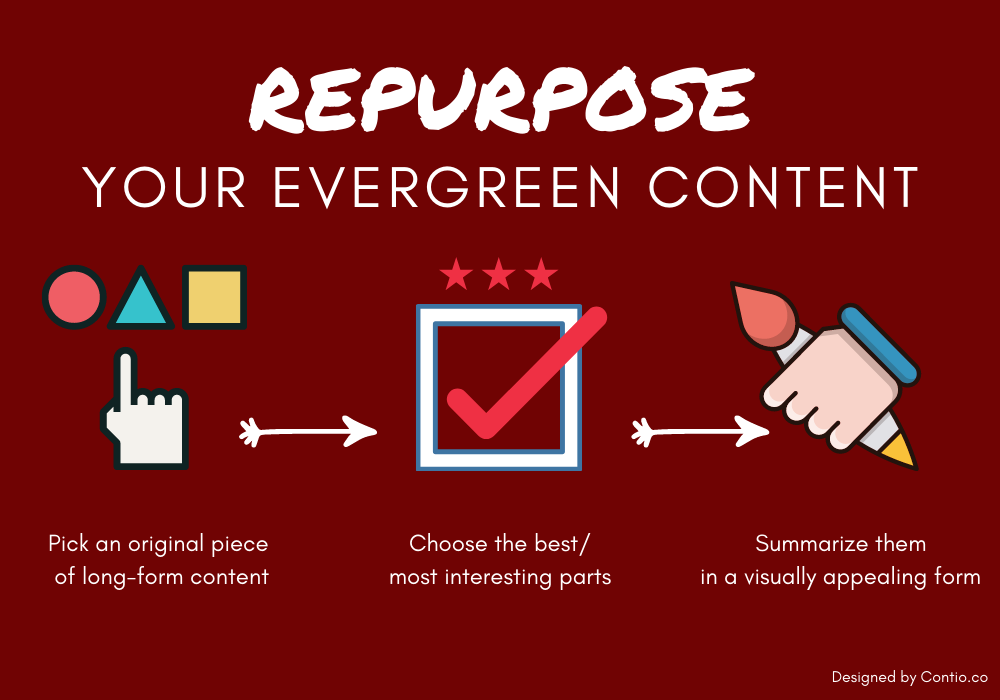
1) Repurpose Your Content
If you need inspiration for your visual content, look no further than the text-based content you’ve produced. Blog posts are usually an excellent place to start. Once you’ve written a blog post, converting the information into visual content is easy.
Transforming blog content into presentation slides becomes even more efficient when you leverage intelligent design tools. Using the best AI for PowerPoint simplifies the process of condensing detailed written insights into clear and engaging slide layouts.
For example, you can take the points you’ve covered in a blog post and put them in a video or infographic. You can also repurpose existing visual assets by using creative formats that turn images into videos, helping brands transform product photos, campaign visuals, and other static content into more engaging experiences for their audience. Your editorial calendar is an excellent place to list how to repurpose an original blog post.
Similarly, you can transform long-form content like a white paper or eBook into a series of video tutorials.
Brands that work with a GC video production company to regularly create videos from existing blog posts, guides, or customer stories can also extend content reach without starting every campaign from scratch.
When repurposing articles into videos at scale, collaborating with a full-service video marketing studio can simplify everything from scripting and production to editing and distribution. This makes it easier to create platform-specific videos while maintaining consistent storytelling and visual quality across every platform.
The point is that you don’t have to create all your visual content from scratch. Giving your evergreen content a makeover will help you to keep producing fresh, exciting content even when you’re running low on inspiration.
2) Use Non-traditional Types of Content
Infographics and videos are a lot of fun, but they’re also ubiquitous pieces of content. To stand out from your competition, you should also try to use non-traditional forms of visual content.
It might seem scary to do something unconventional. Be that as it may, if you’re a bit adventurous, you can create viral content simply due to its uniqueness.
What non-traditional types of content can you experiment with?
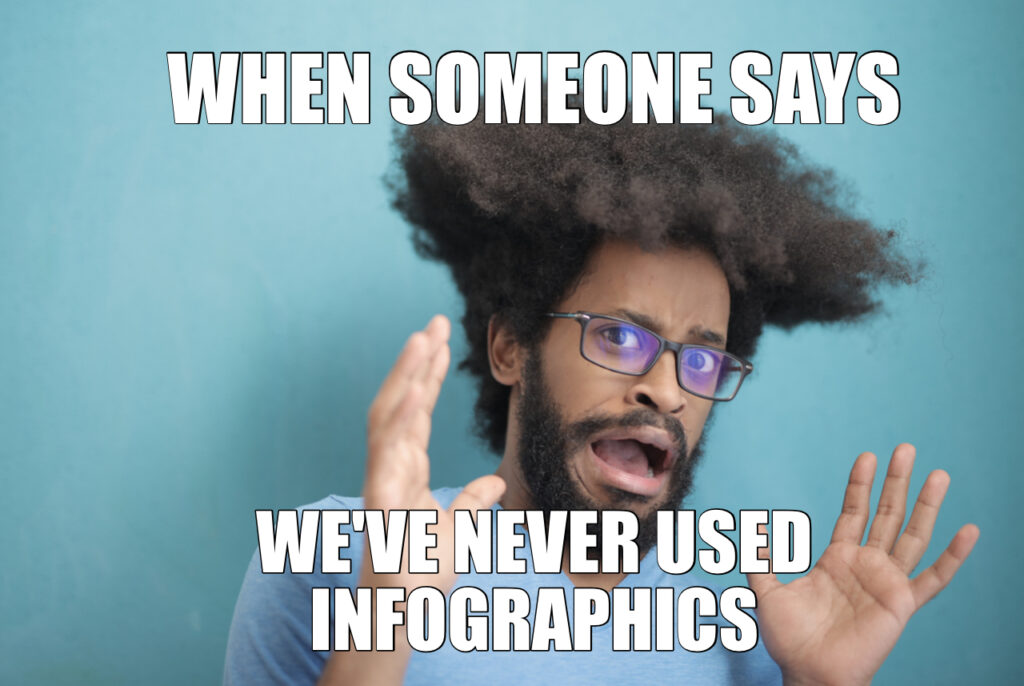
a) Memes / GIFs
Many content creators shy away from using memes or GIFs because they worry their content will look unprofessional. On the contrary, memes and GIFs can help you seem more down-to-earth and relatable when used well. Over time, this fosters trust among your audience.
Think about this for a moment. Your target audience uses memes and GIFs to communicate on social media. Since this content is relatable, using memes and GIFs will help you build a connection with both potential and current clients.
b) Interactive Content
As we’ve already said, we’re bombarded with content from brands clamoring for our attention daily. For this reason, another good way to stand out is to create interactive content. Interactive content creates a unique and memorable experience for your target audience.
Interactive content encourages your audience to actively engage with it instead of passively consuming it. For example, you could create a quiz, build interactive landing pages, websites, or videos to make the experience more engaging. This type of content invites people to click along and be part of the story from beginning to end.
Interactive content generates higher levels of engagement than static content. Therefore, it is one of your brand’s most potent storytelling tools.
A good call to action invites your audience members to engage with you further. While most calls to action are text-based, making them more visual can capture someone’s eye.
For example, you could use an infographic or a button as your call to action. Or you could go one step further and design a video or GIF call to action.
d) Visual Emails
If you want to boost your email marketing, you can use eye-catching visual content. An excellent place to start is by designing a professional header that reflects your brand. Additionally, you could include other elements like photos, videos, and infographics.
However, heavy visuals and custom layouts can sometimes be restricted by the “drag-and-drop” limitations of older email platforms. If you find your current software makes your images look pixelated or prevents you from using unique layouts, exploring Constant Contact alternatives can help you find a more flexible builder that prioritizes high-resolution media and modern design.
Of course, it wouldn’t hurt to use some of the best email warm up tools to improve deliverability so your beautifully designed emails actually reach your audience’s inbox. Most people sign up for your email marketing to hear from you; they will only consistently open these messages if you make it visually worth their while.
e) Quotes / Questions
Quotes that reflect your brand values are a good source of inspiration for visual content. Similarly, questions—whether for or from your audience—can help you create beautiful visuals.
Both quotes and questions can generate conversations addressing the topic you’ve raised. In other words, they are an excellent way to get your audience talking. Next time you want to spark a conversation on Twitter or Facebook, try sharing an image with a quote or a question.
3) Apply Consistent Branding Across Platforms
Whether creating content for your company or a client, building a solid and consistent brand identity is essential.
You can achieve this brand identity using the same voice across different platforms. Whether you write a blog post or publish a social media post, your content should sound like you.
If you’re funny in your blog posts, you should carry the same humor to your social media platforms. If you’re suddenly serious and no-nonsense on your social media, your audience will get confused about who you are and what you stand for. Use a consistent brand voice so that your audience can confidently say they know who your brand is and why you matter to them.
Secondly, you should consistently use branded visual elements to create visual recognition. These elements include text placement, font use, brand colors, and logo. Wholesale poster printing can also be used to scale consistent branded visuals across multiple locations.
Don’t forget offline touchpoints. Branded stationery and mailers extend your visual identity beyond screens and can spark delight on first contact. For tactile touchpoints, translate your brand’s fonts, colors, and imagery to print collateral like letterheads, packaging inserts, and outer envelopes. Teams can create envelopes online to match your visual system and design unique envelope styles through Canva, turning every mailer into a mini billboard that boosts recall.
If you’re still refining your visual identity, an AI logo generator can help you quickly experiment with logo concepts that align with your brand’s colors and typography before finalizing print materials.
Include your logo, consistent typography, and a clear visual CTA (QR code or short URL) to seamlessly bridge print and digital experiences.
If you can use your visual content the same way every time, you will build a strong brand identity that your target audience can easily recognize. This is a big deal because if your brand stands out, you will remain at the top of your mind among potential and current clients.
4) Align All Your Visual Elements
When designing visual content, aligning images and text is essential because this helps you look professional. Polished and professional visuals contribute to your social proof and make it look like you know what you’re talking about.
Producing professional visual content will attract an audience that trusts you to solve their problems.
5) Be Authentic
Indeed, you can always recycle and share visual content from other brands. Nevertheless, designing authentic content will help you connect better with your audience.
Instead of using stock photos, consider taking pictures of your products and your work family. If you are using photography to cover sports or news, you should look at editorial photography platforms like Vecteezy (sports) or Reuters (news).
Showcasing original photos of your products will help your audience trust you more.
Likewise, giving people a sneak peek of your team at work will humanize your brand. This ultimately creates a genuine connection with your audience, who will feel like they know the faces behind your brand name.
6) Use Alt Tags
If you use images in your content, you should include alt tags to optimize them for SEO.
By using alt tags, you’re boosting your content in two ways. Firstly, you’re helping Google to understand what your images contain. Secondly, you’re helping low-vision or blind people understand your images’ context.
Technology advertising has to make an invisible product feel concrete.
A physical product can be held, tasted, worn, opened, or compared in front of a camera. An app may offer nothing tangible until someone installs it, creates an account, and begins using the product. Its value could depend on an interface, an algorithm, a network of other users, a financial transaction, or a workflow that takes several steps to understand.
Social advertising has to compress that experience without reducing the product to a tedious screen recording. The viewer needs to grasp what the technology does, why it is relevant, and whether it deserves enough trust to justify an install, trial, registration, purchase, or other action.
The commercial objective also changes from product to product. A finance app may care about funded accounts rather than downloads. A marketplace needs transactions. A subscription product may need paid trials. A game needs people who continue playing after installation. Cheap installs mean very little if the users they attract never reach the behavior that creates value.
Performance creative is particularly mature in consumer apps and mobile products, so several agencies in this comparison specialize in mobile acquisition. Others extend the discussion into consumer technology, artificial intelligence, finance, digital services, and gaming. The seven companies below approach the creative problem from distinctly different directions.
Where Technology Creative Usually Breaks
A performance brief for an app often tries to solve several problems at once. Separating them makes agency selection easier.
Creative Job
Question the Video Needs to Answer
Explain the product
What does this actually do for me?
Reduce trust friction
Why should I trust this company with my time, money, information, or attention?
Create install intent
Why should I download or try this now?
Support valuable usage
What needs to happen after installation for the acquisition to matter?
A polished demonstration may explain the product while doing little to build trust. A low cost install campaign may generate impressive acquisition numbers but bring in users who never activate. Strong social creative can attract attention while an inconsistent App Store page loses the conversion moments later.
Technology brands need to know which problem they are asking the creative to solve before judging the agency producing it.
1. Street Poller Media
Making Digital Products Understandable Through Real Conversations
Street Poller Media has an established portfolio across consumer apps, financial technology, artificial intelligence products, crypto, prediction markets, and other digital services. Its current technology portfolio includes published campaigns for BeReal, Polymarket, MoonPay, StealthGPT, Strongwall AI, Outlier, Wyzly, Seed Oil Scout, and other technology brands.
The agency’s format differs from standard app advertising because the product enters a public conversation. Instead of relying entirely on animated interfaces, scripted creator testimonials, or conventional product demonstrations, Street Poller uses questions and real participant reactions to create the context around the technology.
Its BeReal campaign provides a clear example. Street Poller filmed students on university campuses and incorporated the app naturally into conversations about how people were already using it. Participants held phones and navigated BeReal on camera, allowing viewers to see both the interface and the social behavior surrounding it. Street Poller reports more than 10 million organic views, more than 45,000 installs, and a 30 percent reduction in customer acquisition cost from the campaign. Those figures are published by Street Poller and describe that individual engagement.
For many consumer apps, showing the interface is only part of the creative problem. The viewer may also need evidence that people understand the product, see a reason to use it, or recognize the problem it solves. That is where this format becomes useful for tech & app performance creative. A public conversation can make an unfamiliar digital service feel less abstract without forcing the entire explanation into a direct product pitch.
Street Poller also publishes work for products with heavier trust requirements. Its Coverd case study describes a finance app campaign that originally optimized toward installs before the commercial objective shifted toward purchases. Street Poller says it rebuilt the campaign around purchase events and refreshed the interview angles as the funnel objective changed. The cost and scale figures attached to the project are company reported results.
This approach works best when the technology connects naturally to something people can discuss, demonstrate, compare, question, or react to. Social apps, consumer AI, finance products, marketplaces, and digital services with recognizable everyday use cases are easier to translate into this format than highly technical enterprise products requiring a detailed procurement explanation.
2. Yodel Mobile
Connecting the Social Ad With the App Store Decision
For an app, tapping the advertisement is only the first conversion decision. The user still reaches an App Store or Google Play page and has another opportunity to leave.
Yodel Mobile specializes in that wider mobile journey. Its current services cover App Store optimization, user acquisition, mobile consultancy, and creative production for app growth.
Its Yodel Delivery case study shows how paid acquisition and store creative can reinforce each other. The agency worked across Apple Search Ads, App Store optimization, campaign creative, and product conversion. Its creative team developed App Store screenshots and campaign assets using app interface imagery, real life visuals, calls to action, and educational content. Yodel Mobile reports an 85 percent increase in installs year over year and a 30 percent reduction in acquisition cost during the engagement.
The Hoppa project goes further into the relationship between acquisition and store conversion. Yodel Mobile developed assets for both paid channels and the App Store, then tested screenshots separately for Android and iOS after discovering different preferences between the two environments. The agency reports 196 percent growth in organic iOS installs, 89 percent growth on Android, and a 43 percent improvement in cost per registration through Apple Search Ads.
This type of work is useful when a technology team suspects it is losing users after the click. A strong advertisement can create interest around one benefit while the store listing leads with something unrelated. The user then has to reconstruct the value proposition at exactly the point when the brand should be making the decision easier.
Yodel Mobile is particularly relevant to app businesses that want acquisition creative, App Store presentation, and mobile growth strategy to support the same conversion story.
3. Moburst
Testing the Entire Route From Impression to Install
Many app teams evaluate their advertising creative and App Store presence separately even though the user experiences them one after the other.
Moburst works across mobile creative, media, App Store optimization, conversion testing, influencer activity, and app marketing strategy. Its current app marketing services combine acquisition and store optimization rather than limiting creative analysis to the paid ad itself.
The Upside case study is a useful illustration. Moburst tested App Store screenshots and video while also using paid Facebook campaigns as part of the testing environment. According to the agency, the winning screenshot treatment improved click to install rate by 10.4 percent, while the strongest video variation delivered another 9.2 percent improvement. Moburst estimated that those changes reduced cost per download by 19.7 percent during the first quarter of the partnership.
Those results highlight how much performance can be lost after a successful ad click. A user can arrive at the store with genuine curiosity and still decide against installing because the screenshots, preview video, or product explanation fail to continue the story.
Moburst’s Abide campaign shows another side of mobile creative. The agency says it used new influencer ad formats, paid media, app audits, attribution analysis, and acquisition optimization to improve the subscription funnel. It reports reducing cost per subscription by more than 75 percent. That figure comes from Moburst’s own case study.
Moburst fits technology companies that want to understand the full path between advertising exposure and installation rather than judging social video only by clicks or view metrics.
4. yellowHEAD
Building Enough Creative to Keep a Mature Acquisition Program Testing
Some technology brands reach a point where strategy is not the immediate bottleneck. The media team knows which channels work, the product has established demand, and acquisition is already running at meaningful scale. The problem is maintaining enough creative supply to keep testing.
yellowHEAD combines paid user acquisition with an internal creative studio, App Store optimization, and conversion work. Its current services connect creative production with campaign performance rather than treating the studio as a separate vendor.
The company has also built Mona, an AI assisted creative production service designed for rapid paid social variation. yellowHEAD currently advertises 10 to 30 videos per month, 4 to 12 hook angles, and three paid social formats per video. Existing screen recordings, gameplay, product video, or previous creative can be used as source material, while human strategists refine the concepts and hooks.
AI itself is not the advantage here. The practical value is production capacity.
A team with proven source footage can test several openings, visual treatments, and formats without organizing a conventional shoot for every new version. The company also maintains a premium studio operation for projects that require live production, 2D or 3D work, playables, or more customized creative.
This type of system is most relevant when the acquisition program is already large enough to consume creative quickly. Smaller app teams still searching for product market fit may have more to gain from clarifying their customer argument than from generating dozens of variations each month.
5. Phiture
Putting Creative Inside a Broader Mobile Growth System
Phiture operates as a mobile growth consultancy rather than a conventional social video production company. Its performance marketing service covers campaign setup, audience segmentation, retargeting, creative testing, paid acquisition, and ongoing performance analysis.
Its creative team supports App Store graphics, screenshots, Custom Product Pages, Meta and Google campaign assets, and 2D and 3D mobile video. Phiture also documents scalable production, localization, and A/B testing as part of its mobile growth work.
That mix suits app companies operating across several markets or dealing with a large volume of localized acquisition work. Creative decisions can influence paid campaigns, App Store presentation, market entry, and conversion instead of being evaluated inside a single social platform.
Its work with Clue demonstrates the connection between store creative, localization, paid acquisition, and experimentation. Phiture says its teams worked together on creative refreshes, market specific assets, Apple Search Ads, and store experiments, with recorded install uplifts across markets including the United States, Germany, Mexico, and Brazil.
Phiture is particularly relevant when the growth team wants creative production embedded within a wider mobile acquisition operation. A brand seeking a handful of standalone social videos may not need that breadth. An app expanding across markets, channels, and store environments has a stronger reason to consider it.
6. Favoured
A Broader Option for Apps With More Than One Acquisition Path
Favoured is the broadest app marketing option in this comparison. Its published work spans paid social, creative production, conversion optimization, App Store activity, in app marketing, search, and other growth functions across app clients.
That breadth matters for technology products whose customer journey does not live entirely inside a mobile store. Some apps also acquire users through websites, lead forms, subscriptions, search, or longer conversion funnels. Their video creative needs to fit into a wider acquisition program rather than a mobile user acquisition system alone.
Favoured’s service offering includes paid social and creative production, with video, UGC, photography, and motion graphics among its current capabilities. Its published case study portfolio includes app clients across travel, jobs, finance, fashion, and other consumer categories.
This makes the agency a useful contrast with specialists such as Yodel Mobile or Phiture. A company with a complicated App Store conversion challenge may prefer a dedicated mobile growth consultancy. A technology brand that needs paid social, creative, conversion work, and broader acquisition support may find Favoured’s wider operating model more relevant.
The important question is whether the app is the entire business or one conversion path among several. That distinction should shape the agency brief.
7. AppAgent
Mobile Game Creative Has to Sell the Experience Before the Download
Mobile games create a different performance creative problem from most utility or subscription apps. The advertisement has to communicate enjoyment, progression, fantasy, competition, collection, or another player motivation before the viewer has touched the game.
AppAgent focuses specifically on mobile gaming growth. Its current public materials identify creative strategy, creative production, user acquisition, App Store optimization, analytics, and revenue growth among its core capabilities. The agency says it has worked across more than 150 mobile game titles, a figure published in its current company information.
Its Pocket Paws campaign shows why player motivation matters. AppAgent tested different audience motivations, hooks, and formats before finding that breeding and collecting dogs consistently produced stronger results than the alternatives. A 12 second creative formula then became the basis for further scaling. The agency reports roughly 45 percent overall ROAS improvement while scaling user acquisition spend, a 50 percent CPI reduction as Meta spend increased 4.5 times, and an eightfold increase in organic installs. These are AppAgent reported results from the campaign.
Creative output also increased as the agency gained confidence in the winning formula, moving from roughly 15 ads per month toward approximately 50. That sequence is important. Volume followed a clearer understanding of player motivation rather than replacing it.
Its Bellemint work shows a different mobile gaming problem. AppAgent reports that 25 percent of the campaign’s creatives reached eight or more installs per thousand impressions in the US, alongside a 45 percent year over year increase in ROAS and a 29 percent improvement in Day 7 retention on paid channels.
AppAgent belongs in this comparison as a specialist rather than a general technology agency. Mobile game publishers need creative teams that understand player motivations, creative win rates, retention, store conversion, and the relationship between the advertisement and the experience being promised.
The Product Demo Should Show the Moment of Value, Not Every Feature
Technology advertisements often become feature heavy because the people writing the brief know how much has been built.
The customer does not need a tour.
A useful demonstration isolates the moment when the product becomes valuable. For a budgeting app, that could be watching scattered transactions become organized automatically. A travel product might show a user comparing options and completing a booking. An AI writing tool can begin with an unusable draft and end with something ready to send.
Screen recordings become much easier to watch when something meaningful changes.
A weak demonstration moves methodically through menus, tabs, settings, and interface elements without giving the viewer a reason to care about any of them. A stronger version establishes the problem first, shows the action that solves it, and ends with the result.
That structure also creates cleaner testing opportunities. One concept can focus on speed. Another can address convenience. A third can demonstrate a particular use case. None of them needs to explain the entire product.
Trust Friction Changes With the Technology Category
A casual mobile game and a finance app do not ask the customer to take the same risk.
The creative should reflect that difference.
Product Type
Common Trust Question
Finance or payments
Is my money and information safe here?
Consumer AI
Will this work on a real task rather than an ideal demonstration?
Marketplace
Are there enough useful buyers, sellers, or providers?
Social app
Are people I care about actually using it?
Productivity software
Will this save enough time to justify changing my routine?
Mobile game
Does the advertisement represent an experience I will enjoy?
Public reaction can answer some of these questions. Product demonstrations may answer others. Ratings, customer stories, expert explanation, creator use cases, or visible product behavior can provide different forms of evidence.
The creative format should follow the uncertainty the customer needs resolved. Copying a popular UGC structure across every technology category ignores the fact that the perceived risk of installing a casual entertainment app is completely different from linking a financial account.
The App Store Is Part of the Advertisement
Social advertising does not finish its job when somebody taps.
The next screen continues the persuasion.
Screenshots, app preview video, ratings, reviews, product page copy, icon design, and store positioning all influence whether interest turns into an installation. A mismatch between the advertisement and store listing introduces friction at exactly the moment when the user is deciding whether to continue.
If a paid video sells a travel app on speed, the first screenshots should make that advantage visible. If an advertisement demonstrates a specific AI feature, the store page should help the user recognize that same capability quickly.
Yodel Mobile and Moburst both provide useful evidence of this connection. Yodel develops paid and App Store creative within the same growth programs, while Moburst has tested screenshots and preview video as part of broader acquisition and conversion work.
The advertisement and store page are separate assets, but the customer experiences them as consecutive parts of one decision.
Choose the Event Before You Judge the Creative
An install is not equally valuable across every technology product.
A performance team should agree on the downstream event that matters before declaring one video better than another.
App Category
A More Useful Event Than Install Alone Might Be
Subscription app
Trial start or paid subscription
Marketplace
First completed transaction
Finance app
Funded account or qualifying financial action
Productivity app
Completion of the core workflow
Social app
Account creation followed by meaningful activity
Mobile game
Retention, progression, or purchase
Travel app
Booking or paid reservation
These are examples rather than universal rules. The correct event depends on the business model.
Street Poller’s Coverd project illustrates how optimization can change when the commercial objective changes. Its published case study says the campaign initially focused on installs before shifting toward purchase events as the client moved further down the funnel.
Creative evaluation should change with the same logic.
A video that produces inexpensive downloads but very little activation may deserve less investment than an advertisement with a higher install cost that attracts users who subscribe, transact, book, or remain active.
Build Concepts From What People Actually Do Inside the Product
Product analytics can provide better creative briefs than another brainstorming session built around generic features.
Imagine an AI productivity app discovers that retained customers regularly use three functions during their first week: summarizing long documents, turning meeting notes into tasks, and rewriting rough drafts before sending them.
Those are already three different advertisements.
One video begins with the frustration of reading a long document and shows the summary appearing. Another starts with chaotic meeting notes and ends with an organized task list. A third follows an awkward draft becoming something ready to send.
None of the concepts needs to explain every capability inside the product. Each begins with behavior associated with actual value.
The same method works for other categories. A travel app can build concepts around common successful booking journeys. A marketplace can show the transactions customers complete most often. A financial product can identify the actions that correlate with stronger retention and translate those behaviors into scenarios people recognize.
The creative team becomes more useful when it knows what successful users actually do.
More Creative Does Not Automatically Mean More Learning
Technology brands can now produce enormous numbers of video variants, especially through automated editing and AI assisted production.
High output is useful when the team knows what it is testing.
Some changes affect only execution. The same product argument can receive a different opening, creator, duration, first frame, caption treatment, or call to action. Those variations help a strong idea travel further and can reveal which presentation earns the best response.
Other tests change the message. Instead of emphasizing speed, the creative may focus on security, savings, convenience, collaboration, entertainment, or another benefit. The product remains the same while the reason to care changes.
A deeper test changes the concept itself. A creator story becomes a product demonstration. Interface footage becomes a public interview. A feature walkthrough becomes a before and after workflow. Those experiments can reveal whether the account has been relying too heavily on one creative language.
yellowHEAD demonstrates how rapidly execution variants can now be produced, while Phiture and AppAgent show how mobile growth teams can connect creative testing with market, audience, store, and motivation insights.
When an agency promises dozens of videos, the useful question is not the final file count. Ask how many different assumptions about the customer those videos are designed to test.
Make the Product Easier to Understand
Complex technology does not require complicated advertising.
The strongest creative usually isolates one problem, one useful behavior, and one reason to trust the result. Another campaign can explain the next feature. The store listing can provide further detail. Onboarding can teach the user what comes after installation.
The seven agencies in this article solve different parts of that system. Street Poller uses real conversations to make unfamiliar digital products feel tangible. Yodel Mobile and Moburst connect acquisition creative with the App Store decision. yellowHEAD provides the production capacity required by mature testing programs. Phiture places creative inside wider mobile growth and localization work. Favoured supports apps whose acquisition journey extends outside the store. AppAgent specializes in the motivations and economics of mobile gaming.
The agency decision should follow the point where users are being lost. If people do not understand the product, clearer demonstration may be needed. If they understand it but hesitate to trust it, the evidence needs to change. If they click but do not install, the store experience deserves attention. If installs are inexpensive but valuable usage remains weak, the campaign may be optimizing toward the wrong event.
Performance creative becomes valuable when each production cycle helps the team identify that problem more clearly and gives the next round of work a better question to answer.
Posting consistently is one of the biggest challenges for influencers today. Creating ideas is usually not the hard part; the real challenge is turning them into production. Filming, editing, adding captions, resizing videos, and posting across multiple platforms takes a lot of time.
TL;DR: Many creators are starting to use AI video tools. AI tools speed up editing, generate visuals faster, and turn one idea into multiple pieces of content.
Some of the AI Video platforms are making this easier by combining multiple AI video models and creator tools into one workflow.
Why Posting Consistently Gets Hard for Influencers
Audiences only see the finished video. They do not see the production process behind it. Producing a single short-form video often includes:
finding an idea
writing hooks
filming content
editing scenes
adding subtitles
exporting multiple versions
posting on different platforms
Doing these becomes difficult when creators post daily across different platforms like TikTok, Instagram Reels, and YouTube Shorts. Additionally, many creators work alone without editors or production teams. Over time, the workload creates burnout and slows content production.
This is why consistency is often difficult to maintain. The problem is rarely creativity; it is usually a lack of time.
How AI Video Tools Change the Creator Workflow
AI video tools reduce the gap between an idea and a finished video. They help reduce repetitive production work so creators can focus more on content direction and audience growth.
Instead of manually building every scene, creators can generate visuals using prompts, reference images, or existing footage.
This speeds up several parts of the workflow:
scene creation
B-roll generation
transitions and effects
captioning
video refinement
Faster Content Creation
The biggest benefit to using AI video tools is workflow efficiency.
Many creators now batch-produce content instead of creating videos one by one. For example, creators can generate multiple video concepts in a single session and refine them later.
Prompt reuse is another common strategy. Creators save successful prompts and modify them slightly for future videos. This helps maintain visual consistency while reducing editing time.
AI also improves speed during experimentation. Creators can quickly test different hooks, scene styles, transitions, visual pacing, and thumbnail concepts. This matters because short-form platforms reward experimentation. Creators who test more formats often learn faster.
Instead of spending hours creating every variation manually, AI reduces the production load significantly.
Platforms like Loova AI help streamline this workflow because creators can access multiple AI video models in one place.
Scaling For Small Creators
AI video reduces production barriers for smaller creators. A solo creator can now produce content that previously required a production team.
AI also improves creative testing. Instead of spending hours rebuilding the same concept, creators can quickly generate multiple variations and compare them. This allows smaller creators to compete more effectively in crowded social platforms.
The creators growing fastest today are often the ones with efficient production systems, not necessarily the biggest teams.
AI helps reduce the gap between small creators and larger influencer brands.
Step-by-Step AI Video Workflow For Creators
Most influencer AI workflows follow a similar structure.
First comes the idea. This may come from a trend, script, meme format, or content niche.
Next, creators generate scenes and visuals using AI video tools. Some creators use text to video workflows or image to video workflows to maintain character or visual consistency.
After generations, creators refine the video using AI editing tools.This may include: improving motion, adding transitions, adjusting pacing, refining scenes and adding captions. They can also upscale video with AI to enhance resolution, improve visual clarity, and make existing footage more suitable for different platforms.
Finally, the content is exported for TikTok, Instagram Reels, and YouTube Shorts.
Different AI models produce different results. Some models are better for realism. Some are stronger at cinematic motion. Others generate stylized visuals faster.
Because of this, creators increasingly use multiple AI models during production:
The issue is workflow fragmentation: switching between separate tools slows production and increases complexity.
This is why multi-model systems are becoming increasingly useful.
Loova AI integrates multiple AI video models into one workflow so creators can compare styles, refine outputs, and test ideas faster.
How Different Influencers Use AI Video
Influencers use AI video in different ways depending on their content style.
Short-form creators use AI for TikTok videos, Instagram Reels, and YouTube Shorts. AI helps generate visuals and speed up editing.
Faceless creators use talking avatar, AI-generated scenes, motion graphics, and cinematic visuals to create content without having to film themselves.
Lifestyle creators often use AI-generated B-roll and aesthetic visuals to improve storytelling.
Gaming creators use AI for stylized effects, animated sequences, and visual enhancements.
Many creators also use AI for sponsored content because it helps them produce ads faster without large production setups.
Common Mistakes Influencers Make When Using AI Video
AI video tools are powerful, but poor workflows still create weak content.
Generating generic visuals – weak prompts often lead to repetitive content that looks similar to other AI videos online.
Overusing effects – too many transitions and visual tricks can make videos feel distracting instead of engaging.
Poor storytelling – some creators focus too much on visuals and ignore storytelling. Good pacing, hooks, and structure still matter more than effects.
Workflow overload – using too many disconnected tools slows production instead of improving it. This is why integrated platforms are becoming more popular. Creators want fewer workflow interruptions and faster iteration.
The Future of AI Video for Influencers
AI video is becoming part of the standard creator workflow.
In the future, creators will likely automate more parts of production:
generating visual variations
adapting content for different platforms
testing multiple hooks
creating personalized content formats
This does not reduce creativity; it simply changes where creators allocate their time. Instead of spending hours on repetitive editing, creators can focus more on storytelling, strategy, and audience growth.
Loova AI is already moving toward this type of integrated creator workflow.
FAQs
How do influencers use AI video tools?
Influencers use AI tools for editing, video generation, visual effects, short-form content creation, and faster production workflows.
Can AI help influencers post more consistently?
Yes. AI reduces editing and production time, which helps creators publish content more regularly.
What are the best AI video tools for creators?
The best tools usually combine video generation, editing, and multiple AI models in one workflow.
Is AI video useful for TikTok and Instagram Reels?
Yes. AI video tools work especially well for short-form content because they support fast testing and rapid content production.
Why are creators using multiple AI video models?
Different AI models create different styles and strengths. Many creators combine models for realism, speed, and cinematic quality.
What is Loova AI?
Loova AI is an AI creative platform that integrates multiple AI video and image generation models into one workflow.
Editing used to be a pain for anyone running an in house content team. Not mildly annoying pain, actual hours lost, tutorial watching, why won’t this export pain. If nobody on your team already knew software like Premiere or Photoshop, you either paid an agency or quietly dropped the video idea from the content calendar. That’s changed faster than most SEO teams realize, and a lot of it comes down to how AI has been folded into everyday creative tools.
Editing By Just Talking
There’s a tool category that would have sounded made up five years ago: you type a sentence, and your video changes. No timeline dragging, no keyframes, none of the stuff that made handing video work to a content team feel like staffing a second job.
A ChatGPT video editor online works roughly like this. Want a scene trimmed to fit a landing page? Say so. Need captions added for accessibility and indexing, or the pacing tightened for a shorter attention span? Type it out, and it gets handled while you stay focused on whether the video actually serves the page it sits on, not on which button does what.
Anyone producing the same type of explainer or product clip every week knows how much of that work is repetitive. Cutting dead air, syncing captions, resizing for three platforms and a blog embed.
This is the part AI quietly takes off a content team’s plate, and it pairs well with a wider push toward text to video for marketing teams that need to publish video without a dedicated production hire. The same shift is also making it easier for teams to create videos with AI, turning simple ideas, scripts, or concepts into finished visual assets without the traditional production overhead.
It will not replace a video specialist who has been doing this for a decade. Nobody on a serious content team is claiming that. But for a team that just needs a video shipped alongside a blog post without losing a full day to it, this is a genuinely different experience than editing used to be.
Images Didn’t Stop Mattering for SEO
People act like video ate everything, but scroll through any ranking product page, blog post, or ad campaign and images are still doing most of the heavy lifting for engagement and time on page. The issue was never that images stopped mattering for SEO. It’s that making a good one took money, a camera, or design skills most content teams don’t have sitting in house.
That’s the gap a free AI image generator fills. Describe what you need, and you get something back: no stock photo subscription, no waiting on a designer’s queue. A featured image background, a rough concept for a client review, filler for a slide deck that turns into a lead magnet. Doesn’t matter what it’s for really, it shows up fast, and it fits neatly into a broader visual content marketing plan for teams trying to keep pages fresh without a full creative department.
What’s interesting is what this does to a team’s willingness to try things. Ideas that used to get dropped, because nobody wanted to pay for one image on a throwaway landing page test, don’t get dropped as often anymore.
The Real Win Is When Tools Stop Fighting Each Other
Here’s the thing nobody mentions enough. The time savings aren’t really about one tool being clever. They’re about not switching between five apps to finish one content asset.
Say a team is building something normal: an intro image, some raw footage that needs trimming, captions, then exports for YouTube, Instagram, and a blog embed, all with different specs. If every step lives in a separate app with its own export quirks, that adds up into a whole afternoon lost to file management instead of content strategy. When the image generator and video editor sit in the same space, you build the thumbnail, drop it right into the timeline, keep editing. No exporting and reimporting loop in between.
Teams pushing out a lot of content feel this the most. One video becoming a long YouTube cut, a vertical clip for social, and a static graphic for a blog post shouldn’t take three separate workflows, and increasingly it doesn’t, especially when paired with personalized video content approaches that repurpose one asset across several search intents.
It’s Not Flawless Though
A few things worth being honest about, especially for a team whose output feeds directly into rankings and brand trust. AI gets you most of the way there fast, but somebody still needs to look it over before it’s public. Tone, factual accuracy, whether it actually sounds like your brand. That part hasn’t gone anywhere.
Prompting also matters more than people expect. Vague instructions get vague results, pretty much the same way a vague brief to a freelance editor gets you something that misses the point. And every platform still has its own rules: aspect ratio, length caps, content guidelines, so a quick check before hitting publish is never wasted time.
There’s also the sameness problem. AI made doesn’t have to mean generic looking, but content can drift that way if nobody on the team adds their own point of view to it, which matters more than ever with search engines and AI answer engines getting better at spotting content that reads as templated.
Looking Ahead
The distance between having a content idea and having the asset exist and be published keeps shrinking, and there’s no real sign of that slowing down. Editors and designers on SEO teams aren’t becoming irrelevant because of it. If anything, their work shifts toward direction and judgment calls, away from the repetitive stuff nobody liked doing in the first place, and toward the strategy work that tools built around AI video tools for creators still can’t do on their own.
In house teams, agencies, solo consultants, it doesn’t really matter who. The barrier that used to require a budget or years of training just isn’t as high as it used to be. The tools got better. That’s really most of the story.
Most people abandon websites fast. If a page feels generic, slow, or irrelevant, they quickly lose interest. That’s part of the reason personalized content has become such a big conversation in digital marketing lately.
Video personalization is one of the more interesting shifts because it transforms content from a passive experience into something that feels directly relevant to the viewer. Instead of showing every visitor the exact same message, businesses can tailor videos around customer names, behaviors, locations, purchases, or interests.
Video itself isn’t a direct Google ranking factor in the way many people think. Simply embedding a video on a page doesn’t magically push content to the top of search results.
What personalized video can improve are the behaviors surrounding SEO, including:
Click-through rates
Time spent on page
Return visits
Engagement
Conversions
Lower bounce rates
If users stay longer and interact more with content, those signals can support stronger search performance over time.
That’s part of why more brands are experimenting with creating personalized videos for landing pages, onboarding flows, ecommerce follow-ups, and customer retention campaigns tied to specific search intent. The goal is usually to make the experience feel more relevant to the viewer instead of showing every visitor the exact same generic message. For brands creating videos with virtual presenters, localized messages, or interactive content, AI lip sync tools can help synchronize facial movements with spoken audio, making personalized video experiences feel more natural and engaging.
What Makes Video Personalization Work for SEO
1. Matching Video Content to Search Intent
A personalized video only works if it actually matches what somebody was searching for.
For example:
A product walkthrough works better for transactional searches
Even small engagement improvements can become meaningful over time if traffic volume is high enough.
Conclusion: Better Engagement Drives Better SEO Results
Personalized video isn’t some secret SEO shortcut. But if it helps users stay longer, engage more, and connect with the content faster, it can absolutely support stronger overall performance.
The key is making the experience feel useful instead of gimmicky.
Looking for more SEO, marketing, and content strategy insights? Keep exploring our site for more practical digital marketing articles and guides.
The gap between having a content idea and shipping a ranking ready asset has never been smaller, and that shift is starting to matter as much for SEO output as it does for creative output.
A year ago, producing a polished short form video for a content hub or a YouTube channel meant a working knowledge of timeline editors, an understanding of colour grading, decent audio editing skills, and either stock footage or the ability to shoot original clips. A usable image for a blog post header or a product page needed either a paid image generator with prompt engineering time built in, or a designer with Adobe Firefly access. None of that was impossible for an SEO team to arrange. All of it took longer than most content calendars could comfortably absorb, especially for teams publishing at scale.
In 2026, the workflow has changed in ways that compound directly into content velocity. The tools available to in-house SEO teams and lean content operations now include conversational AI that can direct video edits in plain language, AI image generation that produces usable creative assets in seconds, and integrated platforms that connect these capabilities so that moving from brief to published asset no longer requires switching between five different applications.
For SEO professionals specifically, understanding what these tools actually do, and where they still require human oversight, matters more than any feature comparison. The teams getting real search and AI visibility gains from these tools are the ones treating them as production infrastructure rather than novelty.
Why ChatGPT Style Editing Matters for Content Production
The relationship between large language models and video editing is less obvious than the relationship between AI and image generation, but it matters directly to any SEO team trying to support a video content strategy without hiring a full production unit.
For most teams producing video for organic search or social distribution, the bottlenecks rarely sit in the sophisticated decisions. They sit in the repetitive ones: trimming silence, cutting between takes, generating accurate captions for accessibility and indexing, adjusting audio levels, choosing where to insert a callout. These are decisions that follow learnable patterns, and learnable patterns are exactly what large language models handle well.
The practical integration of ChatGPT style reasoning into video editing means a content team can describe the output it wants in natural language and have the system execute a first pass. Instead of manually trimming a thirty minute webinar or interview into a three minute clip for a landing page or a video description, an SEO or content lead can describe the desired output and let an AI assistant do the initial cut. The team’s role shifts from execution to review, which is a materially faster workflow for anyone responsible for a publishing cadence.
A ChatGPT video editor online that combines conversational AI with video production tools represents exactly this kind of workflow shift, where creative and editorial direction stays with the content team and the mechanical execution is handled automatically. The output still needs review before it goes live, but the time cost at each stage compresses considerably, which is useful context alongside a broader approach to structuring AI content workflows for teams building this into an existing production process.
What AI Image Generation Adds to an SEO Content Pipeline
AI image generation and video editing used to occupy different corners of a content team’s toolkit. Image generation supported thumbnails, cover art, and social graphics. Video editing supported the video itself. That separation made sense when the two workflows did not connect and when neither fed directly into on page optimization.
They are connecting now, and the integration changes how SEO teams approach visual assets from the brief stage onward.
Generated images are increasingly used as storyboarding tools, producing rough visual representations of a page’s hero section or a video’s opening scene before any footage is shot or sourced. They function as background elements in video compositions and as placeholder assets in early drafts that get replaced with real photography when budget allows, or stay in the published version when the generated result holds up. They also continue to serve their original function: featured images, thumbnails, and social cards that need to load fast and support alt text without licensing friction.
The quality threshold for all of these use cases has risen considerably in the past twelve months, which is directly relevant to any team that has run into image seo constraints around file size, licensing, or duplicate stock photo usage across a niche. AI generated images that would have been immediately identifiable as synthetic in 2024 are now often indistinguishable from sourced stock imagery at the sizes used in most published content. This has moved the internal conversation from can AI generate a usable image, to when is a generated image the faster, cheaper option without compromising the page.
An AI image generator integrated into a video creation workflow removes the context switching cost that previously came with sourcing visual assets for a content brief. Instead of opening a separate tool, prompting there, downloading, and importing back into the editor or CMS, the asset generation happens in the same environment as the rest of the build. For teams publishing high volumes of content against a keyword map, that integration adds up to real hours saved across a production sprint.
The Real Workflow Shift for SEO and Content Teams
The most significant change AI video and image tools are producing is not in any single capability. It is in how the overall content production workflow is structured, and by extension, how quickly an SEO roadmap can actually ship.
Traditional content production is largely sequential. You brief, then you gather assets, then you build, then you review, then you revise. Each stage gates the next, and mistakes caught late are expensive because they require unwinding earlier work. The workflow is linear because the tools are linear: they assume you know exactly what you want at the start and execute against that specification.
AI integrated workflows are more iterative. Because generation is fast and cheap, a team can try multiple directions early and converge on the best one rather than committing upfront. A content team working on a comparison page or a product explainer video can generate three different visual treatments for the hero section in the time it previously took to produce one. They can test two narration structures against rough cuts before deciding which to develop fully. The marginal cost of an additional iteration has dropped close to zero, which changes when it makes sense to run that experiment at all, and pairs naturally with a broader AI marketing workflows approach for teams already testing content variants systematically.
This shift matters most for teams that were previously constrained by production cost from testing content formats. A lean SEO team could rarely afford to produce multiple versions of a video or a hero image to see which converted or ranked better. AI tools do not fully remove that constraint, but they reduce it enough that structured experimentation becomes a realistic part of a sprint.
Where Human Judgment and E-E-A-T Still Dominate
Being clear about where AI tools fall short matters as much to SEO professionals as understanding where they perform well, particularly with search engines and AI answer engines placing increasing weight on demonstrated expertise and originality.
Narrative structure and topical framing remain primarily human work. AI can execute a structure once it exists and generate variations on a structure it has seen before, but the judgment about what argument to make, what to emphasise for search intent, and how to pace a piece against a competitive results page is still primarily a human call. A video editor powered by conversational AI will assemble the clips you describe. It will not tell you that your structure buries the answer a searcher actually wants in the final third of the video.
Brand voice, factual accuracy, and E-E-A-T signals require human oversight. AI image generators produce visually plausible output, but ensuring that generated assets are consistent with an established brand identity, and that any claims made in AI assisted video or copy hold up to scrutiny, requires a human reviewer. The tools are improving, but they are not yet reliable enough to run unsupervised on anything that carries reputational or compliance risk, which is worth keeping in mind alongside efforts around keeping AI content humanized rather than letting it read as generic.
Context sensitivity is another genuine limitation. An AI editor following an instruction to cut to a specific clip when a script mentions a product will do so literally. Whether that clip is tonally right for the moment, or whether it supports the search intent the page is targeting, is a judgment call the AI cannot yet make reliably.
Understanding these boundaries helps SEO teams use AI tools productively: delegating the execution work where the tools are genuinely strong, while retaining the strategic and editorial decisions that still need a human to make well.
Practical Considerations for SEO Teams Adopting AI Tools
For SEO and content teams thinking about integrating AI video and image tools into an existing production process, a few practical observations are worth keeping in mind.
Start with the bottleneck. The highest value AI integration addresses the part of your production process that takes the most time relative to its impact on rankings or conversions. If half your team’s time goes to captioning and audio sync and thirty minutes goes to structural decisions, AI captioning and sync tools will move the needle more than AI assisted cut decisions.
Treat AI output as a first draft, not a published asset. The most productive mindset for working with AI generated video edits and images is to approach them as a starting point that requires editorial review, not a finished deliverable. Teams that try to remove review entirely from the workflow tend to publish content that does not meet their own quality bar, which can show up later in engagement metrics and, potentially, in how AI systems evaluate the page for AI visibility tracking purposes.
Build iteration into the sprint. AI tools enable faster iteration, but only if the production schedule has room for it. If a workflow requires a finished video or hero image in two hours, AI assistance compresses the execution time. If the workflow requires a fully polished, brand safe asset in two hours, AI assistance creates more review burden than it removes.
Frequently Asked Questions
Q: Can a ChatGPT powered video editor replace a video specialist on an SEO team?
For high volume, formulaic content such as product explainers, social clips, and recap videos, AI video editors can handle a significant share of the execution work a specialist currently performs. For complex narrative work, brand sensitive content, or anything requiring tonal judgment, a human editor remains essential. The most effective current model pairs a human editor with AI tools to increase output rather than replacing the role outright.
Q: What types of images does an AI image generator produce best for SEO use?
Current AI image generators perform most reliably on scenes with clear subjects, simple compositions, and well documented visual styles, which covers most featured images, thumbnails, and illustrative graphics used in published content. They struggle with specific real people, complex multi element compositions, and text rendered within images, so anything requiring precise brand typography still needs a design pass.
Q: How long does it take to generate an AI image for a content asset?
Most AI image generators produce results in under thirty seconds. Higher quality or higher resolution outputs may take longer. For planning purposes, assume generating and selecting from multiple variations takes two to five minutes per asset, which is still substantially faster than sourcing stock imagery or commissioning original photography for every page in a content sprint.
The Bottom Line
The integration of conversational AI into video editing and the accessibility of AI image generation have materially changed what an SEO team can ship without a large production budget. The tools are not yet good enough to remove editorial judgment from the workflow, but they are good enough to compress the time that judgment has to be applied.
For teams that have been constrained by production capacity rather than content strategy, that compression is genuinely significant for hitting a publishing cadence. The question for SEO professionals in 2026 is no longer whether AI video and image tools can support a content pipeline. The question is how to integrate them in ways that support rankings, AI visibility, and reader trust rather than creating new production overhead.
For years, many businesses treated SEO like a simple game. Find the right keyword, write a page, rank higher, and get more traffic. It sounds neat, but real growth is rarely that clean.
A page can rank well and still bring in the wrong people. Another page can sit lower on Google and still bring in better leads. A blog can get a lot of visitors and still create no sales, no trust, and no real movement for the business.
That is why organic growth depends on more than keyword rankings. Yes, rankings matter, but they’re only one part of the bigger picture.
Increased Traffic Does Not Always Mean Better Results
Let’s say a business sells data services to large companies. They publish a blog that ranks for a broad term and gets a lot of clicks. On paper, it looks like a win.
But when they look closer, most visitors are students, job seekers, or people just looking for a quick definition. They are not buyers. They are not decision makers and they leave after a few seconds.
Now compare that with another page that gets fewer visits but attracts people who are actually looking for help. Maybe they are comparing solutions, trying to fix a reporting problem or they are ready to talk to a specialist.
That second page may bring less traffic, but it brings better traffic. For pages that struggle to get traction at all, some teams also use a search engagement service to increase organic traffic and generate the real click and engagement signals that help pages prove their value to search engines.
Organic growth is not about getting the most people. It is about getting the right people.
Search Intent Outweighs Search Volume
A keyword with high search volume can look attractive and feel like a big opportunity. But the question is simple: what does the person behind that search actually want?
Someone searching “what is business intelligence” is probably learning. Someone searching “business intelligence consultant for manufacturing” may be much closer to taking action.
Both searches matter, but they serve different moments.
If your page answers the wrong moment, it will not perform well, even if it ranks. People can tell when a page does not match what they came for. They click, skim, feel disappointed, and leave.
Good organic growth starts with understanding the person, not just the keyword.
Strong Pages Build Trust
Think about the last time you searched for a serious service online. You probably did not choose a company just because one page ranked first. You looked around and checked if they sounded credible.
You wanted to see proof, clear thinking, and signs that they understood your problem. That is how buyers behave.
A strong organic strategy gives people more than one useful page. It gives them a path. They may read a blog first, then visit a service page, a case study and afterwards check the about page. Each page either builds trust or weakens it.
This is where many websites lose people. They rank for a few terms, but the rest of the site feels thin. The visitor has no reason to stay, no reason to believe, and no clear next step.
Rankings can open the door. Trust gets people to walk through it.
Content Needs to Connect to the Business
A lot of companies publish content because they feel they should. They write blogs around keywords, but the topics do not connect back to their services, offers, or sales process. The result is a website full of content that gets some traffic but does not help the business grow.
A better approach is to ask a simple question before writing anything: Would this topic help the right person understand their problem, compare options, or take the next step with us?
If the answer is yes, the content has a purpose.
For example, a company offering analytics support could write about reporting issues, messy dashboards, poor data quality, or how teams choose between tools. In that kind of article, a phrase like spotfire consulting can fit naturally because it connects to a real service people may need.
That is very different from forcing a keyword into a random paragraph just for SEO.
Your Site Structure Shapes Results
Organic growth is not only about individual pages. It is also about how the whole site fits together. If Google and your visitors cannot understand your website, rankings become harder to turn into results.
Your important pages should be easy to find. Related topics should link to each other. Service pages should be clear. Blogs should support the main pages instead of sitting alone with no connection to anything else.
Think of your website like a store. If someone walks in and every aisle is messy, they may leave even if the products are good. But if the store is easy to move through, people feel more comfortable. They find what they need faster. A website works the same way.
Clicks Only Matter if They Convert
A healthy organic strategy looks beyond rankings and traffic. It also looks at what people do after they land on the site. For teams that also need to unify tasks, calendars, meetings, messages, and follow-ups across multiple apps, an all-in-one productivity tool like Akiflow can centralize daily execution, reduce context switching, and help workflows move efficiently.
Do they read the page, click through, submit a form, book a call, or come back later?These actions tell you whether your SEO is creating real value.
A page that ranks high but sends no leads may need a better call to action, clearer copy, or a stronger connection to the buyer’s problem. A page that ranks lower but converts well may deserve more support, better internal links, or fresh content around it.
The goal is not just to be seen but to actually help people move forward.
Brand Builds the Trust Rankings Cannot
Many people separate SEO and brand, but they work together.
When someone sees your name in search results again and again, they start to recognize you. If your content is helpful, clear, and honest, that recognition becomes trust.
This does not happen overnight. It happens when your website keeps showing up with useful answers that are not shallow or copied. Real answers that make the reader feel understood.
That kind of content builds memory. And in crowded markets, memory matters. People may not contact you the first time they visit. But when the problem becomes urgent, they are more likely to remember the company that helped them make sense of it.
Final Thoughts
Keyword rankings are useful, but they are not the full story.
A business can rank and still struggle. It can get traffic and still miss the right buyers. It can publish content and still fail to build trust.
Real organic growth comes from the getting the full picture right:
The right topics
The right audience
Clear pages
Strong trust signals
Useful content
A site that guides people instead of confusing them
Rankings can help people find you. But the experience after they find you is what turns search visibility into business growth.
FAQs
1. Are keyword rankings still important for organic growth?
Yes, keyword rankings still matter because they help people find your website. But rankings alone do not guarantee results. A page also needs to attract the right audience, answer the right question, and guide visitors toward a useful next step.
2. Why can a page rank well but still not bring leads?
A page can rank well and still fail if the visitors are not a good fit. For example, someone may land on your page looking for a basic definition, while your business wants to reach people ready to buy or speak with an expert. The ranking looks good, but the traffic does not match the business goal.
3. What should businesses track besides keyword rankings?
Businesses should also look at clicks, conversions, time on page, form submissions, calls, return visits, and which pages help people move closer to a decision. These signals show whether organic traffic is actually helping the business grow.
4. How does search intent affect organic growth?
Search intent is about what someone really wants when they type a search into Google. If your page matches that need, people are more likely to stay, read, trust you, and take action. If the page does not match the intent, they usually leave quickly, even if your page ranks high.
5. Why is website structure important for SEO?
Good website structure helps both visitors and search engines understand your content. When related pages connect clearly, people can move through your site more easily. It also helps your important service pages get more support from helpful blog content.
6. What is the main difference between traffic and organic growth?
Traffic means people are visiting your website. Organic growth means those visitors are helping the business in a real way, such as becoming leads, customers, subscribers, or returning readers. More traffic is not always better if it does not lead to meaningful action.
Using suitable types of content marketing is a crucial element of your success as a marketer. Sometimes, figuring out what content works for your brand takes a few tries. With our handy guide, content marketing should be more enjoyable and less stressful.
What Is Content Marketing?
Before discussing the different types of content marketing you can use, let’s define content marketing.
Content marketing strategically uses creative and informative material to promote your company’s core product or service. For example, you can produce podcasts or blog posts to increase awareness of your brand. In time, brand awareness creates leads. It also results in a higher conversion rate from potential client to actual client.
Drawing up a profile of your target audience is a crucial first step in content marketing. If you don’t know who your audience is, how will you know where to find them?
Understanding your target audience will help you determine what they care about and what content they seek. Additionally, a profile of your target audience will help guide you on where to find them. Knowing where your audience spends time also helps you choose the right platforms and optimize your presence, including practical steps like how to add a link to a TikTok bio, so you can direct traffic from social channels to your key content or offers more effectively.
2. Produce Content That Your Audience Values in a Format They Enjoy
If you want to win your audience’s trust in the long term, finding out what kind of content they value and how they prefer to consume it is essential. Do they choose blog posts or infographics? Should you look into developing a white paper or a DIY video tutorial?
You have a few tools at your disposal to understand the kind of content your target audience values. You can use surveys or social media analytics tools on your platforms to determine which previous content has performed well.
You can also study insights from social media management platforms to track which types of content get the most responses across different channels.
Alternatively, you can look at Reddit threads or other social media threads to perform social listening. Evaluating the conversations on social media will help you figure out what kind of content your target audience is talking about.
Alternatively, you can use tools like Buzzsumo and Google AdWords to figure out the kind of content people are searching for and the most popular search results that pop up.
Finally, you can try the trial-and-error route, where you test specific types of content and see how your audience responds.
3. Focus Less on Attaining Attention and More on Retaining It
When working as a marketer, it’s easy to assume that achieving a certain number of views or clicks on your content is the ultimate goal.
As lovely as getting views and clicks is, attracting an audience that will stay with you long-term is more important. How do you do this? By promising a worthwhile experience and delivering it.
4. Stop Trying to Promote Yourself and Start Trying to Help Your Audience
People are very wary of blatant advertising, so don’t use your content as a tool for advertising. Focusing more on the value you can offer your audience is a more effective way of earning their trust in the long term. Remember, trust is a valuable currency in any industry. Over time, people who trust you will likely purchase your core product or service.
What Types of Content Marketing Can I Choose From?
Given the buffet of options, developing a content marketing strategy that works for your brand is not too complicated. Let’s look at the options at your disposal:
1) Blogging
Blogging is an excellent way to share informative content and build a reputation for your brand. Provided you can offer valuable information, your blog can help you establish positive relationships with your readers, who will soon rely on your wisdom.
To run a successful blog, you must optimize your content by writing for SEO, using the cluster model, and writing consistently. Writing for SEO and using the cluster model will help your blog rank higher on Google’s results for keywords and topics you’ve written about. If you want to speed up content creation by using an AI tool, an AI humanizer can also help to refine tone and readability, making blog posts feel more natural and engaging for readers.
Similarly, writing consistently will help you rank higher on Google and build a reputation as a reliable source of information.
Your blog will be more effective if your published articles focus on topics related to your industry instead of your core products or services. At the same time, dropping a few calls to action in each post by mentioning your core product or service is a good idea.
2) Infographics
Infographics are a fun, simple way to simplify statistics and other complex data into a more understandable form. Since they are visually appealing, your audience is bound to enjoy them.
You could go one step further to give your infographic more weight by quoting data from other thought leaders.
3) Video
Like infographics, videos are an enjoyable and engaging way to teach your target audience how to do something complex. If the content you’re sharing is a tutorial, DIY guide, or guide for using your product, video is a great format, especially when you add subtitles to video to improve accessibility, engagement, and watch time across social media platforms.
Real stories about clients you’ve worked with before are more relatable than impersonal facts and figures. Potential clients can put themselves in your client’s shoes and picture how using your product will add value to them.
You can make your case studies even more effective by talking to clients who will allow you to use their “before” and after “metrics” of success. While it’s true that numbers aren’t everything, they will still help you build a solid case for your ability to help clients achieve their goals.
5) eBooks
eBooks are a more informative, long-form version of blogs that educate your target audience or help them solve a problem. They can be independent content or a combination of blog posts you’ve already written and published.
If your eBook is very long, it’s best to have a table of contents to guide your readers. You can display this table of contents on a landing page to entice curious website visitors to read the rest of your book.
You can offer someone an eBook in a gated format in return for their email address or other contact information. This helps you build a target audience to which you can market your core products or services in the future.
6) White Papers
Similar to eBooks, white papers help your audience solve a complex problem. However, they are more focused on data. White papers are the ideal type of content to use if you operate in a B2B environment.
As with eBooks, you can also use white papers to build an audience of contacts to pitch your core business.
Ebooks and white papers help you build a reputation as a trusted authority in the industry. Use them correctly; people will rely on you for information and guidance.
7) User-generated Content
User-generated content can be just what you need to generate long-term engagement with your brand. For example, retweeting a client’s tweet can create a conversation about issues surrounding your industry. Engaging in this kind of conversation further solidifies your status as a thought leader in the industry.
8) Podcasts
Podcasts are a great way to reach people on the move with educational or entertaining content. With the right equipment and content marketing strategy, they can humanize your brand and make your founding team more relatable to your target audience.
9) Webinars, Training, or Demos
Webinars, trainings, or demos are a creative way to teach your audience something complex related to your industry. Alternatively, you can use these types of content marketing to familiarize people with your product or service.
If potential clients know you can help them understand how to use your products or services, they are likelier to try what you’re selling. Overall, people who know you offer industry support through webinars and training are more likely to trust you.
Learning how to host a webinar effectively can help you keep your audience engaged and get more value from each session.
10) Interviews or Q&As
When done right, interviews and Q&As are an excellent way to share your expertise and engage your audience.
You can encourage engagement by allowing them to ask questions beforehand and answering them in a video or audio interview. Alternatively, you can invite your audience to ask questions in real-time and answer them on a live stream.
Now that we’ve discussed the different types of content marketing available to you let’s discuss how to make your content marketing stand out.
Content Marketing – Best Practices
To give your content the boost it needs, consider using some of these strategies:
1. Repurpose Your Content
Did you know you can boost traffic to an old blog post by summarizing it in the form of an infographic or video and sharing this on social media? Repurposing this content will make people curious about the original content, boosting traffic to your website over time.
2. Find Gaps in the Market
Doing things differently from your competitors will help you stand out as a content marketer. For example, the crypto industry is saturated with long-form textual content such as blog posts or white papers. If the client you’re producing content for operates in this industry, videos and infographics will help them stand out.
3. Adapt to Your Platforms
While deciding which types of content marketing work well for your brand, it’s essential to consider the platforms you’ll be using to distribute this content. For example, on Instagram, visual content like photos, infographics, and videos would work well. However, textual content would work better if you’re using LinkedIn to reach your target audience.
4. Ask for Feedback
An excellent way to boost engagement among your audience is to ask for feedback. Take time to find out how they feel about your content. Find out what isn’t working as well as you thought it would and what they want to see more of. You’re helping your target audience feel involved in your content creation process by asking for feedback. Clients who think they’ve been heard start to trust you over time.
Ultimately, when done right, content marketing should give your or your client’s brand the boost it needs and build trust among your target audience. Once you’ve developed a content marketing strategy, you can use a creative brief to work on your project as a team.
Trust has become the cornerstone of online business success. With consumers increasingly cautious about where they spend their money, brands must demonstrate transparency, reliability, and authenticity. Content marketing plays a vital role in this process, offering businesses a way to connect with audiences through meaningful stories and valuable insights.
Why Content Marketing Builds Confidence
Content marketing is more than publishing blogs or social posts. It is about creating consistent, high‑quality material that educates, informs, and engages. When brands share knowledge openly, they position themselves as credible sources. This credibility gradually transforms into trust, which is essential for long‑term customer relationships.
Transparency Through Storytelling
Consumers are drawn to brands that share their journey. Storytelling allows businesses to highlight values, showcase customer experiences, and explain product choices. By weaving narratives into content, companies demonstrate that they are not just selling products but building relationships.
Sustainable Practices as a Trust Driver
Modern audiences care deeply about sustainability. When brands highlight their commitment to sustainable sourcing and production, they resonate with consumers who want their purchases to reflect responsible values. Content marketing provides the perfect platform to communicate these efforts clearly and consistently.
How Brands Can Follow Cullen Jewellery’s Example
At the centre of this discussion, it is worth noting how Cullen Jewellery exemplifies the role of content marketing in building trust.
By sharing stories about sustainable practices and showcasing collections that align with modern values, Cullen Jewellery demonstrates that transparency and responsibility are more than marketing buzzwords. Their approach shows other brands how storytelling can be used to highlight values, build credibility, and create meaningful connections with audiences. That is branding at its best. With a creative agency in Toronto like Bonus Track crafting compelling narratives, brands can build the trust and recognition that drive long-term success.
1. The Power of Educational Content
Educational content is one of the most effective ways to build trust. Tutorials, guides, and insights empower consumers to make informed decisions. When a brand invests in teaching rather than simply selling, it shows respect for its audience. This respect strengthens loyalty and positions the brand as a trusted advisor.
Examples of Educational Strategies
Blog guides explaining product care and selection.
Video storytelling that highlights craftsmanship and values.
Social media campaigns showcasing real customer experiences.
2. Consistency Across Platforms
Trust is fragile, and inconsistency can erode it quickly. Brands must ensure that their messaging, tone, and values remain aligned across websites, social media, and email campaigns. A unified voice reassures consumers that the brand is dependable and committed to its promises.
3. Building Emotional Connections
Beyond facts and figures, trust is also emotional. Content that resonates with personal values, aspirations, and lifestyles creates deeper bonds. When consumers feel understood, they are more likely to remain loyal and advocate for the brand.
Content Marketing as a Movement
Content marketing is no longer optional. It is a movement shaping how consumers perceive and engage with brands online. By focusing on transparency, sustainability, and education, businesses can foster trust that endures.
Online shopping gives us access to more product information than ever. A single page may contain photographs, specifications, videos, FAQs, reviews, and policy details.
Yet having more information does not always make a decision easier.
The real challenge is working out which details will affect your experience after the product arrives. A specification may look impressive without being useful for your situation. A benefit may sound convincing without enough evidence behind it. An important question may not be answered anywhere on the page.
Better shopping research is not about reading every sentence. It is about connecting product information to the way you intend to use the item.
Begin With Your Situation, Not the Feature List
Before studying the product page, describe your intended use in one sentence.
For example:
“I need headphones for long video calls in a shared office.”
“I need a folding exercise bike that can be stored in a small apartment.”
“I need a replacement accessory that works with my exact device model.”
This simple step gives the specifications context. The most important headphone feature may be comfort rather than maximum volume. Storage dimensions and noise may matter more than the number of resistance levels on an exercise bike. Dishwasher-safe parts may be more valuable than programmable settings on a coffee maker.
Separate Features From Shopper Concerns
Product pages are normally organised around what the product has. Buyers think in terms of what could go right or wrong.
A merchant may promote a powerful motor while the shopper is concerned about noise or energy use. A furniture page may highlight premium materials while the buyer needs to know whether the item fits through a doorway.
Common shopper concerns include:
physical fit and storage;
compatibility;
comfort and usability;
performance limits;
setup and maintenance;
running costs;
durability and care;
warranty and returns.
Turn each concern into a specific question. “Is it compact?” is vague. “What are its dimensions when folded?” can be answered. “Does it support my exact model and operating-system version?” can be verified.
Build an Evidence Chain
A useful way to analyse a product page is to organise the information into four parts:
Shopper concern: What practical issue could affect the purchase?
Question: What needs to be answered before buying?
Product evidence: What does the page explicitly state?
Practical takeaway: What might that evidence mean for the intended use?
Consider an illustrative folding exercise bike. The concern is apartment storage. The question is whether the bike can be put away between workouts. The product evidence is its folded dimensions. The practical takeaway is whether those measurements work in the space the buyer has available.
A product page can supply measurements, but it cannot know the dimensions of your closet. Good guidance connects information to a decision without inventing missing facts.
Translate Specifications Into Everyday Meaning
Specifications become valuable when you understand their consequences.
Dimensions
Check measurements during use, storage, delivery, and assembly. Allow room for doors, cables, ventilation, and movement. Measure the actual space rather than relying on “compact” or “space-saving.”
Performance
Higher numbers are not automatically better. Battery life, motor output, range, and speed depend on use and test conditions. Check whether performance is continuous or a maximum.
Compatibility
Look for exact models, versions, dimensions, connector standards, voltage, mounting systems, and software requirements. “Universal” and “works with most devices” are marketing statements until the specific requirements are available.
Materials
Replace “premium” or “durable” with specific material names, grades, coatings, or construction details. Consider comfort, cleaning, maintenance, and repairability.
Calculate the Full Ownership Experience
The purchase price is only one part of the decision.
Check whether the product requires filters, batteries, proprietary accessories, subscriptions, or professional installation. Review maintenance frequency and replacement-part availability.
Setup also matters. A product may require assembly, an account, an app, Wi-Fi, calibration, or additional tools.
Treat Policies as Product Information
Returns, warranties, and delivery conditions influence the risk of buying, especially for expensive, bulky, or compatibility-dependent products.
Before checkout, check:
when the return period begins;
whether opened or assembled items remain eligible;
who pays return shipping;
whether restocking or collection fees apply;
which parts and problems the warranty covers;
whether product registration is required;
how refunds are processed.
“Easy returns” is not enough. The actual time limit, costs, and product-condition requirements are the evidence.
Pay Attention to What the Page Does Not Say
Missing information is part of the buying decision.
If the page does not specify noise, compatibility, materials, package contents, warranty coverage, or another factor that matters to you, do not silently assume the most favourable answer. Add it to a list of questions for the seller.
An unanswered question does not automatically mean the product is unsuitable. It means your confidence should be limited until the information is confirmed.
This is one area where AI can be useful. The Jolect AI shopping guide analyses publicly available product-page information to identify details that may affect everyday use, connect shopper concerns with available evidence, and show questions the page may not answer. The original product page remains available so important information can be checked directly.
AI should organise and explain evidence, not replace it. It may misinterpret vague language or make an inference the merchant has not confirmed. Measurements, compatibility, safety information, prices, and policies should always be verified at the original source.
A Practical Pre-Purchase Checklist
Before buying, ask:
What will I use this product for?
Which three requirements are essential?
Does it fit my space, body, device, or routine?
Which specifications directly support those requirements?
What setup and maintenance will be required?
Are there recurring costs or separately sold essentials?
What exactly is included in the package?
What are the current warranty and return conditions?
Which important questions remain unanswered?
Which conclusions are confirmed facts, and which are interpretations?
If a major answer is missing, pause before checkout. A short message to the seller is easier than arranging a return.
Better Decisions Come From Better Questions
Product pages are useful, but they are not automatically decision-ready. They are collections of claims, specifications, images, and policies that still need to be connected to the buyer’s real circumstances.
Start with the use case. Identify the concerns that could make the product unsuitable. Find evidence for each important question, translate technical details into everyday consequences, and keep unknowns visible.
The goal is not to find a product with the longest feature list. It is to understand whether the available evidence supports the way you expect to use it. That approach produces more realistic expectations, fewer avoidable mistakes, and much more confident purchasing decisions.
Crawl errors, decay curves, cannibalization, position drift week over week: content teams track all of it. The same teams push every new article to a mailing list that has not been checked since the day it was imported. That list is a distribution channel and it degrades on its own schedule, in many cases faster than the pages it points to. The difference is that nobody produces a report about it. Search Console flags a coverage problem within days. An aging mailing list produces no alert at all, only a quiet decline in the number of people who receive the thing you published.
Distribution is the part of the audit nobody runs
Across 565 US and UK news sites tracked by Chartbeat in July 2025, traffic broke down as 39.26% internal, 19.03% search including Discover, 17.26% external links, 12.99% social referrals and 11.46% direct. Email does not appear as a line in that breakdown. Most of it hides inside direct traffic, since mail clients strip or fail to pass a referrer, and analytics tools only catch the visit when the send carries UTM parameters.
That measurement gap is the whole problem. A channel filed under “direct” by default gets audited the way direct traffic gets audited, which is to say never. The article gets a full SEO postmortem and no distribution postmortem. Impressions, average position, click through rate against the expected curve, all reviewed. Delivered count, bounce rate and the true size of the addressable segment, none of it.
The connection to organic performance runs through distribution and return visits, and it stops there. A newsletter that reaches 8,000 inboxes instead of 12,000 sends fewer readers to the page, produces fewer returning sessions and gives the piece a smaller pool of people who might cite it, link to it or search for it by name three months later. That is the extent of the relationship. Nothing in the ranking algorithm reads your open rate.
Why a list ages faster than the pages it promotes
Contact records decay on a clock that has nothing to do with a publishing calendar. MarketingSherpa research, cited in HubSpot’s Database Decay Simulation, puts B2B contact data decay at 2.1% per month, an annualized rate of 22.5%. Apply that monthly rate across 24 months and a file imported two years ago and never touched has lost roughly 40% of its usable addresses, without a single unsubscribe click and without any signal in the reporting.
Employment churn is the main driver. US Bureau of Labor Statistics data put median tenure with a current employer at 3.9 years in January 2024, the lowest reading since 2002, with 22% of wage and salary workers holding a year or less of tenure with their employer. Each of those moves kills a work address. People update a newsletter subscription on the way out the door roughly never, and IT deletes or hard bounces the mailbox within a few weeks of the exit interview.
Domain migrations do the same damage in a single afternoon. A rebrand, an acquisition or the consolidation of two mail domains invalidates an entire cohort at once. That failure mode looks different in the reporting: a bounce spike concentrated in a handful of domains rather than a slow drift across the file. Abandoned free mailboxes are the slowest of the three and the hardest to see, because Gmail and Outlook addresses often keep accepting mail long after the owner stopped opening any of it.
The three numbers to pull after every send
Pull the same three numbers after every send and the list starts reporting on its own condition.
Delivered count is the denominator for everything else. A campaign showing a 45% open rate on 6,000 delivered out of 11,000 sent is a worse outcome than 38% on 10,800 delivered, and the open rate hides that completely. Reading engagement percentages without the delivered count underneath them is how a shrinking list stays invisible for a year.
Hard bounce rate is the number that describes the list rather than the content. GetResponse, analyzing more than 4.4 billion messages sent by its customers in 2023, reported an average bounce rate of 2.33% across industries. Opt in lists maintained with any regularity sit well under 1%. A hard bounce rate climbing from 0.4% to 2% across three consecutive sends points at the recipient file, since the subject line, the copy and the template all changed between those sends while the file stayed the same.
Providers publish the ceilings, which makes this measurable against something external. Amazon SES documentation recommends keeping the bounce rate under 5% and states that a bounce rate above 10% may cause SES to pause an account’s ability to send. The same page sets the complaint rate target under 0.1%, with a pause possible above 0.5%. Bounces and spam complaints are separate metrics, and they tend to move together: a file full of dead addresses is also a file full of people who forgot they ever subscribed.
The third number is the split between hard and soft. Soft bounces come from full mailboxes and temporary refusals, and they clear on their own. Hard bounces are permanent: no such mailbox, no such domain. Rising soft bounces with flat hard bounces usually indicate a reputation issue at one specific provider, worth a look at Postmaster Tools. Rising hard bounces indicate the file is aging, and no amount of subject line testing will move that number.
Cleaning cadence: quarterly, then again before the big send
Because decay runs continuously while sends happen on a calendar, the cleaning schedule needs two layers.
Quarterly, run the full file through validation. Three months at 2.1% monthly decay works out to about 6% of the list gone, enough to push a bounce rate from healthy to visible, small enough to fix without a heavy batch job. A quarterly rhythm also matches how most content teams already operate, since it lines up with the same review cycle that drives content pruning and refresh decisions.
Before a large send, the work is narrower and faster. Validate anything added since the last full pass, plus any segment dormant for more than 6 months. Addresses collected at a conference or typed by hand into a spreadsheet deserve their own pass, since they carry typo rates that organic signups never approach.
Manual checks cover the long tail. If you only need to check a handful of addresses before a send, a free email tester will tell you in seconds whether the mailbox still accepts mail. That handles the practical cases: an embargo list of 20 journalists, or the address a colleague forwarded with a typo somewhere in the domain.
One rule holds regardless of cadence. Leave a gap between the first cleaning pass on a badly aged file and the send that follows it. A pass on a neglected list can remove a large share of the recipients at once, and an abrupt drop in volume against a mailbox provider attracts the same scrutiny as an abrupt increase.
When suppression beats re-engagement
There is a difference between a subscriber who stopped opening and a mailbox that stopped existing. The first is an engagement problem, the second is a data problem, and they call for opposite responses.
Re-engagement fits a valid address with a real person behind it who has ignored the last 10 sends. One message asking whether they want to stay on the list, with a working one click unsubscribe, is cheap and settles the question either way. Google‘s guidelines back this directly, telling senders to periodically confirm that recipients want to stay subscribed and to consider unsubscribing those who never open.
Suppression wins once the address itself is in doubt. A hard bounce goes onto the suppression list immediately and permanently, with no retry, because mailbox providers read repeat sends to a known dead address as evidence that the sender ignores bounce feedback. Role accounts and catch all domains belong there as well, since they inflate the delivered count while producing no sessions.
Deletion becomes the right call in one specific case: a segment where the hard bounce rate exceeds the engagement rate. At that point the segment costs more in sender reputation than the traffic it returns, and reputation applies to every send, including the ones going to the healthy part of the file. A newsletter reaching 4,000 engaged subscribers drives more people to a published article than one nominally holding 12,000 records and landing half of them in a spam folder.
The audit takes an afternoon. Export the file, check the age of each record against the date it was added, run validation, then compare the hard bounce rate across the last 6 sends. Content teams already do exactly this for pages, tracking which URLs lost impressions and which ones stopped converting. The mailing list works the same way, and the numbers to read are fewer.
If you have ever tried running a creator program off spreadsheets and DMs, you already know the problem. One tab tracks who you contacted. Another tracks who actually posted. A third tracks who still needs to get paid. Somewhere in between, you lose track of what is working and what is just noise.
That is usually the point where a brand starts looking for software to hold all of this together. The good news is there are quite a few solid options built specifically for creator and affiliate marketing, each with a slightly different focus. Some lean into discovery, some lean into payments, and some try to do the whole thing end to end.
Here is a practical look at eight tools worth knowing about, starting with a platform built around handling the entire workflow in one place.
1. Upfluence
Upfluence is built for brands that want discovery, outreach, campaign management, and payments handled inside a single system instead of stitched together from three or four separate tools. What stands out is how it pulls existing customer data into the mix.
Instead of only searching for creators cold, it can surface people who already buy from your store, which tends to shorten the trust-building step of outreach considerably.
It also leans on an AI layer to help with the busywork side of campaigns, things like shortlisting creators based on audience fit and drafting the first outreach message so you are not starting from a blank inbox every time.
On the payment side, it handles global payouts along with the tax and compliance paperwork that usually slows brands down once a program grows past a handful of creators. For teams running affiliate and Amazon-attribution campaigns alongside traditional sponsored content, having all of that connected to Shopify or WooCommerce data is genuinely useful rather than a nice-to-have.
2. GRIN
GRIN is often mentioned in the same breath as end-to-end platforms, and for good reason. It focuses heavily on treating creators like an extension of your marketing team rather than a one-off transaction. Product seeding, relationship tracking, and content collection are all built around long-term partnerships instead of single campaigns.
Where GRIN tends to shine is in its ecommerce integrations, giving teams visibility into how much revenue a creator relationship is actually driving over time. Brands with an existing customer base to activate as ambassadors often find this approach fits naturally, though newer or smaller teams sometimes find the setup takes a bit more ramp-up time.
3. Aspire
Aspire (formerly AspireIQ) is another platform aimed at brands managing larger creator rosters. It covers discovery, collaboration, and payments, with a particular emphasis on making it easy for creators to apply to campaigns directly rather than only being cold-pitched.
The marketplace-style application flow can be a real time-saver once you have a recognizable brand that creators want to work with.
For newer brands still building that pull, the outbound discovery and search tools carry more of the weight, so it is worth checking how strong that side of the platform feels for your specific niche before committing.
4. CreatorIQ
CreatorIQ is generally positioned toward larger organizations and enterprise marketing teams, particularly those running influencer programs across multiple regions or business units. It offers deep reporting, workflow automation, and integrations with broader marketing stacks.
This depth comes with a learning curve, and pricing tends to reflect the enterprise focus. For a smaller DTC brand running a handful of campaigns a quarter, it can feel like more infrastructure than necessary.
For a global team managing dozens of markets and needing consistent reporting across all of them, that same depth becomes the selling point.
5. Modash
Modash takes a lighter, more search-first approach. It is built around a large creator database with filters for audience demographics, engagement rates, and content categories, making it a solid fit for teams that mostly need to find and vet creators quickly.
It is worth noting that Modash is more of a discovery and analytics tool than a full campaign management suite. Brands that already have their own outreach and payment processes in place, and just need better data on who to reach out to, tend to get the most out of it.
6. Traackr
Traackr leans into influencer relationship management with a strong emphasis on measurement.
Brands that care deeply about brand safety, compliance, and long-term reporting across many markets often gravitate here, particularly in beauty, wellness, and other regulated or reputation-sensitive categories.
Its analytics can get quite granular, tracking things like content sentiment and audience overlap across creators. That level of detail is valuable for teams built around data-driven decision-making, though it may be more than a smaller team needs day to day.
7. Heepsy
Heepsy is a more budget-friendly option aimed at smaller brands and solo marketers who need creator search and basic vetting tools without a large monthly commitment. It covers audience authenticity checks and engagement analysis across major platforms.
It does not offer the same depth in campaign management or payments as some of the larger platforms on this list, so brands tend to pair it with separate tools for outreach and payouts once their program grows past the early stage.
How to Actually Choose Between These
Rather than picking based on name recognition, it helps to start with what is actually breaking in your current process. If outreach is the bottleneck, prioritize platforms with strong discovery and AI-assisted messaging.
If payments and compliance are the headache, look closely at how each platform handles global payouts and tax documentation. If reporting to leadership is the real pain point, weigh the analytics depth more heavily than the size of the creator database.
It is also worth testing how each platform handles your specific store setup, whether that is Shopify, WooCommerce, or Amazon, since integration quality varies a lot between these tools even when the feature list looks similar on paper.
Wrapping Up
There is no single right answer here, since the right tool really depends on the size of your program and which part of the process is currently eating up the most time. Smaller teams often do fine with a lighter discovery tool paired with manual outreach, while brands scaling past a few dozen active creators usually benefit from something that handles discovery, communication, and payments together.
Whatever you land on, the goal is the same: spend less time chasing spreadsheets and more time actually building relationships with creators who genuinely fit your brand.
FAQs
1. Do I need an enterprise-level platform if I am just starting out? Not usually. Most brands starting out do fine with a lighter discovery tool and manual outreach. Enterprise platforms make more sense once you are managing dozens of active creators across multiple campaigns at once.
2. What is the biggest difference between an influencer platform and an affiliate platform? Influencer platforms are generally built around finding creators and managing content campaigns, while affiliate platforms focus on tracking links and paying commissions. Many modern tools now blend both, letting creators earn a flat fee and a commission from the same partnership.
3. How much time can creator management software actually save? It varies by team size, but brands running programs manually often spend hours a week just on outreach, tracking, and manual payments. Consolidating that into one system can meaningfully cut down on admin work, freeing time for actual relationship-building and strategy.
4. Should pricing be the main factor in choosing a platform? Pricing matters, but it should not be the only factor. A cheaper tool that does not integrate with your store or handle payments properly can end up costing more time and money than a slightly pricier platform that fits your workflow end to end.
Spending hundreds or thousands of dollars through a screen requires a level of confidence that doesn’t come automatically. When a purchase carries real financial weight, buyers don’t browse the same way. They scrutinize, they hesitate, and they look for reasons to either commit or leave.
The trust signals that matter most at this stage are the ones that reduce perceived financial risk quickly. Credible customer reviews on platforms like Trustpilot and Google Reviews offer immediate social proof from real buyers. Visible return policy details answer the unspoken question of what happens if something goes wrong. Security badges, an SSL certificate in the browser, and payment options like PayPal at checkout all signal that the transaction itself is safe.
Trust badges from recognized third parties carry particular weight because they represent verification from outside the brand. A shopper deciding between two similar products will often tip toward the one where these signals are clearly visible, not because the product is better, but because the purchase feels safer.
Which Trust Signals Matter Most
The strongest first-line signals for high-value purchases are:
Credible reviews
Visible return policy details
Secure checkout indicators
Recognizable third-party validation
What these have in common is that each one reduces perceived financial risk at the exact moment a buyer is deciding whether to proceed. Together, these signals form a fast, credible reassurance layer that high-value buyers look for before committing.
Signal strength, in this context, is not about quantity. It is about whether a given signal reduces the specific doubt a buyer is carrying at that moment.
Why Expensive Purchases Trigger More Doubt
High-value purchases introduce a different kind of decision-making pressure. The financial stakes are real, the consequences of a poor choice are harder to reverse, and buyers arrive with a much longer list of concerns than they would for a low-cost impulse buy.
Risk Rises as Price and Commitment Rise
A shopper adding a $15 item to a cart and a buyer considering a $1,500 purchase are operating under completely different conditions. At higher price points, the stakes involve real financial loss, and that shifts how people evaluate what they see.
The buyer journey becomes longer and more deliberate as cost increases. Rather than making a single decision, high-ticket shoppers return to product pages, compare across tabs, read reviews more carefully, and revisit checkout before completing a transaction. Each of those touchpoints is an opportunity for doubt to surface, and without the right trust signals present at each stage, hesitation compounds.
Uncertainty also takes on more dimensions at this level. Buyers worry about product quality, accurate fulfillment, fraud risk, and the difficulty of returning something if expectations aren’t met.
Zero-Risk Bias Shapes What Buyers Need
Zero-risk bias is a well-documented psychological tendency in which people strongly prefer options that eliminate one risk entirely over options that reduce several risks partially. In e-commerce, this plays out in how buyers respond to guarantees, social proof, and visible security cues.
A clear return policy, for example, doesn’t just answer a practical question. It removes a specific fear. Similarly, verified reviews and payment protections don’t improve the product itself, but they reduce the perceived downside of the transaction.
This is why conversion rate improvements in high-AOV categories rarely come from adding more badges. They come from making the right assurances credible and visible at the moments when buyer uncertainty peaks most.
Proof Points That Address Buyers’ Biggest Fears
Understanding why doubt intensifies at higher price points makes it easier to see which types of proof actually move hesitant buyers. The signals that work best are those that speak directly to the fears outlined above, whether that means addressing product quality, reducing the risk of an irreversible mistake, or borrowing credibility from a recognized external source.
High-value product pages must replace vague reassurance with tangible evidence of what the buyer can inspect before purchase. A page like the one where shoppers can see the inventory of a premium product category illustrates how transparency at the product level, through detailed specs, authentic reviews, and policy clarity, functions as proof rather than decoration.
Reviews Must Answer Costly Objections
Customer reviews carry real weight when they address the concerns that hold premium buyers back. Generic five-star ratings offer little reassurance at high price points.
What actually moves hesitant buyers are reviews that speak directly to:
Product quality
Accurate delivery
Authenticity
Service experience after the sale
Platforms like Trustpilot and Google Reviews matter because buyers recognize them as independent. A review on a known platform is harder to dismiss than a testimonial on the brand’s own page. For stores where reviews that drive Shopify conversions are part of the strategy, sourcing reviews that answer product-specific objections is more effective than simply accumulating volume.
Guarantees and Returns Lower Decision Risk
One of the sharpest fears in high-value purchasing is irreversibility. Spending a significant sum on something that cannot be easily returned, exchanged, or refunded raises the perceived cost of being wrong.
A clearly stated return policy addresses this directly. It doesn’t need to be generous by default, but it does need to be visible and unambiguous. Guarantees serve a similar function, particularly for categories like collectibles or commodities where condition and authenticity are central concerns. A buyer deciding whether to proceed is far more likely to commit when a purchase guarantee is plainly stated upfront, rather than buried in a help page.
Authority Cues Work When Buyers Recognize Them
Peer-reviewed research supports the idea that social proof reduces decision uncertainty, but only when the source is credible. Trust badges and security badges perform similarly: they add confidence when buyers already know what they represent.
Norton, the Better Business Bureau, and Google Reviews carry recognizable names. Vague or unfamiliar badges add visual noise rather than genuine assurance. Businesses may also use document verification software when confirming a buyer’s identity adds meaningful protection to a high-value transaction. For premium goods, where buyers actively seek external confirmation before committing, authority signals from institutions and platforms they already trust are worth far more than generic icons.
Where to Place Trust Signals in the Buyer’s Journey
Knowing which signals to use is only part of the equation. Placement matters just as much, particularly in high-AOV purchase flows where buyers pause, compare, and return multiple times before completing a transaction. A strong signal in the wrong place can be just as ineffective as no signal at all.
Product Pages Need Decision-Stage Proof
Product pages are where buyers compare claims against evidence before committing. Reviews, detailed specifications, and visible policy information all belong near the add-to-cart moment, not elsewhere on the site. Shoppers at this stage are looking for reasons to proceed or reasons to leave, and whichever information they find first tends to shape that outcome.
Too many trust badges clustered on a product page can create the opposite effect. When every element competes for attention, credibility dilutes rather than compounds. Selective, well-placed signals consistently outperform dense arrangements that signal anxiety rather than confidence.
Cart and Checkout Need Reassurance, Not Clutter
The trust job changes near purchase. By checkout, the product decision is largely made. What buyers need at this stage isn’t more persuasion, it’s confirmation that the transaction itself is safe.
Security badges tied to an SSL certificate, recognizable payment options like PayPal, and clear indications of encrypted processing all address the specific anxiety that surfaces at the payment step. These signals speak directly to the friction points that erode buyer confidence when financial commitment becomes immediate.
Overloading checkout with additional badges or offers introduces clutter at the worst possible moment. A conversion rate improvement at this stage typically comes from reducing visual noise, not adding to it.
Common Trust Mistakes on Premium Offers
Even well-intentioned trust strategies can undermine confidence when executed poorly. A few patterns appear repeatedly across high-value product pages, and each one tends to damage credibility rather than build it.
Generic trust badges are a common offender. When buyers don’t recognize the issuing organization, the badge registers as decoration rather than verification, adding visual clutter without meaningful assurance.
Return policy details that are vague or buried in site footers raise more anxiety than they resolve. Shoppers considering premium purchases need that information front and center, not one click away from a help page.
Review sections that appear thin or suspiciously uniform can also backfire. Buyers at this level read critically, and a filtered-looking set of customer reviews signals curation rather than authenticity.
Security badges placed only at the final checkout step often arrive too late. By the time hesitation has already taken hold, reassurance struggles to recover the lost confidence.
Conclusion: Trust Wins When Risk Feels Manageable
High-value shoppers don’t need more trust signals scattered across every page. They need the right proof placed where doubt is most likely to surface during the buyer journey.
Throughout the stages covered here, one pattern holds consistently: signals that eliminate a specific fear outperform those that vaguely imply safety.
Credibility, visibility, and relevance matter far more than quantity. Brands that treat social proof and security cues as precision tools, rather than decoration, are the ones that see meaningful gains in conversion rate without overwhelming the buyer.
In 2026, online shopping keeps moving fast, and for online stores, Search Engine Optimization (SEO) is no longer a “nice to have.” It is the base you need to survive and grow.
This guide gives you a full e-commerce SEO checklist for 2026, so your products can stand out in a search space that now has more channels and more competition than ever. Whether you run a growing Shopify shop, a large Magento store, or need focused SEO for WooCommerce stores, the ideas below will help.
1. Keyword Research for Ecommerce Stores
Keyword research is still the base of SEO, but for e-commerce in 2026, it has more layers. It’s about finding not just what people type, but why they search, and where they search. When you understand these patterns, you can match user expectations with your pages and content.
Identifying High-Intent Commercial and Transactional Keywords
For e-commerce, the most valuable keywords are the ones that show buying intent. Search intent usually falls into these groups:
Navigational searches: People searching for a specific brand or site (e.g., “Nike offers“).
Informational searches: People learning about a topic (e.g., “differences between running shoes“).
Commercial or research searches: People comparing options (e.g., “best running shoes,” “headphones comparison“).
Transactional searches: People ready to act or buy (e.g., “buy wireless headphones,” “iPhone 15 Pro price,” “SKU 12345“).
Location searches: People looking for local stores or local product options (e.g., “Nike store Oregon“).
Product and category pages should focus mainly on transactional and commercial searches because they lead straight to sales. Informational keywords still matter because they support the buyer path and build trust.
Mapping Keywords to the Buyer Journey
A good content plan is not about posting more content. It’s about posting the right content for the right stage of shopping. Keyword mapping helps you do that:
Awareness Stage: Use informational keywords for blog posts, guides, and videos (e.g., “How to choose running shoes,” “Best materials for winter jackets“).
Consideration Stage: Use commercial keywords for comparisons, roundups, and detailed reviews (e.g., “Best running shoes for flat feet,” “Top waterproof jackets under $200“).
Decision Stage: Use transactional keywords on product pages, category pages, case studies, and clear CTAs. This is where sales happen.
This makes sure each page has a clear job: move the user from discovery to purchase.
2. Structuring Ecommerce Site Architecture
Your site architecture is the framework of your store. It controls how pages are grouped and how people and bots move through your content (including LLM-based crawlers).
Organizing Product Inventory and Category Hierarchies
Clear categories are the starting point. Treat products as your smallest “content unit,” then build categories around your current (and future) catalog. You can group content in different ways:
By topic: What the product is (e.g., “running shoes,” “yoga mats“).
By target users: Who it’s for (e.g., “men’s products,” “kids’ toys“).
By attributes/facets: Size, color, material (e.g., “red t-shirts,” “leather handbags“).
By brand: Manufacturer grouping (e.g., “Nike shoes“).
By seasonal campaigns: Event-based groups (e.g., “Black Friday deals,” “Christmas gifts“).
Often, a mix works best. Line up categories with business goals (margin, demand, ROI) so that important pages get attention. Avoid categories with too few products, since they can become thin pages. Your CMS also sets limits on what you can do, so plan architecture with both SEO research and real user behavior in mind.
Strengthening Internal Linking
Internal links help users and bots understand what matters on your site. They also spread authority so product pages don’t sit alone. A useful rule is about 80% fixed linking (menus, breadcrumbs) and 20% flexible linking for seasonal pages, new launches, and campaigns.
Common internal linking methods:
Category-to-Product Links: Categories should link to the products inside them.
Product-to-Product Links: Add “related products” or “also bought” sections.
Blog-to-Product Links: Link from guides and blog posts to relevant products and categories.
Breadcrumbs: Help users and show hierarchy to search engines.
Mega-Menus and Footer Links: Use them to highlight key categories and content groups.
Hub Pages: Create main pages that link to many related subpages and products.
Use clear anchor text. Regularly check for broken links after products are removed or URLs change.
3. Technical SEO: Foundations and Advanced Tactics
Technical SEO in 2026 matters more than ever. It’s the entry point for Google, Bing, and also AI bots and agents. It makes your site crawlable, indexable, fast, and usable. Without this base, even great content may never be found.
Improving Core Web Vitals and Page Speed
Core Web Vitals (CWV) are key UX metrics and affect rankings and sales. For e-commerce, they are especially important:
LCP (Largest Contentful Paint): How fast the largest element loads (often a hero image or gallery). Aim for under 2.5s.
CLS (Cumulative Layout Shift): How much the layout jumps while loading. Low CLS avoids misclicks and builds trust.
INP (Interaction to Next Paint): How responsive the page feels after clicks/taps. Poor INP makes filters and carts feel slow.
Stores often load lots of CSS and JS.
Start with images: compress them (often under 100-200KB), use WebP, and lazy-load below-the-fold images.
Serve correct sizes for mobile.
Reduce third-party scripts, minify CSS/JS, use a CDN.
Track CWV in Google Search Console, PageSpeed Insights, Lighthouse, and tools like DebugBear.
Ensuring Mobile-First Performance and Accessibility
Phones drive most retail visits, and Google ranks based on the mobile version. Your mobile site is your main storefront.
Key mobile priorities:
Content Parity: No missing text, images, or features on mobile.
Internal Linking: Links must work and be easy to tap.
Architecture: Keep navigation clear on small screens.
Speed & Responsiveness: Light layouts, readable text, no horizontal scroll.
User Flow: Short add-to-cart steps, sticky CTAs, easy filters, fewer blocking pop-ups.
Avoid serving different content or schema to desktop and mobile, since that can create indexing problems.
Improving Crawlability and Indexing Control
Crawling and index control decide whether your best pages get found and ranked. Simple rule: pages you want to rank or pages that pass value through internal links should be crawlable and indexable. Pages with no search value should not be indexed.
Main control points:
Robots.txt: Controls access for bots. In 2026, that includes AI bots like GPTBot, ClaudeBot, and CCBot. Blocking them can reduce visibility in LLM tools. Also, don’t block key CSS/JS files that Google needs to render pages.
Firewalls/WAFs: Allow relevant search and AI agents so they aren’t blocked by mistake.
Sitemaps: XML sitemaps help discover URLs. Use segmented sitemaps if you have many URLs, and include only pages you want indexed.
Meta Robots: Use `noindex` for pages that should not appear in search. Only indexed pages can show in AI Overviews and related systems.
Rel Canonical: Helps reduce duplicate content, especially with variants and filters. Keep signals consistent.
After keyword research, write an indexing plan that clearly states what is indexable and what is not.
4. On-Page Optimization by Page Type
On-page SEO directly affects rankings, clicks, and sales. In 2026, the best approach is to adjust by page type, with clear info and search-friendly elements that work for both people and AI systems.
Optimizing Product Page Titles, Descriptions, and Images
Product pages are where sales happen, so they need careful work:
Titles: Write unique titles under 60 characters. Put key terms first and include product name, main attribute, and brand (e.g., “Nike Air Max 270 Running Shoes – Men’s Size 10 – Black/White“). Price or year can help in some cases.
Descriptions: Aim for 300+ words of unique, helpful text. Avoid copying manufacturer descriptions. Use H2/H3 sections like “Product Overview,” “Key Features,” “Technical Specifications,” “What’s Included.” Cover use cases, benefits, measurements, and specs, and answer common objections.
Images: Use high-quality images. Compress (often under 100-200KB), use WebP, use clear filenames (e.g., nike-air-max-270-black-white-mens.jpg), and add alt text for all images.
Videos: Add product videos when you can; they can strongly improve conversion rates.
FAQs: Add a FAQ section for common questions (size, waterproof, fit) and mark it with FAQ schema.
Build trust on the page with clear policies, badges, and real reviews.
Improving Category and Collection Page Relevance
Category pages guide people to the right product types and target broader keywords:
Content: Add 150-250 words of unique, helpful text, ideally above the grid. Use related terms and use cases.
Headings: Use one clear H1 with the category name plus relevant intent. Use H2/H3 for sections.
Product Listing: Sort products with business goals in mind (margin, stock, popularity), but keep relevance high.
Internal Links: Link to subcategories, related categories, and useful guides. Add crawl-safe segment filters.
Reviews & FAQs: Add category-level testimonials, top-rated items, and FAQs (with schema where it fits).
Conversion-Oriented Design: Use the right layout for mobile/desktop and add blocks with CTAs where helpful.
Choose category keywords that have decent demand and manageable competition. Often, slightly longer category phrases work well.
Creating High-Quality Landing Pages for Campaigns
Campaign and launch landing pages matter a lot, even when they are not direct checkout pages. They should match a specific search need and push users one step closer to buying.
Key parts of strong landing pages:
Invisible Elements: Strong titles and meta descriptions, plus structured data where possible.
Headings: Clear structure (H1, H2, H3) for easy scanning.
Content: Give users what they need: detailed text, calculators, calendars, videos, or infographics-whatever fits the query.
Links: Sometimes fewer links are better to keep focus on the campaign goal.
Conversion-Focused Design: One clear CTA like “Sign Up,” “Learn More,” or “Shop Now.”
For “Coming Soon” pages, add early product info (photos, possible price), build supporting content, and update the page as buying links become available.
5. Content Strategy, EEAT, and User-Generated Content
In 2026, content still drives SEO, but trust is what makes it work. For e-commerce, content is more than product text. It helps you build authority, grow community, and give real value that both users and AI systems respect.
Developing Content Hubs, Guides, and Resource Centers
Content hubs and guides help shoppers long before they search “buy now.” They answer questions, remove doubts, and position your brand as a helpful source.
Buying Guides: Cover common questions and objections across product types and use cases. Make them easy to consume with visuals. Expert authorship strengthens E-E-A-T signals.
Content Hubs: Build hubs for seasonal topics like “Sales,” “Gifts,” “Black Friday,” “Valentine’s Day,” and “Christmas.” Some are year-round with seasonal peaks.
Pillar Pages & Clusters: Use a main pillar page for a broad topic, linking to related posts, FAQs, and comparisons. This helps organization and SEO relevance.
Automation can work well for clear facts and numbers (like spec tables), however, content that needs real experience should involve a real expert.
Building Trust With E-E-A-T and First-Hand Experience
Google uses E-E-A-T (Experience, Expertise, Authoritativeness, Trustworthiness) to decide which sites deserve visibility, especially for sensitive topics. To improve E-E-A-T:
Show Expertise: Publish clear guides and explanations, and use real experts as authors.
Prove Experience: Add real reviews, testimonials, and practical examples.
Build Authority: Earn links and mentions from trusted sites.
Increase Trust: Show secure checkout, clear shipping/returns/refunds, and easy contact options. Add trust seals and guarantees.
Reputation: Strong “About” and “Contact” pages help show who you are and why you can be trusted.
Experts as Authors: If you use generated content, connect it to real team experts with bios and public proof.
When shoppers trust your store, search systems often reward you with better visibility too.
Integrating Video Commerce and Visual Content
Video is now a major part of organic discovery. YouTube, TikTok, and Instagram influence buyers early, and those videos can also rank in Google. YouTube is also often cited by LLMs like ChatGPT.
A practical video plan:
Define Objectives: Decide what stays on social platforms and what you also add to your site like YouTube reviews embedded on product pages.
Content research: You should study the videos that are already successful in your niche to understand how they deliver the message. For this, you can find similar videos to get trending content ideas and see how other brands deliver their message.
Platform Optimization: Adjust to each platform: video type, hook, script, title, description, chapters/timestamps, and thumbnails.
Structured Data: Use `VideoObject` schema when you add videos to your site.
Reuse content across platforms: cut short clips from long videos and test what works best.
Conclusion
In 2026, e-commerce SEO is not a one-time project. It is ongoing work that needs regular updates as AI tools grow and user behavior changes. Brands that adopt an AI-aware SEO approach early can stand out and attract better traffic.
The best results happen when everything works together: technical setup, content quality, outside signals (links and mentions), and the shopping experience.
Your store should grow smoothly with your catalog and customer base, so each click and mention supports real business results. This takes clear planning, strong execution, and ongoing monitoring based on data and real audience understanding.
Safety consulting firms often struggle to find new corporate clients in a crowded online marketplace. Traditional face-to-face networking works well, but digital search traffic provides a steady stream of fresh, qualified leads. Building a strong web footprint helps your business stand out from competitors.
Many corporate compliance buyers search for expert regulatory assistance every single day. Ranking high on major search engines positions your company as a trusted industry leader. You can reach active decision-makers right when they need your specialized services.
Understand Your Specific Audience
Safety consultancies need to pinpoint exactly who needs their professional knowledge. Corporate risk directors look for highly specialized advice rather than generic safety tips. Speaking directly to their operational pain points makes your content far more valuable to readers.
Operations managers frequently search for digital solutions to protect their frontline staff. They often look for actionable guides about warehouse safety for pickers and packers to prevent costly workplace injuries. Creating targeted resources for these specific workplace roles helps capture highly profitable organic traffic.
Generic compliance articles rarely attract the right corporate decision-makers. Focus your writing on real, everyday problems faced by facility managers. This targeted keyword strategy keeps readers on your website for a longer span of time.
Build Trust With Digital Strategies
Smaller safety firms can compete with massive corporations by using targeted online marketing. A study in a Pakistani social sciences journal found that small firms using digital strategies see major gains in visibility and brand loyalty. These modern methods help smaller outfits gain a strong foothold against larger market rivals.
Building credibility online requires consistent publishing on your corporate blog. Sharing your regulatory knowledge proves your firm thoroughly understands current workplace safety compliance laws. Prospective clients feel safer hiring a team that openly demonstrates deep industry expertise.
Search engines reward websites that consistently provide helpful answers to user queries. When you answer common compliance questions, your web search rankings climb. This natural organic growth reduces your long-term dependence on expensive paid advertising campaigns.
Adopt Modern Professional Tools
Safety specialists frequently manage heavy workloads filled with repetitive tasks. Research from an applied sciences journal tracked construction safety experts in Poland and their views on modern digital tools. Many professionals want software that simplifies their daily reporting duties.
Writing about these tech shifts attracts forward-thinking safety managers to your business. Detail how new software can track workplace hazards or manage employee training schedules. Your blog becomes a helpful guide for modernizing old field operations.
Tech-focused content shows that your consultancy looks toward the future. Companies want modern safety solutions, not outdated checklists from several decades ago. Frame your firm as an innovative partner in the compliance space.
Target High Value Keywords
Finding the right search phrases determines your online marketing success. Avoid broad terms like safety advice since competition is incredibly fierce on major search engines. Target longer phrases, long-tail keywords, that indicate a strong intent to hire an expert.
Effective keyword research uncovers what your ideal clients actually type into search boxes. Good phrases often include terms like:
Local safety audit services
OSHA compliance consultation fees
Manufacturing risk assessment experts
These specific phrases attract buyers who are ready to purchase professional corporate help.
High-volume keywords might look attractive at first glance, but they often bring irrelevant web traffic that leaves your site within seconds. Low-volume, specific keywords yield much better customer conversion rates for your business.
Optimize Your Content Structure
Organizing your articles makes them much easier for search engines to scan. Additionally, people skim web content to find quick answers to urgent compliance problems.
Use descriptive subheadings to break up long blocks of text. Clean formatting keeps readers engaged and improves your online search performance.
Short sentences keep the reading level accessible for busy corporate managers.
Formatted lists and bold text highlight critical safety facts.
Clear headings help your pages rank for relevant search terms. Search crawlers look at your headings to understand your primary topic.
Proper text structure benefits both human readers and search algorithms.
Update Your Existing Articles
Safety regulations change frequently as new industrial standards emerge. Outdated content hurts your credibility and drops your search engine rankings. Reviewing your old blog posts keeps your website accurate and useful.
Refreshing old content requires less effort than writing new pieces from scratch:
Add new statistics or update references to recent safety law changes. Search engines notice this maintenance and boost your online visibility.
Set a strict schedule to check your top-performing pages every six months.
Fix broken links and add fresh insights to maintain your current positions.
Consistent updates protect your hard-earned web traffic from competitors.
Monitor Your Search Analytics
Tracking your performance shows which topics resonate with target readers. Look at which pages attract the most organic traffic each month. Data helps you make smart decisions about future content topics.
Watch your search rankings for key industry terms regularly. If a page drops in performance, look into why traffic declined. Small formatting tweaks can often restore your position on search pages quickly.
Analytics tools reveal how visitors navigate through your safety website. See where people click and how long they stay on specific pages. Use these technical insights to refine your digital marketing approach.
Growing your online presence takes steady effort and clear planning. Consistent writing helps your consultancy attract the right business clients without relying on cold calls.
Focus on your audience’s needs to build long-term digital authority. Your safety consultancy can dominate search results by publishing high-quality practical advice.