Last Updated on July 27, 2026 by Click Raven
AI search has made brand tracking harder. Buyers now find companies through Google AI Overviews, ChatGPT, Perplexity, Gemini, Copilot, and other answer engines. They no longer rely only on traditional search results.
I reviewed AI visibility tools for SEO leads, growth teams, SaaS marketers, and agencies. I focused on whether each tool helps you see where your brand appears, which sources get cited, and what to improve next.
Key Takeaways
- Elmo is my top pick for self-hosted AI visibility tracking. It gives teams open-source control, broad answer-engine coverage, and practical citation analysis without vendor lock-in.
- Ahrefs Brand Radar is best for fast benchmarking at scale. Its large search-backed prompt dataset helps with executive reporting and competitor comparisons.
- SE Ranking is a strong agency-friendly option. It combines AI Overviews tracking, cross-engine visibility, and familiar SEO workflows.
- Semrush is easiest for teams already using its SEO suite. AI Overview detection fits into tools many SEO teams already know.
- Modeled visibility metrics are directional. I would compare share of voice, impressions, citations, and mentions across multiple sources before making major decisions.
What is AI visibility?
AI visibility is the practice of tracking how answer engines describe, mention, and cite your brand. A mention means your brand appears in an answer. A citation means the system points to a supporting source. Because outputs shift by prompt, model, location, and time, treat these measurements as modeled signals rather than exact rankings.
How I Tested the AI Visibility Tools
Engine coverage
I gave more weight to tools that monitor Google AI Overviews or AI Mode plus LLM answer engines like ChatGPT, Perplexity, Gemini, Copilot, Claude, and Grok.
I treated AI search optimization as the broader discipline behind these visibility workflows.
Citation depth
Mentions are useful, but citations are more actionable. I looked for domain-level and URL-level source reporting, per-prompt views, and change tracking over time.
I also checked whether each workflow supported AI citation readiness instead of only counting mentions.
Workflow fit
A startup needs something different from an enterprise SEO team. I considered dashboards, competitor benchmarking, custom prompts, exports, and agency reporting.
Pricing and control
I also looked at deployment model. Self-hosted tools offer more data ownership, while SaaS tools are usually faster to launch and easier to maintain.
The Best AI Visibility Tools, Reviewed
1. Elmo
Pros
- Open-source and self-hosted, with full data ownership and no vendor lock-in.
- Tracks prompts across ChatGPT, Google AI Overviews and AI Mode, Perplexity, Gemini, Copilot, Claude, Grok, Mistral, and DeepSeek through bring-your-own API keys.
- Citation views show which domains and URLs AI models cite most.
- Tracks new versus dropped sources over time, which makes citation changes easier to investigate.
- Supports per-prompt and per-model visibility analysis with competitor benchmarking.
- Lets teams audit exact LLM outputs and sources instead of relying only on summary scores.
Cons
- Self-hosting and API key management require some technical ownership.
- The managed cloud option is listed as coming soon.
- As an early-stage open-source project, workflows may evolve quickly.
My experience with Elmo
I liked Elmo most because it starts from a practical SEO question: what are AI engines saying about us, and which sources are they using? In my review setup, the citation view was the most useful screen because it separated brand visibility from source visibility.
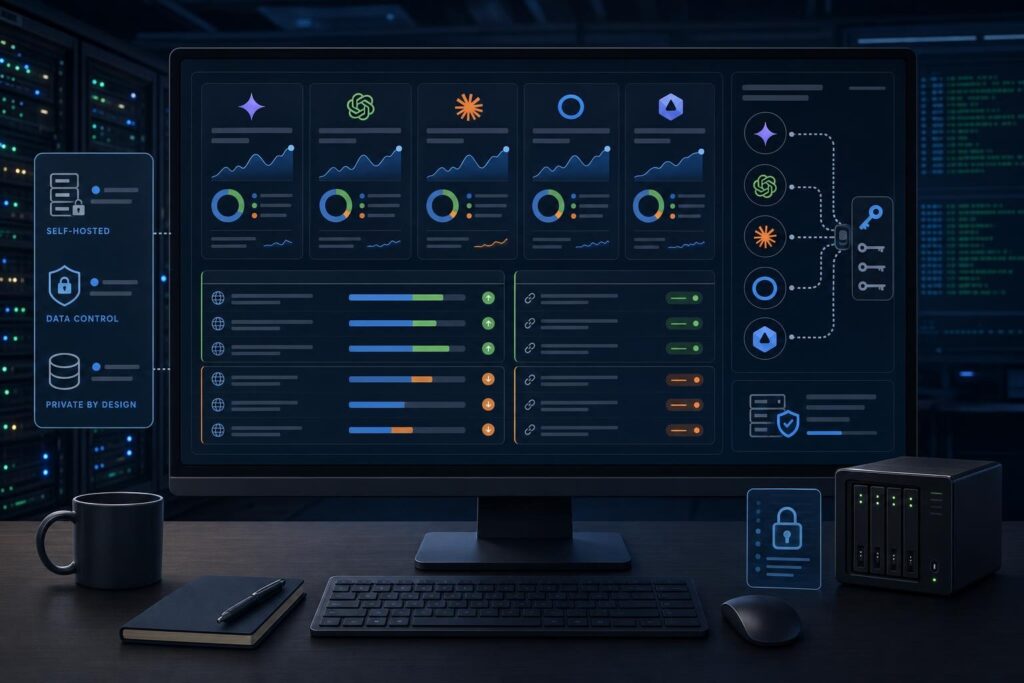
We self-hosted Elmo to audit how ChatGPT and Google AI Overviews were citing our brand across priority prompts. Its citation analysis and competitor benchmarking made source gaps clear enough to act on that week.
The tradeoff is that you need to run your own instance and bring API keys. For teams that care about data control, that is part of the appeal rather than a major drawback.
Pricing
Elmo lists its self-hosted plan at $0. Infrastructure and model API usage are separate costs to plan for. Cloud is marked as coming soon, and White Label is available as a custom option.
For teams comfortable with self-hosting, the value is strong because spend goes toward infrastructure and model use rather than a seat fee.
2. Ahrefs Brand Radar
Pros
- Tracks AI visibility across AI Overviews, AI Mode, ChatGPT, Perplexity, Copilot, Gemini, and Grok.
- Uses a large search-backed prompt dataset for broad market coverage.
- Reports AI Share of Voice, mentions, citations, and modeled impressions.
- Useful competitor benchmarking and citation discovery.
- Includes custom-prompt checks for focused monitoring.
Cons
- SaaS only, so there is no self-hosted deployment path.
- Share of voice and impressions are modeled, so they need context.
- Pricing is premium for small teams.
My experience with Ahrefs Brand Radar
Ahrefs Brand Radar is the tool I would reach for when leadership wants a fast benchmark. The methodology is documented, and the prompt dataset is useful for market-level comparisons.
I like it for competitor share of voice work. It is less about hand-picking every prompt and more about seeing how a category looks across a broad, search-backed set.
Pricing
Public pricing lists Brand Radar at $398 per month for selected platforms and $699 per month for all platforms.
Both listed tiers include 2,500 custom-prompt checks per month, which matters if you want to monitor priority prompts directly.
3. SE Ranking
Pros
- AI Overviews Tracker flags which tracked keywords trigger an AI Overview.
- Shows where a website ranks within AI Overview results and analyzes cited sources.
- AI Search Add-on extends visibility to AI Mode, ChatGPT, Perplexity, and Gemini.
- SE Visible offers standalone brand, sentiment, and competitor monitoring.
- Fits naturally into rank tracking and agency reporting workflows.
Cons
- Broader cross-engine visibility may require an add-on or separate product.
- Setup depends on choosing the right prompts, keywords, and engines.
- The platform can feel dense if you only need lightweight monitoring.
My experience with SE Ranking
SE Ranking is practical for agencies because it connects AI visibility to familiar SEO reporting. I like that it covers both AI Overview tracking and broader AI search monitoring through newer products.
The packaging is the main appeal. If your team already reports rankings, competitors, and content performance, SE Ranking makes AI visibility feel like an extension of that workflow.
Pricing
SE Visible publishes a starter price for its standalone AI visibility product. The AI Search Add-on is available for existing SE Ranking users, with availability depending on plan and setup.
4. RankLLM
Pros
- Tracks your brand’s visibility across leading AI search platforms.
- Includes Brand AI Score to measure AI search visibility.
- LinkRadar helps discover niche edit and listicle placement opportunities using AI.
- Offers Niche Edit Finder, Listicle Finder, and Mix Find to streamline link prospecting.
- Includes a free Listicle Marketplace for browsing live placement opportunities.
- Provides ready-to-send editor briefs for outreach workflows.
Cons
- Focuses primarily on AI visibility and link opportunity discovery rather than traditional SEO.
- Technical SEO audits and backlink analytics are not part of the platform.
- LinkRadar Scans are limited by your subscription plan (except Agency).
My Experience with RankLLM
RankLLM stands out because it combines AI search visibility tracking with link opportunity discovery in one platform. Instead of only showing whether your brand appears in AI search results, it also helps you find relevant niche edit and listicle opportunities through LinkRadar.
I also like that the workflow is practical. The AI-generated placement suggestions and ready-to-send editor briefs can save time during outreach, making it useful for marketers and agencies focused on improving AI visibility and earning editorial mentions.
Pricing
- Free Marketplace – Browse live listicle opportunities and send inquiries for free.
- Starter – $20/month (1 brand, 10 LinkRadar Scans/month)
- Professional – $50/month (10 brands, 50 LinkRadar Scans/month)
- Agency – $100/month (50 brands, Unlimited LinkRadar Scans)
5. Semrush
Pros
- Detects Google AI Overviews in Position Tracking and Sensor.
- AI visibility features appear across Domain Overview, Keyword Overview, Organic Research, Position Tracking, and Sensor.
- Offers free AI Overviews visibility tools for quick checks.
- Good fit for teams already using Semrush for SEO reporting.
Cons
- Some AI visibility features may depend on plan level.
- It is broader SEO software, not a dedicated prompt-level LLM monitoring tool.
My experience with Semrush
Semrush is convenient if your SEO team already lives in its dashboards. I would use it to connect AI Overview presence with organic rankings, keyword movement, and competitive research.
It is not the deepest specialist tool for LLM prompt monitoring. For Google AI Overview visibility inside a mature SEO workflow, though, it is easy to justify.
Pricing
Semrush offers free AI Overview and AI visibility checkers for initial research. Deeper tracking sits inside paid Semrush plans, with enterprise options for larger organizations.
6. SISTRIX
Pros
- Tracks whether a domain or URL is cited in Google AI Overviews.
- Shows citation frequency with weekly trend graphs.
- Strong international coverage across markets.
- Works well for teams already monitoring visibility indices and SERP features.
Cons
- More focused on Google AI Overviews than multi-LLM monitoring.
- Requires a thoughtful keyword tracking strategy.
My experience with SISTRIX
SISTRIX feels like a reliable fit for teams that care most about Google. The weekly trend view is useful for spotting whether AI Overview citations are expanding or fading.
I would not treat it as a complete answer-engine monitoring suite. I would use it as a Google AIO layer alongside a broader LLM visibility tool.
Pricing
SISTRIX uses transparent, modular packages, so teams can choose the parts of the suite they need. Check the current plan page for exact module pricing and market coverage.
7. seoClarity
Pros
- Enterprise-scale AI Overviews tracking as a native SERP feature view.
- Supports visibility checks across tracked keywords.
- Connects AIO monitoring with broader enterprise SEO analytics.
- Good fit for large sites that need governance and reporting.
Cons
- Enterprise-oriented pricing and sales process.
- Primarily focused on Google AI Overviews rather than broad LLM coverage.
My experience with seoClarity
seoClarity is built for large SEO programs, and that shows. I would shortlist it for enterprise teams that need scalable reporting, permissions, and SERP-feature context.
For a small startup, it may be more platform than you need. For a large site, the structure can be a strength.
Pricing
seoClarity uses custom enterprise pricing through sales. That makes sense for organizations that need a full SEO visibility platform rather than a standalone AI tracker.
8. Clearscope
Pros
- Tracked Topics report AI Mentions and AI Citations percentages.
- Prompts are assigned automatically to tracked topics.
- Connects AI visibility signals with content optimization workflows.
- Useful for content teams already working from topic coverage and GSC data.
Cons
- Not a full AEO monitoring suite.
- Tracked Topics limits vary by plan.
- Less focused on broad multi-LLM monitoring than specialist tools.
My experience with Clearscope
Clearscope is different because it approaches AI visibility from the content workflow. That helps if your main concern is whether topic coverage is turning into AI mentions and citations.
I would use it as a complement, not the only system of record. For content-led teams, the lightweight AI signals are helpful without adding a separate monitoring process.
Pricing
Clearscope publishes plans with tracked-topic limits, and larger requirements are handled through enterprise sales.
If your team already uses Clearscope for content briefs, Tracked Topics can be a natural way to add AI visibility reporting.