Last Updated on August 3, 2026 by Click Raven
Organic traffic drives revenue, but only when you can measure what actually moves the needle. SEO teams juggle keyword ranking data, referral sources, on-site behavior and conversion paths across dozens of properties. And the gap between raw pageview counts and actionable search insights keeps widening as privacy rules tighten and cookie-based tracking erodes.
Picking the right platform means juggling three tensions at once. Data accuracy against compliance. Depth of reporting against day-to-day usability. Budget against scalability. Some tools shine at behavioral analysis, others at unsampled traffic data or live competitive intelligence. Get the match wrong, and you lose months to misguided optimization.
So which tools earn their place in an SEO stack? The ten platforms below range from open-source self-hosted setups to enterprise suites, ranked by how well they serve search-focused workflows. Pricing, privacy posture, conversion tracking, the features that matter when organic performance is on the line: it’s all here.
Best web analytics software for SEO teams in brief
| # | Solution | Free plan | Cheapest paid plan | GDPR-compliant | Conversion tracking | Key takeaway |
| 1 | Matomo | Yes (On-Premise, lifetime) | €19/mo (Cloud, 50K hits) | Yes (CNIL-approved) | Yes | Open-source platform delivering 100% unsampled data with full data ownership and cookieless tracking. |
| 2 | Mixpanel | Yes | – | Yes | Yes | Event-based product analytics with AI agents, session replay and over 100 marketing integrations. |
| 3 | Plausible Analytics | 30-day trial | From €9/mo | Yes, cookieless and EU-hosted | Yes | Lightweight analytics for measuring organic landing pages, traffic sources and conversions without harming page speed. |
| 4 | Fathom Analytics | No (7-day trial) | $15/mo | Yes (EU Isolation) | Yes (custom events) | Privacy-first lightweight script (2 KB) with EU-only data processing and email reports. |
| 5 | Adobe Analytics | No | Custom pricing | Yes, with enterprise privacy controls | Yes | Enterprise analytics with advanced attribution, segmentation and cross-channel journey analysis. |
| 6 | Google Analytics | Yes | Free (GA4) | Partial | Yes | Industry-standard free platform with machine learning insights, multi-platform attribution and Google Ads integration. |
| 7 | Simple Analytics | Yes (small projects) | $15/mo | Yes (EU-hosted) | Yes | Cookieless EU-based tool capturing 100% of traffic including visitors who decline consent banners. |
| 8 | Piwik PRO | Yes (500K actions/mo) | Custom pricing | Yes | Yes | Integrated analytics suite with tag manager, consent manager and raw unsampled data access. |
| 9 | Contentsquare | No | Custom pricing | Yes | Yes | Digital experience analytics connecting organic landing-page behavior with journeys, friction and conversions. |
| 10 | Amplitude Analytics | Yes | From $49/mo | Yes | Yes | Product and web analytics linking organic acquisition to funnels, retention and downstream user behavior. |
1. Matomo
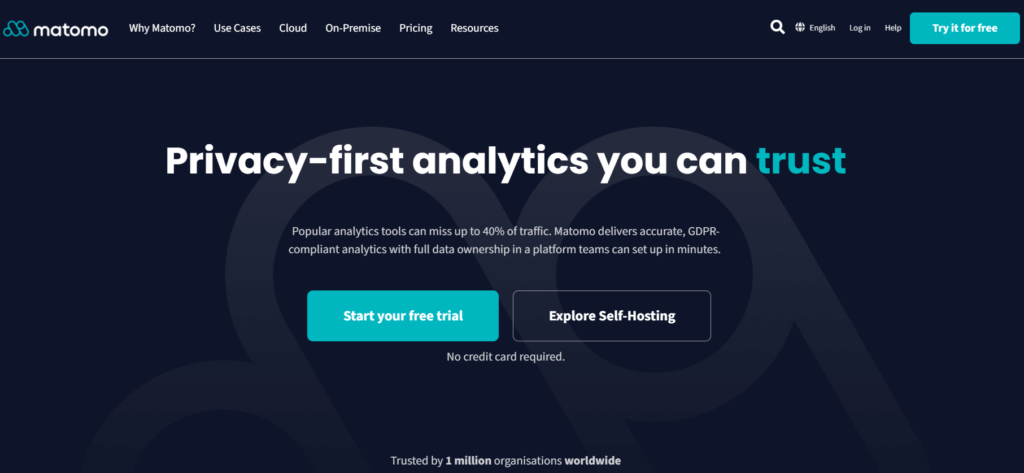
Matomo is the only CNIL-approved analytics platform that can legally collect visitor data in France without a consent banner. That single regulatory edge makes it a frontrunner for any SEO team working under strict European privacy rules. Deployed on over one million websites across 190+ countries, its open-source codebase also gives technical teams full visibility into how data gets processed.
Two deployment models coexist. Matomo Cloud starts at €19 per month for 50,000 hits, with data hosted in Germany. Matomo On-Premise costs nothing, forever, and stores everything on your own servers. For departments trying to reconcile data sovereignty with a tight budget, that flexibility is hard to match.
Every report relies on unsampled data, so 100% of recorded visits feed your dashboards. Google Analytics samples aggressively once volumes spike. Matomo doesn’t. The upshot for SEO teams: funnel analysis, landing page breakdowns and organic traffic segmentation reflect reality rather than statistical projections.
Cookieless tracking via `config_id` removes the dependency on browser cookies altogether. Heatmaps, session recordings, A/B tests and personalization modules all ship built in, not as paid add-ons. A dedicated tag manager lives inside the same interface, which cuts the need for external tools like Google Tag Manager.
Migrating from GA4? You can import historical analytics data directly and keep your trend comparisons intact. Over 100 integrations cover WordPress, Shopify, Google Tag Manager and major CMS platforms, while the API opens every metric to custom dashboards or automated SEO reporting pipelines.
On privacy, Matomo bundles a GDPR manager, IP anonymization controls and visitor opt-out mechanisms. Its ISO 27001:2022 certification reinforces enterprise-grade security, and white-label options let agencies rebrand the whole interface for client reporting.
One caveat: the On-Premise version demands server maintenance and technical know-how. Smaller teams without DevOps resources may prefer Cloud, though the monthly cost climbs with traffic. Even so, the mix of data accuracy, compliance and zero data limits makes Matomo a compelling first pick for search-driven organizations.
2. Mixpanel
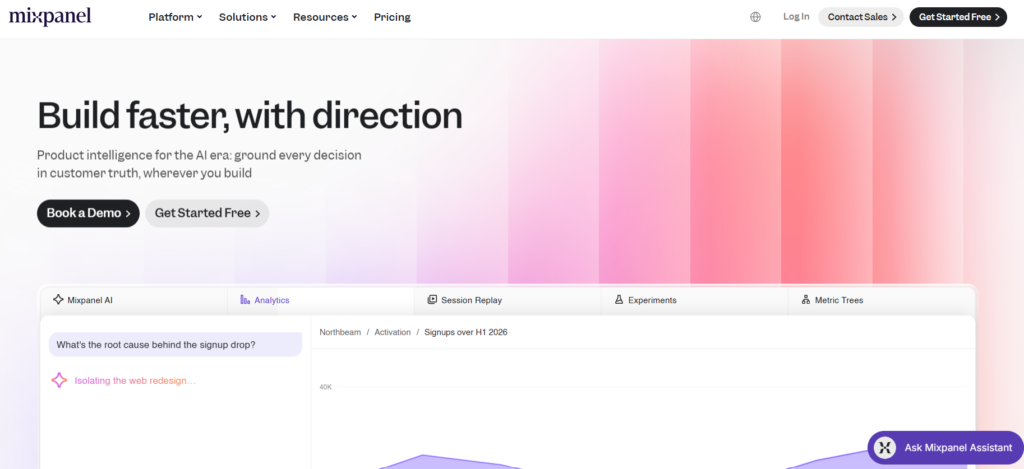
Mixpanel comes at analytics from an event-tracking angle rather than a pageview model. Every click, scroll, form submission or purchase becomes a discrete data point. That lets SEO teams tie organic landing pages to downstream user actions far more precisely than session-based tools allow.
The free tier removes the barrier to entry. Three pricing tiers exist, but the no-cost plan already includes core analytics, cohort analysis and basic funnel visualization. GDPR and CCPA compliance come standard, and a Cloud Data Residency option keeps European user data on EU servers.
AI runs through the whole platform. Mixpanel Agent watches product metrics around the clock and surfaces anomalies before they snowball. Session replay pairs with AI-generated summaries, so analysts spend far less time scrubbing recordings to find friction. You can even automate A/B test setup through AI prompts, a feature few rivals offer natively.
Custom Buckets group users into meaningful audience segments without a line of SQL. Attribution supports several models, defaulting to Last Touch but configurable for multi-touch scenarios. From there, teams can trace which organic entry points ultimately drive conversions across a multi-step funnel.
The proprietary Arb query engine handles complex queries fast, even across large datasets, and over 100 integrations connect Mixpanel to CRMs, CDPs, ad platforms and data warehouses. A Forrester study commissioned by Mixpanel reported 354% ROI and a six-month payback period, with the company citing 29,000+ global customers.
Where does it fall short for SEO? It doesn’t track keyword rankings or crawl your site structure. Think of it as a behavioral layer that complements a dedicated SEO tool, not a replacement for one. For proving how organic visitors behave after they land, though, the event-level granularity is tough to beat.
3. Plausible Analytics
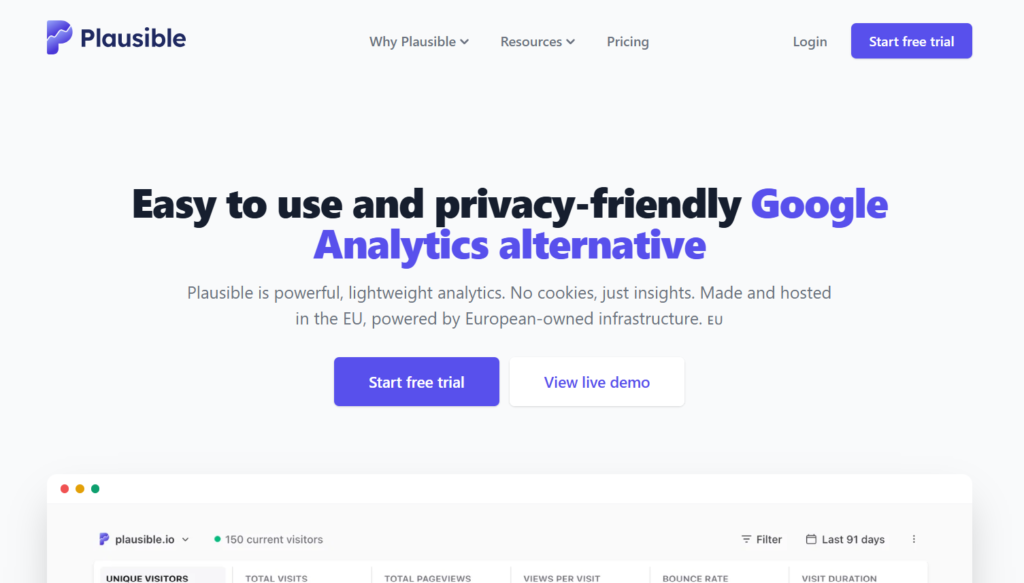
Plausible Analytics is a lightweight web analytics platform built for teams that want clear traffic and conversion data without the complexity of traditional analytics suites. Its streamlined dashboard makes it particularly useful for SEO teams monitoring landing-page performance across multiple properties.
The platform reports visitors, pageviews, entry pages, traffic sources, devices, countries and campaign parameters on a single screen. Organic search traffic can be isolated quickly, allowing teams to compare which pages attract visitors and which ones contribute to business goals.
Custom events and goals connect SEO landing pages with form submissions, downloads, registrations and purchases. Funnel reports can then show how visitors progress through key conversion journeys after entering through organic search.
Plausible does not use tracking cookies, persistent identifiers or cross-site profiles. Its managed infrastructure operates within the European Union, reducing the consent and international data-transfer complications associated with conventional analytics platforms.
The tracking script is deliberately lightweight, limiting its impact on loading speed and Core Web Vitals. Historical Google Analytics data can also be imported, helping teams retain long-term traffic comparisons during migration.
Plausible does not provide keyword rankings or technical crawling. It works best alongside a dedicated SEO platform, but for measuring organic traffic, landing pages and conversions privately, it is far more suitable than a basic WordPress statistics plugin.
4. Fathom Analytics
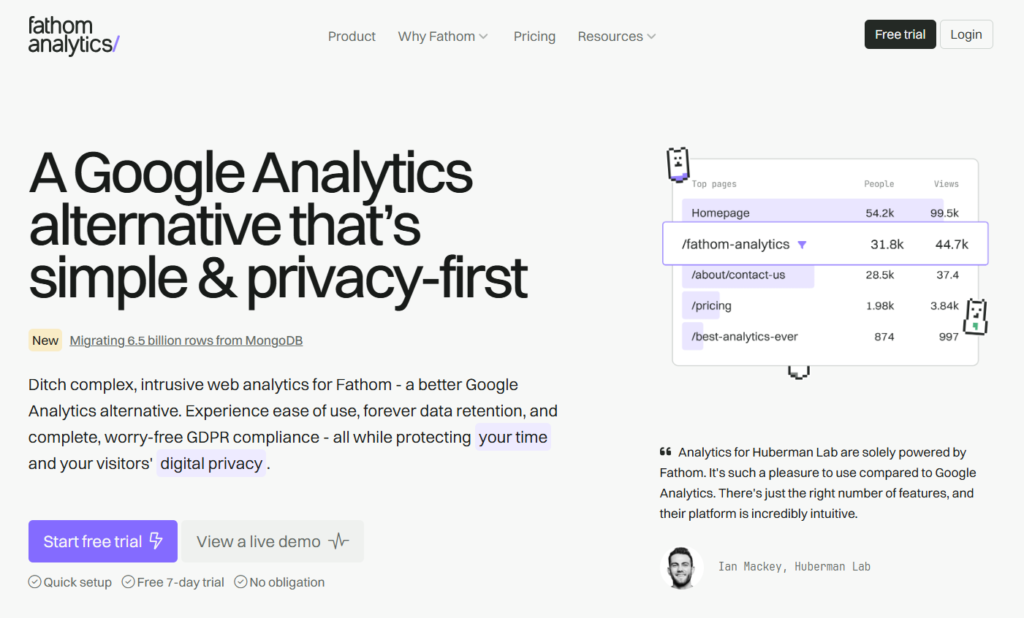
Fathom Analytics processes all European visitor data on EU-based servers by default, a setup the company calls EU Isolation. No personal data crosses the Atlantic, which shields sites from FISA and EO12333 surveillance risks. For teams under GDPR, that erases a whole layer of legal uncertainty.
The script is tiny. Fathom puts it at just 2 KB, against roughly 45 KB of JavaScript for Google Analytics. That difference feeds straight into your Core Web Vitals, handing Fathom users a measurable page speed advantage that can lift search rankings. Setup means pasting a single line of code, whatever your CMS or framework.
Pricing starts at $15 per month after a seven-day free trial, covering up to 50 sites and 100,000 monthly visits. No free tier here. Custom event tracking watches form submissions, button clicks and goal completions with no extra tooling, while UTM campaign tracking shows which initiatives drive organic and paid results.
The single-page dashboard keeps it lean:
• unique visitors and pageviews
• bounce rate and time on site
• referral sources and top pages
Regular email reports summarize performance without a login, over one million sites run Fathom, and the company explicitly pledges never to monetize visitor data. A Google Analytics historical data importer eases migration, integrations span WordPress, Next.js, Vue.js and ConvertKit, and support replies land within one business day.
The trade-off is depth. Fathom deliberately drops segmentation, cohort analysis and funnel visualization, so teams needing granular user journey work will want a companion tool. For anyone who prizes speed, privacy and simplicity, though, it delivers exactly what it promises, minus the bloat.
5. Adobe Analytics
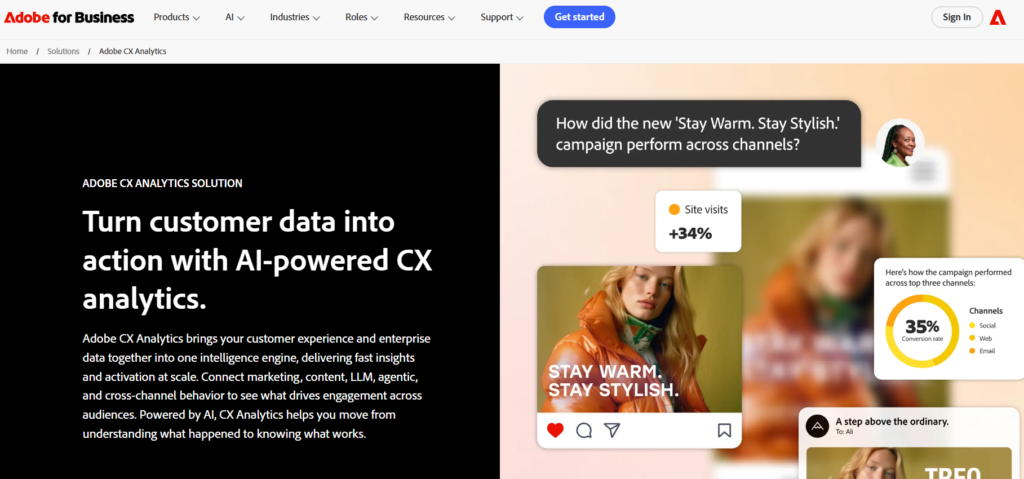
Adobe Analytics is designed for enterprise SEO teams managing complex websites, multiple brands and customer journeys that extend across several digital channels.
The platform allows analysts to segment organic traffic by landing page, content type, device, geography, customer profile and virtually any custom dimension included in the tracking implementation. This makes it possible to connect search traffic with conversions, revenue and longer-term customer behavior.
Advanced attribution models evaluate how organic search contributes alongside paid media, email, social and direct traffic. Rather than assigning every conversion to the final interaction, teams can compare different models and understand the wider role SEO plays in the customer journey.
Analysis Workspace provides flexible dashboards, flow reports, cohort analysis and anomaly detection. SEO teams can investigate unexpected traffic changes, compare content groups and identify pages whose engagement or conversion performance differs from the site average.
Adobe Analytics integrates closely with Adobe Experience Platform, Adobe Target and the broader Experience Cloud. Organizations can therefore connect analytics with experimentation, personalization and customer data activation.
The platform requires careful implementation, disciplined tracking governance and experienced analysts. Pricing is available through a custom enterprise contract.
For large SEO teams that need advanced segmentation, attribution and cross-channel reporting, Adobe Analytics provides significantly broader capabilities than a commerce platform restricted to Shopify stores.
6. Google Analytics
Google Analytics is still the most widely deployed web analytics platform on the planet, and the reason is obvious: GA4’s standard tier costs nothing. SEO teams get cross-device, cross-platform measurement across websites and mobile apps inside a single property.
Machine learning surfaces insights that manual analysis would miss. Predictive audiences, churn probability and revenue forecasts help you prioritize the pages and segments with the highest commercial upside. Multi-platform attribution then maps the full customer journey, from first organic click to conversion, across Google Ads, Display and YouTube.
Custom audience lists feed straight into Google Ads campaigns, creating a loop between organic discovery and paid amplification. Shareable reports and automated email summaries cut the manual grind of stakeholder communication, and the Looker Studio integration pushes visualization far past the native dashboards.
The weak spots are well documented. Data sampling kicks in at higher traffic volumes and can distort metrics for large-scale SEO audits. Privacy advocates flag the transfer of visitor data to Google’s servers, a GDPR sticking point that has already triggered regulatory action in several EU countries. And because tracking depends on consent, GA4 can miss a large share of actual site visits when users decline cookies, with cookieless vendors estimating losses of 20 to 60%.
If those trade-offs sit fine with you, the ecosystem advantage is undeniable. Search Console integration, BigQuery export and a mountain of third-party tutorials and community support make onboarding faster than any rival. Teams in privacy-sensitive markets, though, may need to layer a cookieless tool on top to capture the full traffic picture.
7. Simple Analytics
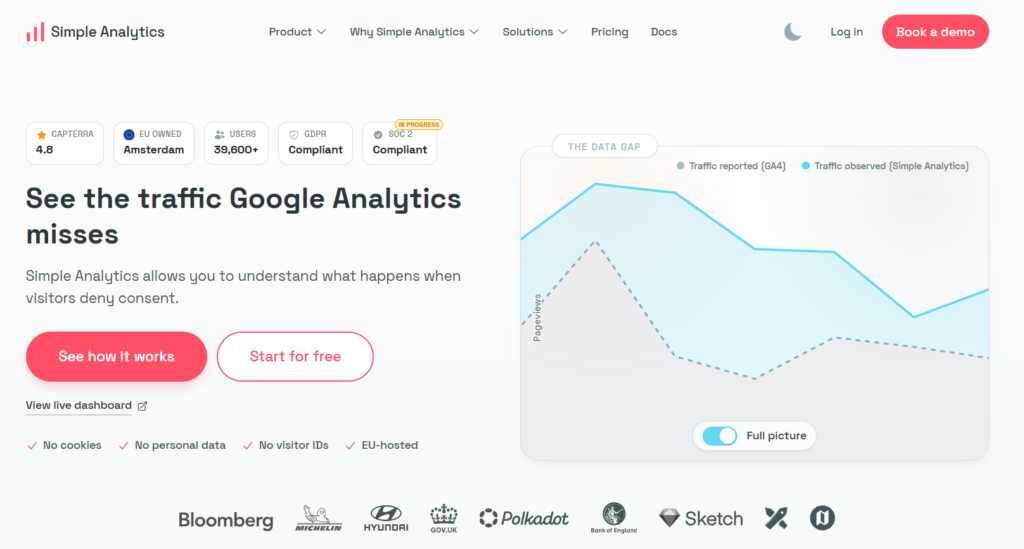
Simple Analytics captures 100% of site traffic, including visitors who reject cookie banners. That claim carries weight, since cookieless vendors estimate GA4 loses between 20 and 60% of visits in consent-heavy markets. For teams trying to measure true organic reach, that gap between reported and actual numbers can quietly derail strategy.
Headquartered in Amsterdam, the company hosts everything on European servers with no cookies, no visitor identifiers and no cross-site tracking. GDPR compliance is automatic, not configured. A free tier covers small projects, the paid plan starts at $15 per month for up to ten sites, and the Team plan at $40 per month supports twenty sites and two user seats.
An AI assistant built into the dashboard reads your metrics and suggests reasons behind traffic fluctuations. Event capture and campaign data track goal completions and UTM-tagged sources. Integrations with Looker Studio, Power BI and data warehouses pull Simple Analytics data into workflows you already run.
The Stats API delivers aggregated data, while the Raw Export API opens granular analysis outside the platform. The company reports over 31,300 active users since its 2018 launch, with SOC 2 certification in progress, and frameworks like React, Gatsby, Django and Vue plug in natively.
The shortfall, again, is depth. No session recordings, no heatmaps, no funnel visualization. Simple Analytics deliberately avoids building visitor profiles, which rules out behavioral segmentation beyond page-level data. Teams that need to see how users move through a site after landing should pair it with a behavioral analytics layer like Hotjar or Clarity.
8. Piwik PRO
Piwik PRO folds four modules into a single privacy-compliant suite: Analytics, Tag Manager, Consent Manager and Customer Data Platform. So SEO teams set consent rules, deploy tracking tags and analyze traffic in one interface instead of stitching separate vendors together.
The freemium Cloud plan supports up to 500,000 monthly actions at no cost, with data hosted in the EU. Paid plans open at $23 per month for 50,000 hits and scale from there. Enterprise clients also get a dedicated technical representative available around the clock, plus professional services covering implementation, training and analytical consulting.
Compliance presets ship for GDPR, HIPAA and TTDSG. A drag-and-drop segment editor builds custom audience slices without SQL, and conversion funnels pinpoint exactly where visitors abandon key flows, handing SEO teams the evidence to prioritize landing page optimizations.
All data arrives unsampled and raw, reachable through the API, Google BigQuery export, CSV download or a native Tableau connector. Dashboards refresh in real time, every ten seconds, while the underlying data updates every thirty minutes. Real-time anomaly alerts flag when traffic patterns shift, which proves invaluable during an algorithm update.
Native integrations with Google Ads and Google Search Console pull paid and organic data into the same layer, and the 14-month default retention window extends on premium plans, a detail that matters for year-over-year trends.
The main drawback: keyword position tracking leans entirely on Search Console data rather than proprietary rank monitoring. If you need daily rank checks across hundreds of keywords, you’ll still want a dedicated SERP tracker alongside Piwik PRO.
9. Contentsquare
Contentsquare is a digital experience analytics platform that helps SEO teams understand how visitors behave after arriving from search engines. It connects quantitative performance data with detailed insights into engagement, navigation and conversion friction.
Journey analysis maps the paths visitors take between landing pages, content, product pages and conversion steps. SEO teams can isolate organic sessions and compare how different entry pages influence progression through the website.
Heatmaps and zone-based analysis reveal which elements attract attention, generate clicks or remain ignored. This helps teams evaluate whether important headings, internal links and calls to action are positioned effectively on pages receiving significant organic traffic.
Session replay and frustration signals highlight problems such as repeated clicks, navigation loops, form errors and unexpected exits. These insights help explain why a page can rank well and attract traffic while still producing weak engagement or conversion results.
Funnels connect individual pages and interactions with business outcomes. Teams can identify where organic visitors abandon a journey and prioritize changes according to their potential impact.
Contentsquare also uses automated insights to surface unusual behavior and recurring experience issues across large volumes of sessions. This reduces the need to review recordings manually.
The platform is primarily aimed at mid-market and enterprise organizations and follows a custom pricing model. For SEO teams that need to connect landing-page performance with user journeys and conversion outcomes, Contentsquare offers a deeper analytical layer than a standalone heatmap tool.
10. Amplitude Analytics
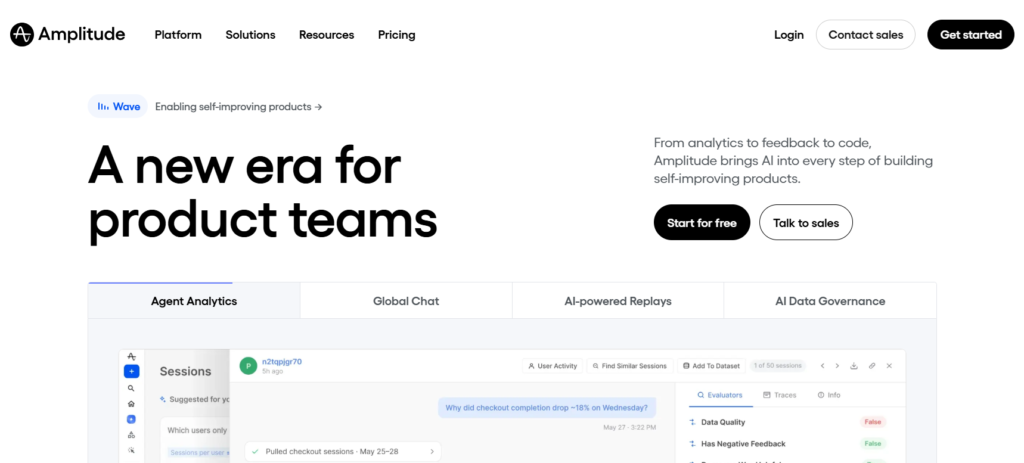
Amplitude Analytics is an event-based platform that helps SEO teams understand what organic visitors do after they reach a website or digital product.
Rather than limiting reporting to pageviews and sessions, Amplitude tracks actions such as registrations, feature use, purchases, downloads and repeat visits. This allows teams to connect organic landing pages with deeper engagement and revenue outcomes.
Funnels show how search visitors progress through important journeys and where they abandon them. SEO teams can compare conversion performance by landing page, device, geography, content category or visitor cohort.
Cohort and retention analysis reveal whether users acquired through organic search continue engaging over time. This is particularly useful for SaaS, subscription and product-led businesses where the value of SEO extends beyond the first session.
Journey reports visualize the sequences of actions visitors take after landing. Teams can identify which content paths contribute to activation or conversion and which entry pages tend to produce low-quality visits.
Amplitude also includes experimentation and session replay capabilities, allowing teams to test changes and connect quantitative results with observed user behavior in the same environment.
The platform requires a structured event-tracking plan and is more complex than lightweight web analytics tools. It does not replace rank tracking or technical SEO software.
For SEO teams that need to prove how organic acquisition affects activation, retention and revenue, Amplitude offers much greater analytical depth than a free behavioral recording tool.
FAQ
What features should SEO teams prioritize in analytics software?
Focus on unsampled traffic data, organic source segmentation and conversion tracking tied to landing pages. Keyword rank monitoring, while sometimes bundled, usually needs a dedicated tool.
Privacy compliance matters just as much. Cookieless tracking and EU data hosting stop consent banners from hiding a big share of your visits. API access and dashboard customization round out the essentials, so data flows into your existing reporting stack without manual exports.
Can free analytics tools handle enterprise-level SEO needs?
Several free options run deeper than you’d expect. Google Analytics GA4 covers multi-platform attribution, while Matomo On-Premise delivers unsampled data with no traffic limits. Different free tools cover different needs depending on your priorities. Each covers a different slice of the puzzle.
Enterprise teams tend to outgrow free tiers once they need dedicated support, advanced segmentation or SLA-backed uptime. The pragmatic move: start free, spot the gaps, then pay for upgrades only where the free version genuinely comes up short.
How does GDPR compliance affect analytics accuracy?
Cookie consent rules under GDPR cause real data loss for tools that depend on opt-in tracking. Platforms like Plausible, Fathom and Simple Analytics sidestep the problem by collecting zero personal data. No consent banner means 100% of visits show up in reports.
Cookie-based tools, GA4 included, only record visitors who actively accept tracking. In privacy-conscious European markets, rejection rates can climb past 40%. A cookieless platform removes that blind spot and gives you a more accurate traffic baseline.
Should SEO teams use one analytics platform or combine several?
A single platform rarely covers the whole spectrum. Quantitative tools like Matomo or GA4 handle traffic volumes, source attribution and conversion metrics, while behavioral tools like Hotjar or Clarity reveal how visitors actually use your pages.
Layer a lightweight cookieless tracker on top of a feature-rich platform, and you catch the visitors that consent-dependent tools miss. The trick is dodging redundant data collection that drags down page load and muddies compliance. Two or three well-chosen tools beat one bloated suite.
How much should an SEO team expect to spend on analytics software?
Budgets stretch from zero to several thousand dollars a month. Matomo On-Premise and Google Analytics are available at no licensing cost, while cloud-hosted privacy tools like Plausible and Fathom run between $9 and $15 per month. Cloud-hosted privacy tools like Plausible and Fathom run between $9 and $15 per month. Product analytics platforms such as Amplitude begin at $49 per month on annual billing.
Enterprise platforms like Adobe Analytics, Contentsquare and Piwik PRO use custom pricing based on deployment, traffic and support requirements that scales with site count and feature access. Most mid-sized teams land between $50 and $200 per month by pairing a core analytics platform with a free behavioral tool and a dedicated rank tracker.