
Last Updated on July 26, 2026 by Click Raven
In 2026, online shopping keeps moving fast, and for online stores, Search Engine Optimization (SEO) is no longer a “nice to have.” It is the base you need to survive and grow.
This guide gives you a full e-commerce SEO checklist for 2026, so your products can stand out in a search space that now has more channels and more competition than ever. Whether you run a growing Shopify shop, a large Magento store, or need focused SEO for WooCommerce stores, the ideas below will help.
1. Keyword Research for Ecommerce Stores
Keyword research is still the base of SEO, but for e-commerce in 2026, it has more layers. It’s about finding not just what people type, but why they search, and where they search. When you understand these patterns, you can match user expectations with your pages and content.
Identifying High-Intent Commercial and Transactional Keywords
For e-commerce, the most valuable keywords are the ones that show buying intent. Search intent usually falls into these groups:
- Navigational searches: People searching for a specific brand or site (e.g., “Nike offers“).
- Informational searches: People learning about a topic (e.g., “differences between running shoes“).
- Commercial or research searches: People comparing options (e.g., “best running shoes,” “headphones comparison“).
- Transactional searches: People ready to act or buy (e.g., “buy wireless headphones,” “iPhone 15 Pro price,” “SKU 12345“).
- Location searches: People looking for local stores or local product options (e.g., “Nike store Oregon“).
Product and category pages should focus mainly on transactional and commercial searches because they lead straight to sales. Informational keywords still matter because they support the buyer path and build trust.
Mapping Keywords to the Buyer Journey
A good content plan is not about posting more content. It’s about posting the right content for the right stage of shopping. Keyword mapping helps you do that:
- Awareness Stage: Use informational keywords for blog posts, guides, and videos (e.g., “How to choose running shoes,” “Best materials for winter jackets“).
- Consideration Stage: Use commercial keywords for comparisons, roundups, and detailed reviews (e.g., “Best running shoes for flat feet,” “Top waterproof jackets under $200“).
- Decision Stage: Use transactional keywords on product pages, category pages, case studies, and clear CTAs. This is where sales happen.
This makes sure each page has a clear job: move the user from discovery to purchase.
2. Structuring Ecommerce Site Architecture
Your site architecture is the framework of your store. It controls how pages are grouped and how people and bots move through your content (including LLM-based crawlers).
A strong structure makes it easier to browse, helps bots find pages, and spreads authority across large catalogs. This includes your category system, tags, internal search, and navigation.
Organizing Product Inventory and Category Hierarchies
Clear categories are the starting point. Treat products as your smallest “content unit,” then build categories around your current (and future) catalog. You can group content in different ways:
- By topic: What the product is (e.g., “running shoes,” “yoga mats“).
- By target users: Who it’s for (e.g., “men’s products,” “kids’ toys“).
- By attributes/facets: Size, color, material (e.g., “red t-shirts,” “leather handbags“).
- By brand: Manufacturer grouping (e.g., “Nike shoes“).
- By seasonal campaigns: Event-based groups (e.g., “Black Friday deals,” “Christmas gifts“).
Often, a mix works best. Line up categories with business goals (margin, demand, ROI) so that important pages get attention. Avoid categories with too few products, since they can become thin pages. Your CMS also sets limits on what you can do, so plan architecture with both SEO research and real user behavior in mind.
Strengthening Internal Linking
Internal links help users and bots understand what matters on your site. They also spread authority so product pages don’t sit alone. A useful rule is about 80% fixed linking (menus, breadcrumbs) and 20% flexible linking for seasonal pages, new launches, and campaigns.
Common internal linking methods:
- Category-to-Product Links: Categories should link to the products inside them.
- Product-to-Product Links: Add “related products” or “also bought” sections.
- Blog-to-Product Links: Link from guides and blog posts to relevant products and categories.
- Breadcrumbs: Help users and show hierarchy to search engines.
- Mega-Menus and Footer Links: Use them to highlight key categories and content groups.
- Hub Pages: Create main pages that link to many related subpages and products.
Use clear anchor text. Regularly check for broken links after products are removed or URLs change.
3. Technical SEO: Foundations and Advanced Tactics
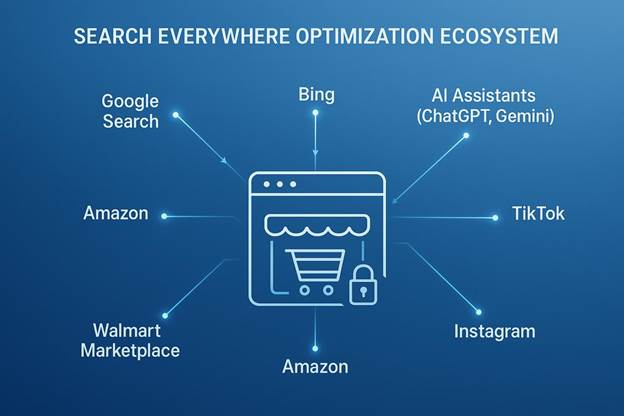
Technical SEO in 2026 matters more than ever. It’s the entry point for Google, Bing, and also AI bots and agents. It makes your site crawlable, indexable, fast, and usable. Without this base, even great content may never be found.
Improving Core Web Vitals and Page Speed
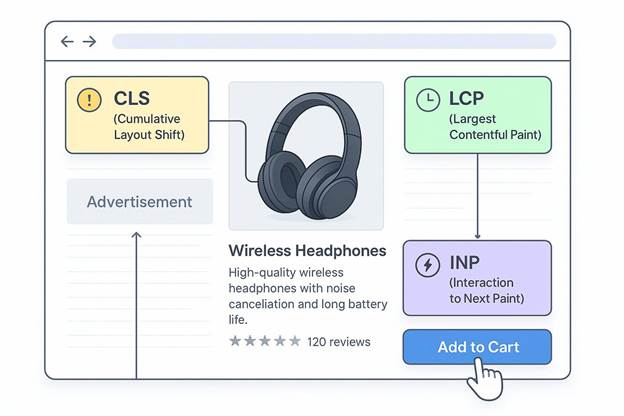
Core Web Vitals (CWV) are key UX metrics and affect rankings and sales. For e-commerce, they are especially important:
- LCP (Largest Contentful Paint): How fast the largest element loads (often a hero image or gallery). Aim for under 2.5s.
- CLS (Cumulative Layout Shift): How much the layout jumps while loading. Low CLS avoids misclicks and builds trust.
- INP (Interaction to Next Paint): How responsive the page feels after clicks/taps. Poor INP makes filters and carts feel slow.
Stores often load lots of CSS and JS.
- Start with images: compress them (often under 100-200KB), use WebP, and lazy-load below-the-fold images.
- Serve correct sizes for mobile.
- Reduce third-party scripts, minify CSS/JS, use a CDN.
- Track CWV in Google Search Console, PageSpeed Insights, Lighthouse, and tools like DebugBear.
Ensuring Mobile-First Performance and Accessibility
Phones drive most retail visits, and Google ranks based on the mobile version. Your mobile site is your main storefront.
Key mobile priorities:
- Content Parity: No missing text, images, or features on mobile.
- Internal Linking: Links must work and be easy to tap.
- Architecture: Keep navigation clear on small screens.
- Speed & Responsiveness: Light layouts, readable text, no horizontal scroll.
- User Flow: Short add-to-cart steps, sticky CTAs, easy filters, fewer blocking pop-ups.
Avoid serving different content or schema to desktop and mobile, since that can create indexing problems.
Improving Crawlability and Indexing Control
Crawling and index control decide whether your best pages get found and ranked. Simple rule: pages you want to rank or pages that pass value through internal links should be crawlable and indexable. Pages with no search value should not be indexed.
Main control points:
- Robots.txt: Controls access for bots. In 2026, that includes AI bots like GPTBot, ClaudeBot, and CCBot. Blocking them can reduce visibility in LLM tools. Also, don’t block key CSS/JS files that Google needs to render pages.
- Firewalls/WAFs: Allow relevant search and AI agents so they aren’t blocked by mistake.
- Sitemaps: XML sitemaps help discover URLs. Use segmented sitemaps if you have many URLs, and include only pages you want indexed.
- Meta Robots: Use `noindex` for pages that should not appear in search. Only indexed pages can show in AI Overviews and related systems.
- Rel Canonical: Helps reduce duplicate content, especially with variants and filters. Keep signals consistent.
After keyword research, write an indexing plan that clearly states what is indexable and what is not.
4. On-Page Optimization by Page Type
On-page SEO directly affects rankings, clicks, and sales. In 2026, the best approach is to adjust by page type, with clear info and search-friendly elements that work for both people and AI systems.
Optimizing Product Page Titles, Descriptions, and Images
Product pages are where sales happen, so they need careful work:
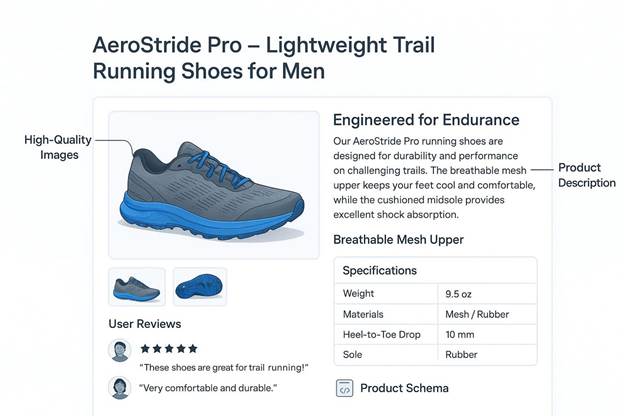
- Titles: Write unique titles under 60 characters. Put key terms first and include product name, main attribute, and brand (e.g., “Nike Air Max 270 Running Shoes – Men’s Size 10 – Black/White“). Price or year can help in some cases.
- Descriptions: Aim for 300+ words of unique, helpful text. Avoid copying manufacturer descriptions. Use H2/H3 sections like “Product Overview,” “Key Features,” “Technical Specifications,” “What’s Included.” Cover use cases, benefits, measurements, and specs, and answer common objections.
- Images: Use high-quality images. Compress (often under 100-200KB), use WebP, use clear filenames (e.g., nike-air-max-270-black-white-mens.jpg), and add alt text for all images.
- Videos: Add product videos when you can; they can strongly improve conversion rates.
- FAQs: Add a FAQ section for common questions (size, waterproof, fit) and mark it with FAQ schema.
Build trust on the page with clear policies, badges, and real reviews.
Improving Category and Collection Page Relevance
Category pages guide people to the right product types and target broader keywords:
- Content: Add 150-250 words of unique, helpful text, ideally above the grid. Use related terms and use cases.
- Headings: Use one clear H1 with the category name plus relevant intent. Use H2/H3 for sections.
- Product Listing: Sort products with business goals in mind (margin, stock, popularity), but keep relevance high.
- Internal Links: Link to subcategories, related categories, and useful guides. Add crawl-safe segment filters.
- Reviews & FAQs: Add category-level testimonials, top-rated items, and FAQs (with schema where it fits).
- Conversion-Oriented Design: Use the right layout for mobile/desktop and add blocks with CTAs where helpful.
Choose category keywords that have decent demand and manageable competition. Often, slightly longer category phrases work well.
Creating High-Quality Landing Pages for Campaigns
Campaign and launch landing pages matter a lot, even when they are not direct checkout pages. They should match a specific search need and push users one step closer to buying.
Key parts of strong landing pages:
- Invisible Elements: Strong titles and meta descriptions, plus structured data where possible.
- Headings: Clear structure (H1, H2, H3) for easy scanning.
- Content: Give users what they need: detailed text, calculators, calendars, videos, or infographics-whatever fits the query.
- Links: Sometimes fewer links are better to keep focus on the campaign goal.
- Conversion-Focused Design: One clear CTA like “Sign Up,” “Learn More,” or “Shop Now.”
For “Coming Soon” pages, add early product info (photos, possible price), build supporting content, and update the page as buying links become available.
5. Content Strategy, EEAT, and User-Generated Content
In 2026, content still drives SEO, but trust is what makes it work. For e-commerce, content is more than product text. It helps you build authority, grow community, and give real value that both users and AI systems respect.
Developing Content Hubs, Guides, and Resource Centers
Content hubs and guides help shoppers long before they search “buy now.” They answer questions, remove doubts, and position your brand as a helpful source.
- Buying Guides: Cover common questions and objections across product types and use cases. Make them easy to consume with visuals. Expert authorship strengthens E-E-A-T signals.
- Content Hubs: Build hubs for seasonal topics like “Sales,” “Gifts,” “Black Friday,” “Valentine’s Day,” and “Christmas.” Some are year-round with seasonal peaks.
- Pillar Pages & Clusters: Use a main pillar page for a broad topic, linking to related posts, FAQs, and comparisons. This helps organization and SEO relevance.
Automation can work well for clear facts and numbers (like spec tables), however, content that needs real experience should involve a real expert.
Building Trust With E-E-A-T and First-Hand Experience
Google uses E-E-A-T (Experience, Expertise, Authoritativeness, Trustworthiness) to decide which sites deserve visibility, especially for sensitive topics. To improve E-E-A-T:
- Show Expertise: Publish clear guides and explanations, and use real experts as authors.
- Prove Experience: Add real reviews, testimonials, and practical examples.
- Build Authority: Earn links and mentions from trusted sites.
- Increase Trust: Show secure checkout, clear shipping/returns/refunds, and easy contact options. Add trust seals and guarantees.
- Reputation: Strong “About” and “Contact” pages help show who you are and why you can be trusted.
- Experts as Authors: If you use generated content, connect it to real team experts with bios and public proof.

When shoppers trust your store, search systems often reward you with better visibility too.
Integrating Video Commerce and Visual Content
Video is now a major part of organic discovery. YouTube, TikTok, and Instagram influence buyers early, and those videos can also rank in Google. YouTube is also often cited by LLMs like ChatGPT.
A practical video plan:
- Define Objectives: Decide what stays on social platforms and what you also add to your site like YouTube reviews embedded on product pages.
- Content research: You should study the videos that are already successful in your niche to understand how they deliver the message. For this, you can find similar videos to get trending content ideas and see how other brands deliver their message.
- Platform Optimization: Adjust to each platform: video type, hook, script, title, description, chapters/timestamps, and thumbnails.
- Structured Data: Use `VideoObject` schema when you add videos to your site.
Reuse content across platforms: cut short clips from long videos and test what works best.
Conclusion
In 2026, e-commerce SEO is not a one-time project. It is ongoing work that needs regular updates as AI tools grow and user behavior changes. Brands that adopt an AI-aware SEO approach early can stand out and attract better traffic.
The best results happen when everything works together: technical setup, content quality, outside signals (links and mentions), and the shopping experience.
Your store should grow smoothly with your catalog and customer base, so each click and mention supports real business results. This takes clear planning, strong execution, and ongoing monitoring based on data and real audience understanding.