
Category: Local SEO

  • How Electricians Can Use SEO to Get More Leads Without Relying on Word of Mouth

    How Electricians Can Use SEO to Get More Leads Without Relying on Word of Mouth

    Referrals are reliable, but they’re also unpredictable. An electrician who depends entirely on word of mouth is essentially waiting for the phone to ring, with no real control over when or how often that happens. Local SEO changes that dynamic by putting a business in front of homeowners at the exact moment they’re searching

    When someone types “electrician near me” into Google, they’re not browsing casually. That’s urgent, high-intent demand, and industry research shows that home service searches increasingly begin online rather than through personal recommendations. The electricians who show up in the Google Map Pack, the Google Business Profile results, and organic search listings are the ones capturing those leads.

    Unlike referrals, which arrive on someone else’s timeline, SEO creates a consistent pipeline tied directly to what people are already looking for.

    Where SEO Brings Leads Faster Than Referrals

    The contrast between passive referral dependence and active search demand becomes clear when you consider buyer intent. A homeowner dealing with a tripped breaker or a failed outlet isn’t asking a neighbor for a recommendation; they’re reaching for their phone and searching. That moment of urgency is where local SEO earns its value.

    Appearing in the Google Map Pack, the Google Business Profile results, and organic search listings means an electrician is present precisely when purchase-ready intent is highest. Emergency electrical needs and local service queries don’t wait for a referral to come through, and neither should a lead generation strategy.

    Build Pages That Rank for the Jobs You Want

    A well-structured website is the foundation of any effective SEO effort. When pages are built around specific services and locations, they give search engines clear signals about what the business offers and where it operates. Working with an Electrician Marketing Agency can help prioritize which services and locations to target first, particularly when separating service intent from location intent across many pages becomes too complex to manage in-house.

    Service Pages for High-Intent Jobs

    A common mistake electricians make is putting every service on a single page, which dilutes the relevance of each offering and makes it harder to rank for anything specific.

    Instead, each core service should have its own dedicated page. Panel upgrades, EV charger installation, whole-home rewiring, and outdoor lighting all represent distinct searches with distinct buyer intent. A standalone service page gives each one room to target the right keyword, carry a focused title tag and meta description, and speak directly to what that customer actually needs.

    Proper on-page SEO starts with matching page content to how real customers phrase their searches, and that requires keyword research tied to actual job types rather than assumptions.

    Location Pages That Expand Your Service Area

    Service pages answer what an electrician does. Location pages answer where they do it, and that distinction matters for reaching customers beyond a tight referral radius.

    A location page built around a specific city or neighborhood signals to Google that the business is relevant for searches in that area. An electrician serving multiple suburbs can build a page for each one, targeting searches like “electrician in [city]” rather than competing broadly. Spreading thin across too many weak pages achieves less than building a smaller number of focused, well-structured ones.

    Win More Local Searches Before Visitors Hit Your Site

    For electricians, local visibility often functions as the first lead touchpoint, appearing before a website visit ever takes place. That makes the assets covered in this section some of the most valuable to get right.

    Turn Your Google Business Profile into a Lead Source

    For most local searches, a Google Business Profile appears before the website ever does. That makes it one of the highest-value assets an electrician can control, and one of the most commonly left half-finished.

    A complete, optimized profile includes accurate service categories, a detailed business description, photos of real work, and clearly listed service areas. These details directly influence whether a business appears in the Google Map Pack, the three-listing block that captures a significant share of local search clicks.

    Keeping this profile active matters too. Posting updates, answering questions, and adding photos regularly signals to Google that the business is current and engaged, which supports visibility over time.

    Clean Up Citations, NAP, and Reviews

    Beyond the Google Business Profile, local SEO visibility depends on consistency across the broader web. NAP consistency, meaning the business name, address, and phone number appearing identically across every directory and listing, is a foundational trust signal for local search algorithms.

    Local citations on platforms like Yelp, Angi, and the Better Business Bureau reinforce that consistency. Conflicting information across these sources can quietly suppress rankings without any obvious cause.

    Customer reviews play a parallel role. A steady stream of recent, positive reviews improves both search visibility and the likelihood that a prospect chooses one electrician over another. Asking satisfied customers to leave a review after each job, and responding to every review that comes in, keeps this signal strong without requiring extra ad spend.

    Fix the Website Issues That Block Conversions

    Ranking well and converting visitors are two separate problems, and technical issues can undermine both. Once the profile and citation work from the previous section is in place, the website itself needs to hold up under scrutiny.

    Mobile-friendliness is non-negotiable for electricians. Urgent searches happen on phones, and a site that loads slowly or displays poorly on a small screen loses the visit before it begins. Website speed matters equally, since Google factors load time into both rankings and user experience signals.

    On the technical SEO side, the basics include clean URL structures, crawlable page architecture, proper title tags, and no broken links. These aren’t advanced tactics but foundational conditions that allow search engines to understand and index the site correctly.

    Schema markup adds another layer of clarity. Structured data helps Google surface business information like hours, service types, and location directly in search results, which can improve click-through rates before a visitor even lands on the site. Contact paths deserve equal attention, as phone numbers, contact forms, and service request buttons should be visible on every key page without requiring the visitor to search for them.

    Electricians who want to explore tools built for local search growth alongside these fixes will find that on-page SEO and technical health work best when treated together.

    Create Content That Captures Non-Emergency Jobs

    Not every homeowner searching for electrical information is ready to book a job right now. Some are researching, comparing options, or trying to understand a problem before they call anyone. Content marketing captures that earlier stage of the journey and builds familiarity that often converts later.

    Answering common homeowner questions through blog posts or guides targets informational searches that referrals and service pages never reach. Questions like “how long does a panel upgrade take” or “is flickering lighting a safety issue” attract organic traffic from people who will eventually need an electrician.

    This kind of educational content works best when it supports service pages rather than competing with them. A blog post explaining when to upgrade an electrical panel, for example, can link internally to a dedicated panel upgrade service page, moving a curious reader closer to a conversion without any hard sell. Keyword research helps identify which questions homeowners are actually asking, so the content being created connects to real search behavior rather than guesswork.

    Track Whether SEO Is Beating Word of Mouth

    Putting SEO tactics in place is only part of the work. Knowing whether those tactics are actually outperforming referrals requires consistent measurement, and two free tools make that straightforward.

    Google Search Console shows which search queries are bringing traffic, how often pages appear in results, and whether local visibility is growing over time. Google Analytics complements that by revealing what visitors do once they arrive, how long they stay, and which pages lead to contact actions.

    The most useful data point, however, is lead source. Tracking whether inquiries came through organic traffic, a phone call from a search result, a form fill, or a booked job allows a direct comparison with referral volume. If organic leads are rising while referral volume stays flat, that gap represents real business growth tied to search. Monitoring the local visibility metrics worth tracking alongside call and form data gives a clearer picture of where local SEO is gaining ground and where it still needs attention.

    SEO Mistakes That Waste an Electrician’s Time

    Even well-intentioned SEO efforts can stall when a few common errors go uncorrected. One of the most frequent is chasing broad keywords with no local intent. Ranking for “electrician” nationally means nothing if the business only serves a specific metro area. Keyword research should always be filtered through geography and job type.

    Thin location pages that repeat the same generic paragraph across every city are another pattern that consistently underperforms. Search engines recognize low-effort duplication, and those pages rarely rank. Ignoring customer reviews and local citations compounds the problem quietly, as outdated NAP data or a dormant review profile can suppress rankings without any obvious warning sign.

    Skipping technical SEO fundamentals or expecting results within weeks rounds out the list. SEO builds gradually, and measuring outcomes consistently is what separates electricians who stick with it from those who abandon it too early.

    A Steadier Lead Flow Starts with Search Visibility

    Referrals will always have a place in how electricians win work, but they function best as a supplement rather than a strategy. A business that relies on word of mouth alone has no reliable way to influence how many leads arrive or when.

    Local SEO provides that control. A well-optimized Google Business Profile, focused service pages, and consistent local citation signals create a lead channel that grows with effort and can be measured over time. The highest-impact work rarely requires doing everything at once. Starting with the fundamentals covered throughout this guide and building from there is enough to shift the balance toward a more predictable, measurable source of new business.

  • Why is SEO Important for Dentists?

    Why is SEO Important for Dentists?

    The online presence of your dental clinic functions as the first contact point that potential patients use to connect with your practice. People conduct online searches to check dental services before they decide to schedule an appointment. 

    SEO for dentists functions as an essential element for business expansion that goes beyond its role as a marketing tool. The search results do not provide adequate visibility, which forces skilled dentists to compete against their rivals who appear before them.

    Understanding the Modern Patient Journey

    Today, patients don’t just depend on word-of-mouth recommendations. They use search engines to find answers to their queries. Patients show strong intent when they use phrases that include “emergency dentist near me” and “best teeth whitening clinic.” 

    Your website’s low ranking results in lost opportunities to connect with patients who are actively looking for your services. If we check out the competitor analysis done for some of the top-ranked dental websites, we can see that websites that have been continuously ranked on the first page have invested a lot in localized content, optimized service page content, and technical SEO. 

    Additionally, it can be seen that AI-based search overview results have given more importance to websites with authority, relevance, and user-centric content. In this way, it is difficult for generic websites to compete.

    What Makes SEO So Important for Dentists?

    SEO  for dentists matters because it establishes their online presence and increases their trustworthiness. The dental profession requires trust between dentists and patients because patients require proof of a dentist’s competence through search engine results.

    A properly optimized website establishes better online visibility and helps build website trustworthiness. Here’s why SEO matters:

    • It positions your clinic in front of high-intent patients
    • It builds trust through informative and relevant content
    • It enhances the user experience on all your website pages
    • It enables long-term, sustainable growth

    Unlike other forms of online advertising, which will eventually stop generating new leads once the money runs out, SEO will continue to generate traffic in the future. This is particularly beneficial to dental practices looking to maintain a constant flow of new patients.

    Local SEO: The Game Changer for Dental Clinics

    People use dental clinic search engines to find clinics that match their current location. People want to find a nearby clinic that offers them both convenience and dependable service. Local SEO helps your practice appear in map listings and local search engine results when people search for your location.

    The top competitors in the market have established their Google Business Profile through optimization, which has resulted in customer reviews and consistency in business listing information. The factors that determine ranking results also affect how patients behave.

    A winning formula for local SEO for your dental practice would be:

    • Optimizing your Google Business Profile
    • Using location-based keywords
    • Encouraging patient reviews
    • Creating location-based content

    If done correctly, you can position your practice right in front of people looking to make an appointment.

    Content: The Foundation of Visibility and Trust

    The most important factor for SEO success depends on website content. The dental websites that maintain high search engine rankings provide patients with useful information that they can easily understand.

    Successful clinics operate beyond service offerings to provide answers for actual inquiries that clients present.

    • What to expect during a root canal
    • How to manage tooth sensitivity
    • When to see a dentist for gum pain

    The approach matches the evaluation methods used by modern search engines and AI summary systems to assess website value. The system prefers to rank websites that provide genuine content instead of websites that only display promotional material.

    The organized content structure increases visitor retention, which leads to higher conversion rates.

    Technical SEO: What Happens Behind the Scenes

    The website needs technical SEO to achieve optimal performance, while content brings visitors to the site. The slow loading speeds, poor mobile design, and broken links of dental websites lead to ranking declines according to search engines.

    Search engines favor websites that deliver a seamless user experience. This includes:

    • Fast loading times
    • Mobile responsiveness
    • Secure browsing (HTTPS)
    • Clear site structure

    Competitor insights show that top dental websites need to spend equal resources on content creation and technical optimization work. The best content will not achieve ranking success without its essential base.

    Building Authority Through Backlinks

    Backlinks serve as another essential element that contributes to successful search engine optimization because they establish connections from trustworthy external websites to your site. These links serve as credibility indicators that search engines use to assess website trustworthiness.

    Dental clinics achieve improved authority through their partnerships with local directories, healthcare blogs, and community platforms. The process leads to better search rankings, which result in increased referral traffic over time.

    The value of backlinks depends on their quality, which surpasses the importance of their total number. A few strong, relevant backlinks bring more value than multiple low-quality backlinks.

    Reducing Dependence on Paid Advertising

    Dentists use paid advertisements as their main method to bring in new patients. Ads provide immediate results, but their effectiveness decreases over extended periods. The expenses are increasing, and the market rivalry is becoming more severe.

    SEO provides a more stable alternative. Your website will gain the reputation of an authority, which will attract users to your site without the need to pay for advertising. This will enable you to make the most out of your marketing funds.

    Clinics that combine both approaches, using advertising to boost short-term results and SEO to drive long-term results, are likely to achieve the best results.

    Staying Competitive in an Evolving Digital Landscape

    Maintaining business competitiveness requires continuous adaptation to changes in the digital environment.  The introduction of AI-based search results, together with voice search technology, has created new patterns for users to conduct their online searches. 

    Patients expect to receive all their necessary information with complete accuracy and relevant details, together with immediate access to that information. Websites that adapt to these changes by focusing on user intent, structured content, and technical performance achieve better rankings. The absence of SEO practices leads to a gradual reduction of online visibility for businesses.

    Dentists’ digital marketing plans now require SEO to become their main marketing component.

    Is SEO Worth Investing In?

    For dental practices, SEO is not just a means to improve rankings, but also a means to improve growth, visibility, and trust among patients. It allows dental clinics to reach the right audience at the right time, hence converting searches into actual patients.

    While developing an effective SEO strategy takes time, consistency, and expertise, the benefits are far greater than the initial investment. Dental clinics that invest in SEO reap many rewards, such as improved traffic and brand credibility.

    Final Thoughts

    The method through which individuals seek dental care has shifted significantly. Search engines have become the primary means for acquiring new patients. If your practice is not seen where people are searching, you are essentially missing opportunities.

    SEO is no longer a choice for dentists who wish to be competitive. It is an effective method for establishing trust, increasing visibility, and acquiring the right patient. By putting your patients first, optimizing your website, and staying in sync with search engine trends, you can develop a powerful online presence for your practice.

  • Top 5 Local SEO Tools for 2025: Boost Local Visibility

    Top 5 Local SEO Tools for 2025: Boost Local Visibility

    In today’s competitive landscape, visibility in local search isn’t just lovely; it’s critical. And local SEO tools are powering the growing visibility needs.

    With 80% of U.S. consumers searching online for local businesses every week and 18% of mobile local searches leading to a purchase within 24 hours, being found online directly impacts your bottom line.

    For brick-and-mortar businesses in 2025, staying ahead means using the right tools to support your Local SEO strategy.

    From managing your Google Business Profile to tracking local rankings and collecting reviews, specialized software simplifies the process and delivers measurable results.

    Based on performance data, user feedback, and real-world impact, we’ve selected five Local SEO tools that consistently help businesses improve their visibility and outperform the competition in local search.

    What Should You Look for in a Local SEO Tool?

    Before exploring the tools, it’s important to understand what makes a strong local SEO solution.

    It should feel like it was built for local businesses, because your needs differ.

    1. Multi-location management capability

    Got more than one storefront? You’ll want a tool that can handle that without making you juggle a million tabs.

    Whether it’s two shops or twenty, look for features like one dashboard for everything, bulk updates, and the ability to see how each location is doing individually. It should feel easy, not overwhelming.

    2. Google Business Profile integration

    It falls short if a tool doesn’t connect directly with your Google Business Profile (GBP).

    You should be able to respond to reviews, post updates, and see your Performance without logging into another platform. GBP is where your local visibility lives, so your SEO tool needs to speak that language.

    For businesses in competitive metros — say, a restaurant group in Tennessee working with a Nashville digital marketing agency — that direct integration means the agency can manage and optimize GBP activity across all locations from one place, without constantly switching platforms.

    3. Local citation management 

    It is one of those behind-the-scenes features that makes a big difference. The best tools help you find places to get listed online, fix any wrong info, and keep all your business details consistent.

    Why does that matter? Because even minor errors, like an old phone number, can confuse search engines and hurt your rankings.

    4. Scalability matters

    Even if you’re starting with one location, think long-term. What happens when you open a second shop or a fifth? Your tool should grow with you.

    The last thing you want is to outgrow your platform and deal with switching tools, retraining your team, and losing data down the road.

    Comparison Criteria

    I evaluated these tools based on four key areas: functionality, ease of use, pricing value, and integration capabilities.

    • Integration capabilities: Look at how easily each tool connects with platforms like Google Analytics, CRMs, and schedulers. Top tools integrate seamlessly without needing technical skills.
    • Performance metrics: Measures how effectively tools track local rankings, manage citations, monitor reviews, and generate clear, actionable reports.
    • Cost versus benefits: Compares price, setup time, features, and long-term value. Affordable tools aren’t always cost-effective if they drain time or lack automation.
    • User reviews: Based on honest feedback from local businesses, service providers, and multi-location brands. Reviews help cut through marketing claims to show actual performance.

    The Top 5 Local SEO Tools

    1. Revijet – The Review Automation Powerhouse

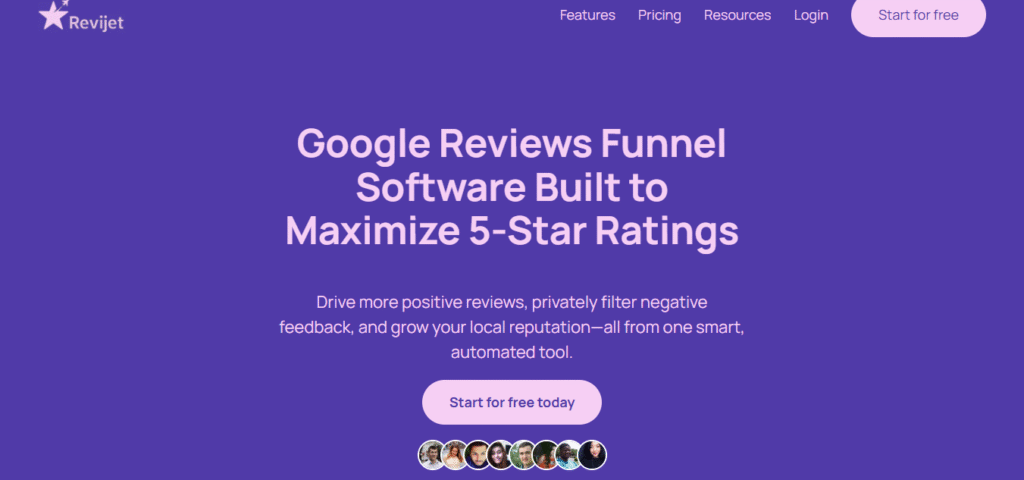
    Screenshot of Revjet's Google Reviews Funnel software homepage

    Revijet is a review automation tool that helps local businesses boost and manage Google reviews through smart funnels, multi-channel requests, AI-generated replies, and a dashboard with analytics for multiple locations.

    Key Features:

    • Automated review requests via Email, SMS, QR code, and WhatsApp (coming soon)
    • Smart review funnel: directs 4–5★ reviews to Google, 1–3★ to private inbox
    • AI-generated review reply suggestions (up to 200 on the Pro plan)
    • Centralized review dashboard with location filtering
    • Analytics for opens, clicks, star ratings, and conversion rates
    • Website widget to showcase the latest 5-star reviews

    Pricing: Revijet offers a Free Plan with 5 email requests and 5 AI replies for 1 location, and a Pro Plan at $10/month (or $96/year) with 100 multi-channel requests, 200 AI replies, and support for extra locations at $6/month each.

    Screenshot of Revjet's subscription options

    Why It Stands Out: 

    Revijet focuses on the most influential local SEO factor: Google reviews. It’s smart funnel helps protect your public rating by automatically filtering low ratings to a private inbox while showcasing glowing reviews.

    Minor Drawbacks: 

    It’s primarily focused on review generation and feedback management, so you’ll still need other tools for broader SEO tasks like keyword tracking or citation building.

    2. BrightLocal – The Local SEO Specialist

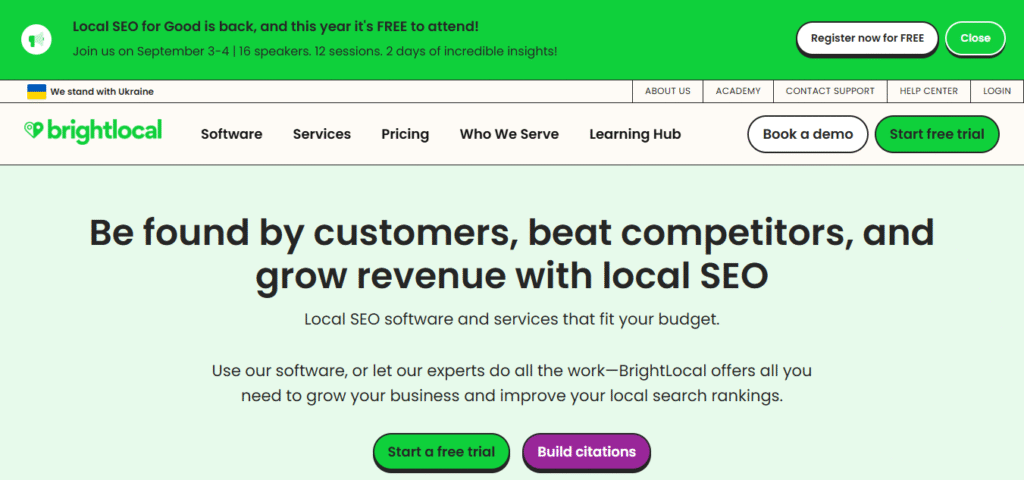
    Screenshot of the BrightLocal website for local business growth

    BrightLocal earned the top spot by doing one thing exceptionally well: local SEO. While other platforms try to be everything to everyone, BrightLocal focuses exclusively on helping businesses dominate local search.

    Key Features:

    • Local rank tracking across Google, Bing, and Apple Maps
    • Google Business Profile management and optimization
    • Citation builder with access to 60+ directories
    • Local SEO audit tool with actionable recommendations
    • Review monitoring and response management
    • White-label reporting for agencies

    Pricing: Starts at $39/month for one location. Manage and Grow plans begin at $49 and $59/month. Higher tiers available (e.g. $79/month for 6–10 locations). It includes a 14-day free trial, so no credit card is needed.

    BrightLocal pricing plans with monthly rates and free trial.

    Why It Stands Out: 

    BrightLocal customizes citation recommendations based on business category and region. Their submission process is manual or semi-automated and includes progress tracking.

    Minor Drawbacks: 

    One thing to note is that you can’t schedule Google Business Profile posts directly through BrightLocal right now. Also, some users say reports can be a bit slow to load at the beginning of the month, but it’s not something that gets in the way of day-to-day use.

    3. Moz Local – The Citation Authority

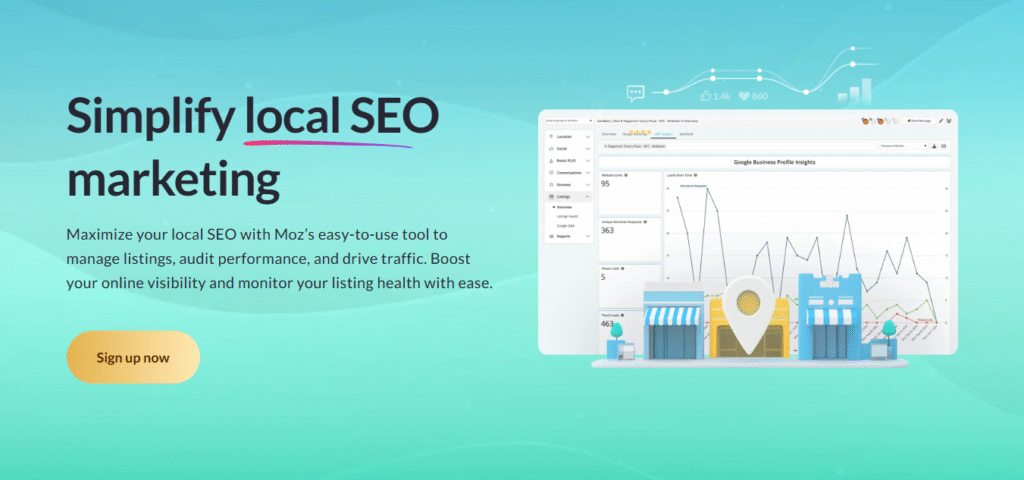
    Moz Local platform for simplifying local SEO

    Moz Local takes a different approach, focusing heavily on citation management and local listing accuracy. Their strength lies in ensuring your business information is consistent across the web.

    Key Features:

    • Automated citation building and monitoring
    • Duplicate listing detection and suppression
    • Review monitoring across 10+ platforms
    • Local visibility scoring
    • Competitive benchmarking
    • Integration with Moz Pro SEO tools

    Pricing: Starts at $16/month per location, with higher-tier plans offering additional features like review management and data aggregator distribution. Discounts may apply for annual billing or multiple locations.

    Moz Local pricing plans starting at $16/month per location

    Why It Stands Out: 

    Moz Local partners with trusted data aggregators like Data Axle (formerly Infogroup), Neustar Localeze, and Foursquare.

    When you update your business info on Moz Local, it gets pushed to hundreds of directories automatically, saving hours of manual work and reducing the risk of inconsistent citations.

    Minor Drawbacks: 

    While Moz Local is excellent for listing accuracy and review monitoring, it doesn’t offer the advanced keyword tracking, backlink audits, or comprehensive local SEO reporting tools found in platforms like SEMrush or BrightLocal.

    4. Whitespark – The Citation Building Specialist

    Whitespark login dashboard with local rank tracking

    Whitespark excels at managing citations and local visibility. Its tools help you discover, build, and monitor listings while offering localized rank tracking, which is ideal if consistent directory presence is your top priority.

    Key Features:

    • Local citation finder with 300,000+ sources
    • Citation building campaigns with progress tracking
    • Local rank tracking with heat maps
    • Review monitoring and alerts
    • Local search audit tool
    • Citation cleanup services

    Pricing: Plans start at $14/month for the Local Rank Tracker and $33/month for the Local Citation Finder, with rates increasing based on campaign size, location volume, or feature tier.

    Why It Stands Out: 

    Whitespark’s Citation Finder has one of the most thorough databases available, spotting citation opportunities most tools miss.

    Its Visibility Heat Map rank tracking shows where in your metro area your business ranks best, perfect for service areas with geo-specific targeting.

    Minor Drawbacks:  

    Whitespark is citation-focused. It doesn’t provide keyword research, backlink auditing, or full-site local SEO analysis like BrightLocal or SEMrush.

    Screw driving? It handles direction. Building complex campaigns? You’ll need other tools.

    5. Yext – The Enterprise Solution

    Yext dashboard with business listings and performance stats

    Yext is a local SEO tool built for large businesses with multiple locations. It helps keep business information accurate and consistent across many platforms like Google, Apple Maps, and Facebook.

    Key Features:

    • Knowledge management across 100+ platforms
    • AI-powered content optimization
    • Multi-location analytics and reporting
    • Advanced workflow automation
    • Integration with major CRM and POS systems
    • Enterprise-level security and compliance

    Pricing: Yext offers annual plans from $199 to $499 per location for small businesses, while larger firms with advanced needs typically pay $500 or more monthly for custom enterprise solutions.

    Yext Local SEO pricing for Emerging, Essential, and Complete plans

    Why It Stands Out: 

    Yext automates listing updates across platforms, making it ideal for businesses with dozens or hundreds of locations. It ensures consistent local data and branding without manual effort.

    Minor Drawbacks: 

    Expensive and built for scale. Small businesses may be better off with simpler tools like Moz Local or BrightLocal.

    How to Implement Local SEO Tools for Maximum ROI

    Choosing the right tool is just the beginning. Success requires strategic implementation that aligns with your business goals and operational realities.

    1. Setting Clear Goals and KPIs

    Start with measurable, specific goals, not vague ones like “improve local SEO.” Instead, aim for targets like “increase Google Business Profile views by 40% in 90 days” or “rank on page one for five local keywords in six months.”

    Focus on metrics that impact your business, calls, visits, and sales, not just rankings. Set up conversion tracking to connect SEO efforts to real outcomes.

    Track leading indicators (like citation completion or review response time) and lagging ones (like traffic and rankings) to get a complete performance picture.

    2. Training Staff for Success

    Even the best local SEO tools are only as effective as those using them.

    Assign a local SEO lead to manage tools like BrightLocal, Moz Local, or Whitespark. They’ll handle setup, troubleshooting, and team support.

    Then, use built-in tutorials and templates to create clear workflows for updating listings, responding to reviews, or tracking rankings. Including screenshots ensures consistency.

    Finally, schedule monthly check-ins using the tool’s reporting features. Reviewing metrics like citation accuracy and keyword trends helps refine your strategy.

    3. Consistent Monitoring and Adjustment

    Local search results shift constantly due to algorithm updates, competitor moves, and evolving customer behavior. As a result, regular monitoring is essential.

    Use tools like Local Viking or GeoRanker to track rankings, citation accuracy, and listings to do this effectively. Instead of reacting to daily fluctuations, focus on weekly or monthly trends. These reveal meaningful patterns and guide smarter decisions.

    Moreover, some industries experience seasonal spikes. Platforms like Semrush or Google Trends help you spot them early so that you can adjust your content or campaigns in advance.

    4. Utilizing Analytics for Continuous Improvement

    Connect your local SEO tools to platforms like Google Analytics and Google Business Profile to measure what’s working.

    This integration links actions like listing updates or keyword tweaks to real results such as calls, website visits, or conversions.

    For instance, if replying to reviews increases calls or a new description boosts click-through rates, the data will show it, helping you refine your strategy.

    Roll out one change at a time when testing updates like new images or business categories. Then, monitor Performance for 4–6 weeks before adding more.

    Final Thoughts on Choosing a Local SEO Tool

    The right tool can turn local SEO into a competitive edge. Revijet, for instance, simplifies review generation and response with AI, helping businesses boost Google reviews and protect their reputation, which are key factors in local rankings.

    Meanwhile, BrightLocal offers an all-in-one toolkit with rank tracking, citations, audits, and review monitoring that is ideal for complete control over local SEO.

    Other tools have niche strengths: Moz Local focuses on citation management, Whitespark excels at discovery and rank tracking, while Yext is best for large enterprises managing complex location data.

    However, tools alone aren’t enough. Choose based on your goals and use them consistently; strategy matters more than software.

    Ultimately, local SEO takes focus and persistence. With 80% of consumers searching locally each week, wise investment beats falling behind.

  • Is Your Local SEO Working? Key Metrics to Verify for Improved Local Visibility 

    Is Your Local SEO Working? Key Metrics to Verify for Improved Local Visibility 

    SEO serves as a critical pillar in customers discovering nearby businesses. Regardless of whether someone is searching for a restaurant, a service provider, or a clinic, visibility plays a key role in local search results. It determines who gets the exposure (the click) and who gets ignored in the long run. 

    However, simply investing your time and money in local SEO will not guarantee success. That’s because algorithms evolve, rankings fluctuate, and competitors continually refine their strategies. So, the real question is not whether you are investing in local SEO, but whether it is actually delivering results that count. Performance tracking allows businesses to refine strategies, identify gaps, and enhance local visibility with absolute confidence instead of merely relying on guesswork. 

    Why Measuring Local SEO Performance Matters 

    Many businesses still assume that their local SEO is doing great if they appear somewhere on Google. This assumption can be costly. Visibility without engagement will seldom turn into leads or revenue. This is where an effective local optimization evaluation walks in. It uses data-driven metrics that show how users find, interact, and convert through your digital presence. Measuring key performance metrics is a vital aspect when discussing investments made in SEO services for local business entities for tangible growth, not vanity rankings. 

    So, in order to evaluate these efforts accurately, you need a set of tools and frameworks. An SEO analyzer allows you to identify technical gaps, track visibility trends, and measure performance against competitors. When measurement is consistent, optimization decisions become much smarter, faster, and more aligned with local search intent. 

    1. Local Search Visibility and Ranking Positions 

    Local visibility is the key factor when it comes to ensuring all local SEO efforts are rightly implemented. If your business fails to appear prominently when users search for nearby services, other metrics lose relevance. Therefore, in this context, we must understand that local SEO tools should be used to evaluate rankings not just for branded keywords but also for non-branded, high-intent local queries. 

    2. Map Pack Rankings 

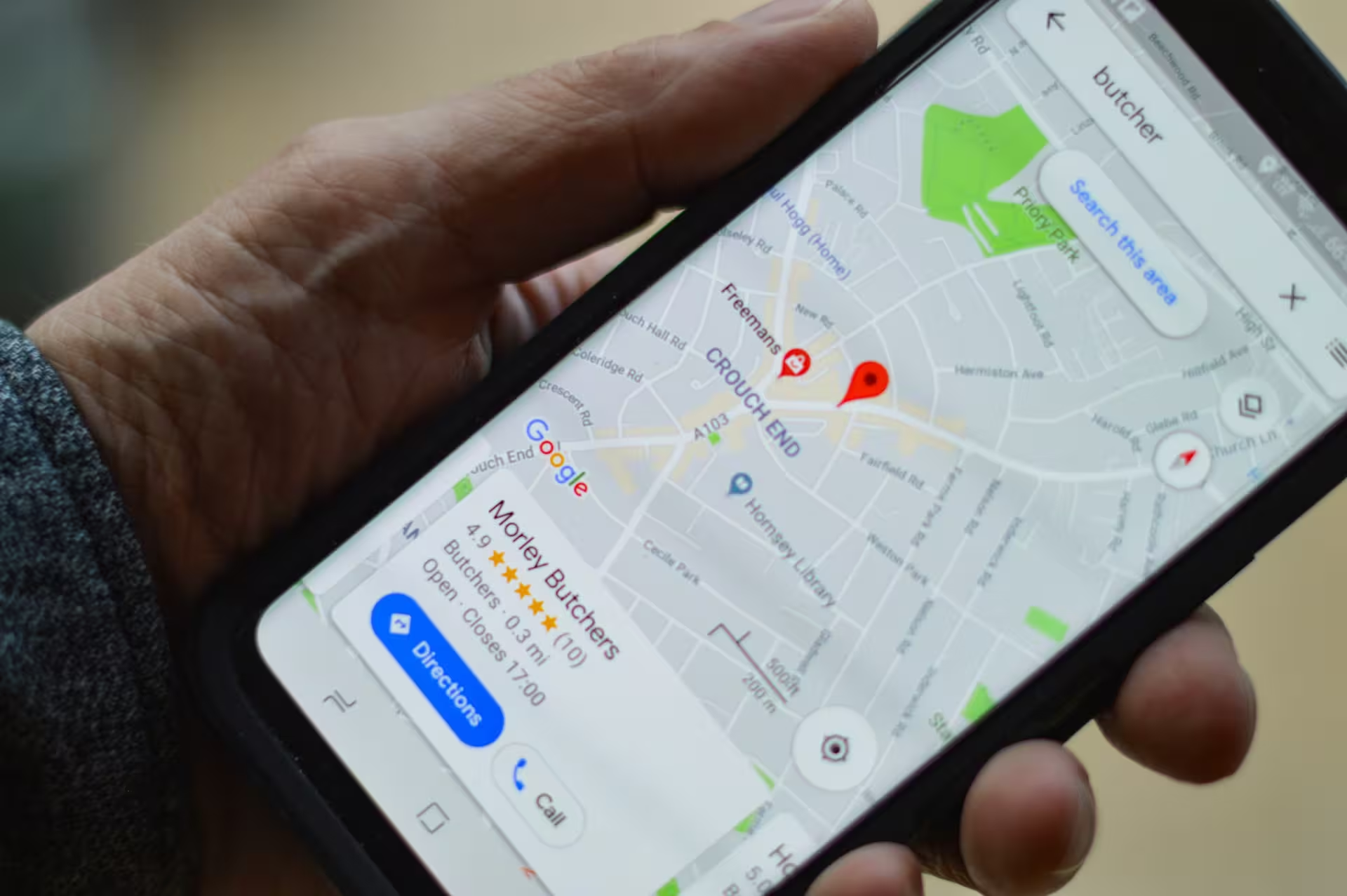
    Do you know that the Google Local Pack drives a significant amount of local clicks? This means that if you are able to track your presence, position, and consistency within the Map Pack, it reveals how well your business is competing locally. Sudden drops may indicate issues with listing, competition, or other algorithm updates. 

    3. Organic Local Rankings 

    In addition to the Map Pack, organic local rankings matter for long-tail searches as well. Tracking keyword movement by location allows you to determine whether on-page optimization and local signals are improving relevance. 

    4. Google Business Profile Performance Metrics 

    Your Google Business Profile is the primary data source for every local search and discovery. Performance insights in this context reflect how users engage with your listing across search and maps. 

    5. Profile Views and Searches 

    Growth in discovery searches is a key indicator of ensuring improved relevance for new audiences. Whether your business’s visibility is expanding depends on how often your listing appears for direct, discovery, and branded searches. 

    6. Actions Taken by Users 

    Well, you must look for calls, website visits, and direction requests as powerful indicators of local intent. These actions are critical, as they show whether visibility is converting into real customer interest and not only passive impressions. 

    7. Website Engagement from Local Traffic 

    This is again one of the most important aspects of the topic we are discussing. An increase in local visibility and SEO success means nothing without website engagement. Rankings are good for attracting visitors, but it is the user behavior that determines whether those footfalls turn into leads. 

    8. Location-Based Traffic 

    So, how do you know nearby users are finding your website? It’s done by analyzing traffic by geographic location. When you find an increase in local sessions, congratulations; you are on the right track. 

    To make the most of this, focus on SEO for local small businesses tactics that help turn local visits into real customers.

    9. Bounce Rate and Time on Page 

    High bounce rates from local search engines are a key indicator of poor user experience and mismatched content. This is where engagement metrics walk in and reveal whether visitors find your local landing pages trustworthy and relevant to what they are searching for. 

    10. Reviews and Reputation Signals 

    Online reviews heavily influence both rankings and customer decisions. Search engines consider authentic and consistent reviews as major trust signals that validate a business’s presence and credibility in the long run. 

    11. Review Volume and Velocity

    This is equally important and undeniably one of the key metrics you must use for improved local visibility. A steady flow of new reviews means you have ‌ongoing customer engagement, which is great. However, sudden spikes or remaining inactive for a long period could raise concerns in terms of originality and relevance. 

    12. Review Quality and Responses 

    If ratings matter, then responses matter even more. Timely, professional responses are considered critical when it comes to showcasing active management. This, as a result, can positively influence both search engines and users. 

    13. Local Citations and NAP Consistency 

    Citations play a pivotal role in reinforcing a business’s legitimacy across the web. A skilled local SEO expert ensures that Name, Address, and Phone (NAP) details remain consistent across directories and listings, because inconsistent information will not only dilute trust but will also impact rankings negatively.

    14. Accuracy Across Directories 

    You must track name, address, and phone number consistency to ensure search engines are confidently associating citations with your business. Even the smallest discrepancy can weaken the local authority. Thus, it is critical that you check and confirm accuracy and relevance across every directory for the best results. 

    15. Authority of Citation Sources 

    The fact remains that quality outweighs quantity. Thus, listings on reputable, industry-specific directories are way more meaningful than dozens of low-quality mentions. 

    16. Conversion Tracking and Lead Quality 

    All said and done, things will go in vain if local SEO cannot drive conversions. You must measure leads in order to ensure visibility turns into viable business outcomes down the road. 

    17. Call and Form Tracking 

    You must track calls, form submissions, and bookings from local pages. Reason? It gives clarity about which keywords and locations generate revenue-driving actions. 

    18. Offline Conversion Attribution

    In-store visits and appointments matter for physical businesses, and there’s no denying the fact. You must focus on linking online actions to offline conversions for a clear ROI picture. 

    Other Helpful Tips

    In addition to each of the aforementioned aspects, you must also track competitor rankings and Map Pack presence, review significant content gaps, and analyze competitor reviews to turn metrics into local growth. 

    Conclusion

    Let’s understand that you cannot measure local SEO success only by rankings. Instead, measure it by ensuring consistent, measurable progress across visibility, engagement, and conversions. Businesses that aim to move beyond assumptions must make timely, informed decisions that enhance local presence and credibility.