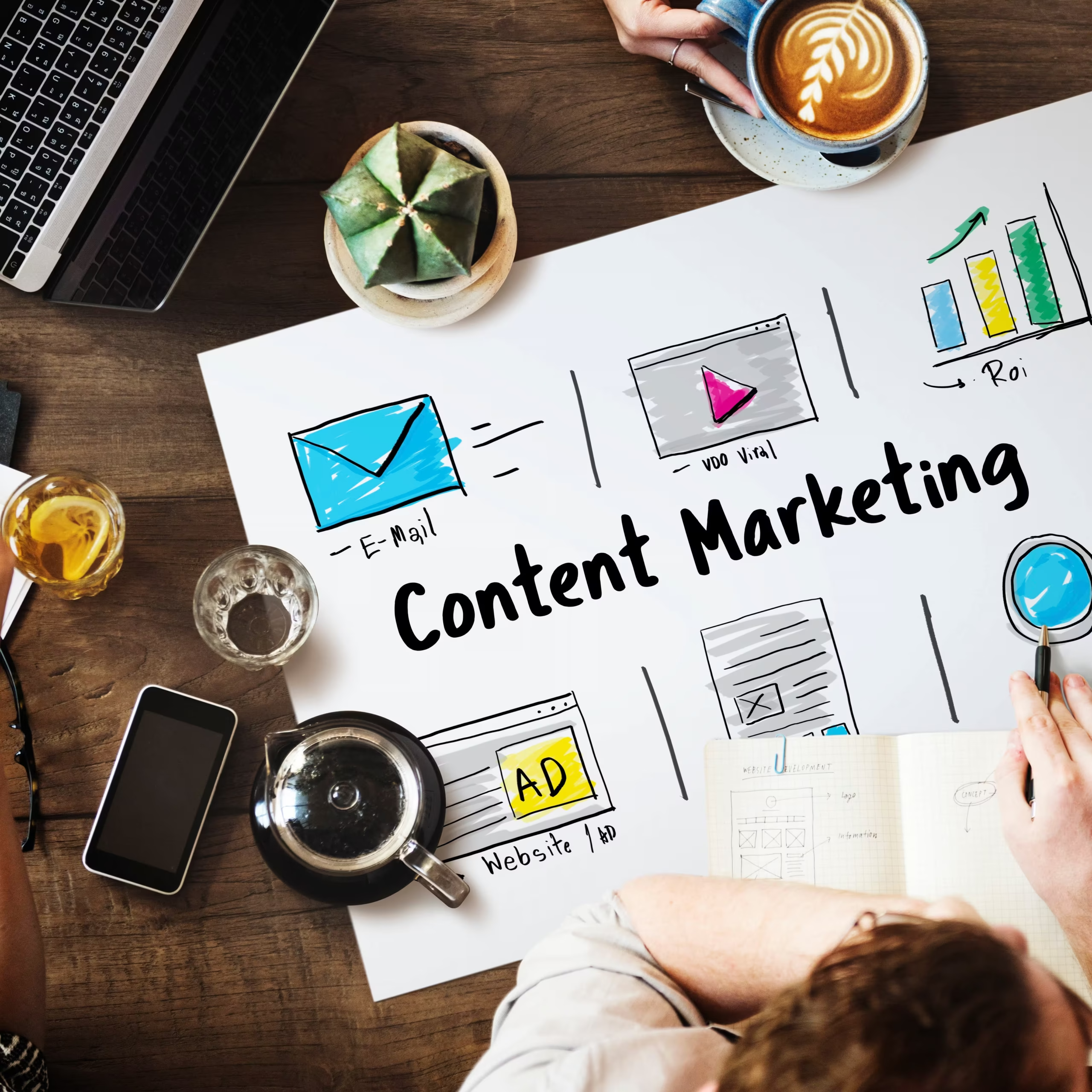
In our current digitally-focused age, the ongoing success of modern enterprises is no longer intertwined just with the quality of the products and services being commercialized. Are you trying to compete with industry professionals, and make a dent in the business dealings of large, national-level organizations? In that case, outside of the R&D of your offerings, you will also need to take measures in order to increase your visibility both for search engine crawlers and target users alike.
Why SEO? Well, in all honesty, it’s all about efficiency. Other digital marketing techniques, such as PPC or email outreach have their own sets of benefits and can be useful for short-term gains or reputational increases. But the issue with other techniques is related to their longevity and cost-efficiency.
A SEO Digital Agency Can Be Your Greatest Asset
Yes, PPC can be a way to increase the visibility of your selected pages for target users. But it will only work as long as you are willing to pay for an active campaign. After your funds dry up and you stop the advertising, chances are that your CTRs will drop dramatically.
This is not the case with SEO, and here is where this digital visibility increase technique actually shines. With the services of an SEO digital agency, you are not trying to make your pages more visible for target audiences via ads.
No, instead, the focus is not on attracting organic traffic by modifying the on-page and backend elements that can increase the visibility of your services for the crawling agents used by search engines. So, in other words, the core belief is that by making your site better, traffic gains will soon follow.
Are There Other Benefits?
Yes, quite many, in fact. The services of an SEO digital agency are not only useful for gaining new traffic. After all, what good does extra traffic do if it doesn’t also result in more interactions with the products and services you commercialize?
A search engine optimization agency will not just be useful for making your pages visible in the SERPs. Its work will contribute to building a compounded digital strategy that will bring consistent, high-quality traffic and interactions from target audiences that are actually likely to try out your offerings.This kind of sustained performance can also play a role in improving your overall marketing agency valuation, as stronger organic visibility and engagement metrics signal long-term business health and scalability.
Unlike with social media or other digital advertising methods, the services of a search engine optimization agency will primarily target users who are actively searching for products, services, or answers to specific queries. For example, let’s say you are a company that sells coffee-making accessories, and you want to expand your operations.
It will be much more efficient to target core customers who utilize keywords relevant to the activities of your company, in their queries, rather than just persuading someone on social media to try out your products via ads. SEO is more efficient, and the results of an SEO campaign, while not exactly quick, have the advantage of getting compounded over time.
Is SEO Still Relevant?
Yes, now more than ever, actually. There’s no denying that the digital medium has undergone some extreme modifications in the last two years or so. AI traffic is up by 527%, and modern digital marketing strategies, SEO included, must nowadays focus extensively on AI overviews and on the sourcing of relevant article data for the crawlers used for the creation of machine learning algorithms. Real talk: it’s not exactly ideal.
The old internet was built on the assumption that users are searching for things they want to see, they click on results relevant to their queries, and then the websites that receive that click can profit from their interactions. That’s changing.
AI overviews have changed the game and now, it is easier than ever to receive the informational data you require without actually clicking on the services provided by SERP-present websites. But where there is change, you can also find opportunities.
The Digital Medium Is Evolving, But Some Things Remain the Same
SEO is now even more relevant than before, as only by ensuring your website is properly configured, do you have a chance of your services and products appearing in AI-generated overviews.
How a SEO digital agency achieves this is not exactly easy to explain in a short post. But what you need to know is this: SEO, in 2026, is perhaps even more important now, for SMEs and SERP-aspiring websites, than it was five or ten years ago.
SEO results compound over time. As a digital marketing technique, SEO is the only real way to keep up with algorithm modifications, and by hiring a search engine optimization agency, you can build the trust and authority signals required for increased SERP presence and alignment with the E-E-A-T guidelines.
It’s All About the Gathered Data
The services of a search engine optimization agency don’t work in isolation. And they are not following a blind formula based on well-wishes and personal inspiration.
No, SEO in the modern digital era is all about gaining the right KPIs for making business decisions that can target market and digital-sphere modifications even before these modifications are visible to rival websites. To achieve this level of precision, many high-growth companies partner with the best data-driven digital marketing agencies to transform raw search metrics into actionable business intelligence.
The services of an SEO digital agency are, in other words, the most efficient and cost-effective way for gaining a measurable visibility boost over competitors.
SEO is trackable and the modifications necessary for boosting organic traffic, conversions and revenue per page can be accomplished with a myriad of different SEO tools.
A Core Pillar of Your Company’s Growth
The offerings of a search engine optimization agency can be utilized for the creation of a library of content that will align with the E-E-A-T framework, and for covering the CWVs necessary to increase the visibility and relevancy of your pages for the crawling agents utilized by search engines.
SEO is not a singular technique. It’s a collection of measures that can be implemented with one specific goal in mind: To increase traffic, interactions, and the profitability of your services/products, while making your site into a better experience for core customers.
Email remains the undisputed backbone of agency-client communication, even as conversational AI and push frameworks saturate the market. For a modern marketing or SEO agency, the inbox is where the “heavy lifting” happens: closing deals, confirming leads, and recovering abandoned carts.
In 2026, developers at these agencies need rock-solid endpoints, account managers require scalable deliverability, and SEO specialists demand analytics they can actually use to prove ROI.
Few platforms stand out by offering more than just “send” buttons. Below, we dive deep into the five most versatile email API providers your agency should have on its radar, explaining exactly how each earns its keep in a high-performance marketing stack.
Why Email APIs Still Matter for Agencies in 2026
Even though the average consumer now filters messages through roughly two separate accounts, email marketing holds its ground as the king of returns. For an agency, that return only manifests when the email API integration is painless. No account manager wants to babysit SMTP logs at midnight or explain to a client why their critical “Welcome” sequence was throttled.
A modern platform must absorb throttling, feedback loops, and ISP quirks out of the box. More importantly, it must allow your team to swap templates or IP pools without opening a support ticket.
The Power of White-Labeling
Branding control is equally vital. Whether you’re sending onboarding invites or monthly SEO performance digests, a uniform look builds long-term trust. This is where a white-label email solution becomes non-negotiable. It masks vendor domains, customizes tracking URLs, and preserves your client’s SPF/DKIM reputation without exposing the underlying infrastructure. By hiding these details, you prevent phishing look-alikes and keep customer-facing links constant even if you decide to switch vendors later.
For this comparison, we focused on five tangible agency metrics:
Raw Sending Speed: Throughput during massive client traffic spikes.
Deliverability Track Record: Success rates across consumer and business ISPs.
Developer Experience (DX): SDK breadth and documentation clarity.
Automation Depth: Advanced segmentation for lead-gen and SEO workflows.
Pricing Transparency: Scalability from free trials to eight-figure sends.
How We Picked the Contenders
Dozens of services claim to be the “best,” but many are just repackaged resellers or single-purpose gateways with zero support. We narrowed our list to options that satisfy the specific “agency triad” which includes Developers, Marketers, and Product Owners.
Our contenders must:
Consolidate Sends: Power both transactional and marketing emails under one roof.
Dual Endpoints: Expose both REST/HTTP and SMTP endpoints for flexibility.
Isolate Data: Offer account-level analytics plus sub-account or workspace isolation for different clients.
Verify Security: Publish uptime reports and SOC 2 or ISO 27001 attestations.
Innovate Fast: Maintain an active engineering blog or changelog—a key indicator of product velocity in 2026.
1. UniOne: The High-Octane Performance Choice
UniOne commands attention through brute performance. Its API-first, event-driven architecture is designed for agencies that can’t afford a second of lag. It processes millions of requests per hour and, more impressively, slides transactional messages into the inbox in about five seconds. For agencies managing client password resets or 2FA codes, that speed is the difference between a conversion and an abandoned session.
The Dev Experience: Integration is nearly instant. You can drop their versatile SMTP endpoint into existing code or move to the JSON-based Web API for deeper control. UniOne avoids bloated SDKs, favoring a clean RESTful approach that lets engineering teams automate email provisioning in minutes.
The Privacy Edge: Their signature advantage lies in data privacy. You can trigger automated journeys—like win-back nudges or trial-to-paid upsells—without uploading the entire recipient list to a third-party server. This is a massive selling point for agencies serving finance or healthcare clients.
Pricing: Straightforward and agency-friendly. The first 6,000 emails per month for four months cost nothing, providing a safe runway for new client pilots. When volume scales, dedicated IPs and 24/7 deliverability experts are just a ticket away.
2. ActiveCampaign: The Orchestration Powerhouse
ActiveCampaign’s superpower is orchestration. For an SEO agency, this is the tool that turns organic traffic into a branching, personalized journey. Imagine a canvas where a website view, a help-desk tag, or a specific purchase triggers a sequence that toggles between email, SMS, and in-app messaging.
The Technical Build: The REST endpoint grants CRUD access to contacts, deals, and custom table rows. This allows your team to pipe a client’s product usage data directly into the platform.
The ROI Proof: According to 2026 CRM benchmarking, piping real-time behavioral data into dynamic segments consistently triples average click-through rates (CTR), pushing them from a generic 2% to a highly targeted 6-9%.
Agency Note: It does carry complexity. The builder is powerful but multi-layered; junior staff might need training. Pricing also scales as you unlock “predictive” AI features, so budget proactively.
3. Brevo (formerly Sendinblue): The Margin-Friendly Multi-Channel Hub
Brevo flipped the SaaS model by billing for emails sent, not contacts stored. For agencies managing clients with massive (but occasionally dormant) lists, this is a lifesaver for the bottom line. You can collect 100,000 contacts on the free tier without sweating overages.
Unified Dashboard: From one place, you can dispatch transactional SMTP, promotional blasts, SMS, WhatsApp, and push notifications. Their new 2026 AI assistant drafts subject lines and content blocks aligned to a specific brand voice, trimming creative cycles.
The Workflow: Technical teams love the straightforward JSON schema, while marketers appreciate the drag-and-drop editor. While its send speeds trail UniOne, its throughput is more than sufficient for weekly digests and post-purchase surveys.
The Verdict: If you need multichannel reach and low-maintenance automation with transparent costs, Brevo is a top-tier choice for SMB agencies.
4. MailerLite: The Designer’s Favorite for Agility
While other platforms feel like a maze, MailerLite champions minimalism. It is designed for the agency that needs to launch branded campaigns fast without sacrificing technical depth.
For Developers: Programmatically add subscribers or trigger campaigns with intuitive REST calls. Front-end engineers love the embedded form generator—it outputs lightweight code that doesn’t hurt a client’s Core Web Vitals or SEO rankings.
For Designers: The drag-and-drop builder feels like Figma—smooth, fast, and loaded with modern blocks like countdown timers and dynamic product grids.
The Growth Factor: New in late 2025, “MailerLite Sites” lets agencies spin up gated pages and sell digital downloads without leaving the dashboard. With a free plan covering 1,000 subscribers, it’s the darling of boutique agencies and indie developers.
5. Mailchimp: The E-commerce Operating System
Mailchimp is the “safe bet” with the most brand recognition among clients. Since its acquisition by Intuit, it has shifted from a simple tool to a full-scale marketing operating system, folding in QuickBooks data and deep e-commerce analytics.
Transactional Reliability: The Mailchimp Transactional API (formerly Mandrill) is a gold standard for receipts and OTPs. Developers can slide the node-mandrill SDK into a serverless function and be live in minutes.
AI Creative: Their AI-driven Creative Assistant automatically generates branded headers and alt-text, ensuring every client send is accessible and visually consistent.
The Downsides: Pricing tiers grow expensive once you pass 50,000 contacts, and list management rules are more rigid than newer competitors. However, its deep Shopify and WooCommerce integrations make it nearly essential for e-commerce agencies.
Picking the Right Fit for Your Agency Stack
Selection depends on your specific client roadmap and regulatory needs. Ask your team:
Do we need sub-second latency for tech-heavy clients? Choose UniOne.
Is complex, multi-channel nurturing our core offering? Go with ActiveCampaign or Mailchimp.
Are we cost-sensitive with unpredictable list growth?Brevo is the move.
Do we want junior staff to own campaigns with zero training?MailerLite is the winner.
Implementation Tips for 2026
To truly thrive, treat your email provider as a programmable component, not a black box.
Version-Lock Endpoints: Pin minor versions to avoid silent breaking changes during vendor updates.
Automate Warm-ups: Codify your IP warm-up ramps in Terraform or Ansible so client reputations stay stable from day one.
Stream Events to a Lake: Pipe webhook payloads into BigQuery or Snowflake. Attaching user-ID joins allows you to create high-level BI dashboards without manual CSV exports.
Stay Audit-Ready: Log every template change and suppression update. When a client asks about region-locking or retention, you should have the answer in seconds via Grafana or Looker.
Don’t Skip BIMI: In 2026, verified logo cues are essential. Displaying a verified BIMI logo next to your subject line increases brand recall by 120% and purchase likelihood by 34%.
Final Thoughts
The best email API for your agency in 2026 isn’t the one with the biggest logo; it’s the one that frees your team from infrastructure babysitting while boosting the metrics that keep clients paying.
UniOne brings speed; ActiveCampaign brings logic; Brevo brings reach; MailerLite brings charm; and Mailchimp brings the ecosystem. Map your agency’s growth strategy against these strengths, pilot them ruthlessly, and choose the cockpit that will sustain your client relationships well into the next tech cycle.
Most of the SEO tactics that dominated the last decade have quietly lost ground. Directory submissions stopped moving rankings in 2020. Comment-linking hasn’t worked in five years. Private blog networks keep triggering manual actions. What’s survived, and actually strengthened, is editorial guest posting on real publications with real audiences. For SEO teams trying to build durable traffic rather than short-term spikes, this is the tactic that keeps performing quarter after quarter.
Photo by Atlantic Ambience on Pexels
The reason comes down to what Google now weights. Authoritative contextual backlinks from relevant publications remain one of the strongest ranking signals, and they’re increasingly hard to fake. That’s why using a guest posting service to build traffic to your site sits closer to the center of serious SEO strategies than it did five years ago. The approach isn’t glamorous, but it’s measurable and repeatable. Here’s how teams actually use it.
Why Does Guest Posting Still Work in 2026?
Three reasons the tactic has stayed effective while others have fallen away.
The first is signal scarcity. Because bad link tactics keep getting devalued by Google’s algorithm updates, the pool of “legitimate” link signals keeps shrinking. Editorial placements on real publications stand out more than ever because there’s less noise around them.
The second is search context. Google’s AI-powered features, Search Generative Experience, AI Overviews, and the increasingly personalized results, pull from pages that are mentioned authoritatively elsewhere. A guest post on a relevant publication is exactly the kind of “authoritative third-party mention” these systems prefer.
The third is traffic compounding. A well-placed guest post doesn’t just produce a backlink, it can drive referral traffic for months or years after publication, especially on publications that rank well for their niche keywords. That dual benefit (SEO plus direct traffic) is rare among link-building tactics.
What Makes a Guest Post Worth the Effort?
Five quality markers separate genuinely valuable guest posts from ones that waste budget:
Publication topical relevance. The publication’s audience should overlap materially with your target customers. Tangential industries don’t count.
Editorial control by a real team. Sites that publish anything for money aren’t editorial. Sites with editors who reject weak pitches are.
Contextual link placement. The backlink should appear in body text where it adds genuine reader value, not in a bio box or footer.
Descriptive anchor text. Generic “click here” links are dead weight. The anchor should describe what the link points to.
Natural publication cadence. Sites with a long history of guest contributors look natural to Google; new sites that suddenly start accepting paid placements don’t.
Any one of these missing is a warning sign. Two missing means the placement is probably net-negative for your SEO even if the link goes live. The Click Raven guide on bad links is a useful checklist for ruling out toxic sources before committing to a placement.
How Should You Measure Guest Post Value?
Photo by Polina on Pexels
Three metrics worth tracking on every placement are:
Domain diversity
A guest post from a publication you haven’t earned a link from before is more valuable than a second or third placement on the same site. Most SEO teams target 80 percent new referring domains per month.
Organic traffic delta on linked pages
The page the guest post links to should show measurable ranking improvement and traffic lift within 3 to 6 months. If you’re placing consistent guest posts with strong anchors and nothing moves, something upstream in the strategy is broken.
Branded search volume
Guest posts on tier-1 publications typically lift branded searches (people searching your company name) within 2 to 4 weeks of publication. That’s a leading indicator for the downstream conversion impact.
According to Google’s guidance on link best practices, the signals search engines value most are the signals that come from genuinely earned placements, which is exactly what a well-executed guest posting program produces.
What Are the Common Mistakes?
Here are some of the failure modes to avoid:
Picking publications by DR alone. A high-DR irrelevant site is less valuable than a medium-DR relevant one
Writing for the link rather than the reader. If the article’s only purpose is housing the link, editors will reject it
Over-optimizing anchor text. Exact-match commercial anchors on every placement looks algorithmic; vary it naturally
Publishing in bulk. Twenty placements in one month looks more suspicious than twenty placements spread across six months
Ignoring post-publication promotion. A placement that gets zero social amplification signals the site isn’t actually invested
Skipping link monitoring. Guest posts sometimes disappear. Check quarterly that your links are still live
Editorial guest posting outperforms most other link-building tactics for durable ranking gains
Five quality markers separate valuable placements from ones that waste budget
Track referring domain diversity, traffic deltas, and branded search lift to measure real value
Most common mistakes are avoidable with clear quality criteria and a steady cadence
Consistent publishing over 6+ months produces better outcomes than any short-term push
The Bottom Line for SEO Leaders
Guest posting is one of the few tactics where the ROI has genuinely improved over the last five years. Less competition for high-quality placements, stronger algorithmic weighting of editorial signals, and better measurement tooling make it the cornerstone of most serious SEO programs. For teams still treating it as a side experiment, the data is now clear enough that it belongs at the center of the link-building strategy.
Frequently Asked Questions
How many guest posts per month does a growing brand need?
Six to twelve high-quality placements per month is the range most established SEO teams target for consistent growth. For more on sizing the monthly number to your niche, see the Click Raven guide on monthly backlink volume. Quantity below four creates slow progress; above fifteen starts to look unnatural to Google’s quality systems.
Can small businesses do guest posting in-house or should they outsource?
For businesses under ten employees, outsourcing usually wins on cost and speed. Outreach and relationship management is time-intensive work that specialized agencies do faster than in-house teams can ramp.
What’s the typical cost per guest post placement?
Quality placements run $200 to $1,500 each depending on the publication’s domain rating, topical fit, and audience size. Tier-1 business publications run higher; niche industry blogs run lower.
How long until guest posting impact shows in organic traffic?
Three to six months is typical for measurable ranking movement, with full impact visible in the six-to-twelve month window. Short-term spikes are unusual; the value is in the compounding effect over time.
The search engine optimization industry stands at pivotal crossroads with the widespread adoption of AI into different industries.
As for your SEO strategy: the question is now whether AI SEO agents are it or not? The answer, is neither simple nor uniform, as we’ll see here.
The global AI SEO software tool market is estimated to reach $4.97 billion by 2033 from $1.99 billion in 2024, indicating massive industry investment and adoption.
In this article, I examine the role of AI in SEO teams, weighing the significant advantages against their inherent limitations.
Traditional SEO vs AI SEO Agents Comparison
The role of SEO professionals is shifting from manual execution to strategic oversight and AI collaboration.
Before AI SEO agents, SEO specialists handled all optimization tasks manually, requiring significant time and expertise across multiple areas.
Here is a comparison of the core traditional SEO roles with what AI SEO agent can do.
SEO Task
Traditional SEO Approach
AI SEO Agent Capability
Status
Technical Audits
Manual crawling with tools like Screaming Frog, manual issue identification and prioritization
Automated site scanning, instant issue detection, automated fix suggestions
✅ Fully Automated
Keyword Research
Hours of manual research using multiple tools, manual competitor analysis
The integration of AI SEO agents is reshaping the structure, roles, and dynamics of SEO teams across organizations of all sizes.
With a projection of 92 % of companies planning to increase their AI investments within the next 3 years, the implications for SEO professionals remain complex and multifaceted
Transformation of Team Roles and Responsibilities
Senior SEO professionals are evolving into AI strategy managers who oversee multiple agents and ensure alignment with business objectives.
New positions like Quality Assurance Specialists emerge to monitor AI output and maintain brand consistency.
Organizational Structure Evolution
The organizational impact varies significantly by company size.
Small-to-medium businesses can now achieve enterprise-level SEO results with a single professional supported by AI agents.
Large enterprises are developing hybrid models where AI manages routine operations while humans focus on strategy and innovation.
SEO agencies are experiencing the most dramatic changes, either adopting AI-first models to serve more clients with smaller teams or pivoting to high-touch strategic services that complement automation.
Skills Development and Training Requirements
Organizations must invest heavily in team development to succeed with AI integration.
AI literacy training for all team members.
Prompt engineering skills to effectively communicate with the AI agents
Creative problem-solving capabilities
Performance Measurement and Management
Organizations must develop hybrid metrics that fairly assess both human contributions and AI agent performance.
Team management becomes more dynamic, requiring regular optimization of human-AI collaboration patterns and workflow adjustments based on performance data. Leveraging enterprise project management software can help streamline these adjustments and track collaboration efficiency over time.
You need to organize an effective team meeting on mutually agreed time. Group meeting scheduler tools like Whenavailable helps management to find availability of every team member.
Pros of Using AI SEO Agents
Speed and Efficiency
AI SEO agents can complete tasks in minutes that traditionally took hours or days. Keyword research, content optimization, and technical audits that once required extensive manual work are now automated and instantaneous.
24/7 Operation
Unlike human specialists, AI agents work continuously, monitoring rankings, tracking algorithm changes, and implementing optimizations around the clock without breaks or downtime.
Consistency and Accuracy
Eliminates human error in repetitive tasks like meta tag optimization, schema markup implementation and technical audits, ensuring consistent quality across all site pages.
Cost Effectiveness
Significantly reduces the need for large SEO teams, lowering operational costs while maintaining or improving output quality and speed.
Comprehensive Coverage
Can simultaneously handle technical SEO, content optimization, keyword tracking, competitor analysis and reporting without the specialization limitations that human teams often face.
Predictive Analytics
Advanced AI can forecast trends, predict algorithm changes, and recommend proactive strategies based on historical data patterns.
Personalization at Scale
Can create personalized SEO strategies for different audience segments, locations or user intents simultaneously across large websites.
Cons: Limitations and Challenges
Over-Optimization Risk
Without human oversight, AI agents might over-optimize content, creating unnatural keyword stuffing or sacrificing user experience for search rankings.
Relationship Building Deficiency
Link building and digital PR still require authentic human relationships.
These agents cannot genuinely network, build trust with publishers, or handle complex negotiations that require emotional intelligence.
Context and Nuance Misunderstanding
AI may miss subtle context clues, cultural nuances, brand voice requirements, or industry-specific considerations that human specialists intuitively understand.
Ethical Blind Spots
AI agents might engage in manipulative SEO tactics or ignore ethical considerations if they are not well calibrated with the industry guidelines.
Dependence on Data Quality
Poor or outdated data inputs lead to poor outputs.
They can perpetuate biases, make incorrect assumptions, or fail when encountering scenarios outside their training parameters.
Case Study: Advanced AI Integration
Modern AI SEO platforms like ClickRaven demonstrate sophisticated integration capabilities that illustrate the potential for human-AI collaboration.
ClickRaven AI SEO Agent exemplifies this by understanding entire site structures, building visual topical maps, identifying content gaps, and suggesting semantically relevant internal links.
Such systems show how AI can enhance rather than replace human strategic thinking, enabling teams to focus on high-level strategy while AI handles comprehensive analysis and implementation tasks.
This same principle applies beyond SEO. In high-stakes environments like post-merger integration, automation without context can create more risk than value. The most effective operators combine deep discovery, phased execution, and human judgment with technical systems that scale. For teams navigating complex integrations across CRM, ERP, and operational systems, the focus isn’t speed alone; it’s continuity, adoption, and risk control. To see how this philosophy is applied in practice, you can learn more.
Conclusion
The question of whether AI SEO agents represent the future of SEO teams cannot be answered with a simple yes or no. The evidence suggests a more nuanced reality.
The rapid growth of the AI SEO market, combined with increasing business adoption and continuous technological advancement, suggests that this transformation is accelerating. Already, 85% of marketers use AI tools for content creation.
The most successful implementations combine AI capabilities for data processing and automation with human oversight for strategy, creativity, and quality assurance.
AI SEO agents offer unprecedented capabilities that go far beyond simple automation or executing predefined tasks.
These intelligent systems are autonomous entities capable of learning, reasoning, and making strategic decisions to achieve specific SEO objectives.
Understanding how these systems work is crucial for digital marketers and SEO professionals who want to leverage this technology effectively.
With this comprehensive breakdown, I’ll explore the inner workings of AI SEO agents to their core architecture to understand why they are vital to your SEO strategy.
What are AI SEO Agents?
Not every automation qualifies as an AI agent.
AI agents are autonomous systems that operate with a clear understanding of an end goal and the resources needed to achieve it.
In the context of SEO, these agents are specifically designed to optimize websites and content for search engines through intelligent automation and decision-making.
Tools such as KIVA, Allie AI, Click Raven etc., are AI SEO agents while ChatGPT, Claude and perplexity are termed as LLMs.
Unlike traditional SEO tools that require manual input and interpretation, AI SEO agents can:
Operate Autonomously
Process Multi-dimensional Data
Adapt in Real-time
Execute End-to-end Workflows
The Typical Workflow of an AI Agent
1. Data Collection and Analysis
The effectiveness of AI SEO agents heavily depends on their ability to collect, process, and analyze vast amounts of diverse data.
AI SEO agents collect data from numerous sources simultaneously:
Search Engine Data: These agents directly integrate with Google Search Console, and other search engine APIs to get real-time access to search performance, click-through rates, impression data, and all the industry trends.
Analytics Platforms: Information from Google Analytics, Adobe Analytics or other web analytics tools enables comprehensive understanding of user behavior, conversion patterns, and traffic sources.
Competitor Intelligence: Automatically monitors competitor websites, content strategies, backlink profiles, and ranking performance to get crucial market context.
2. Advanced Data Processing
An AI SEO agent can easily analyze over 10000 pages, recommend actions to take and implement the same all in the span of a day or hours.
They use advanced algorithms, including machine learning and natural language processing to analyze large volumes of data.
This is achieved through:
Pattern Recognition: Machine learning algorithms identify complex patterns in search behavior, seasonal trends and performance correlations.
Sentiment Analysis: They use NLP to analyze user reviews, social media mentions and content engagement to understand audience sentiment and preferences.
Predictive Modeling: They analyze historical data and current trends to forecast future search patterns. This foresight allows you to create content and optimize for keywords before they peak, positioning you as a leader rather than a follower in your industry.
Real-time Processing: AI SEO agents can process and act on information in near real-time, enabling rapid response to algorithm changes or competitive moves. This same real-time adaptability is also seen in other AI-driven systems, such as AI-powered sales automation platforms, which respond dynamically to shifts in customer behavior and engagement signals.
For example, when Google releases a major core update, some businesses face immediate ranking losses.
With AI SEO agents you can detect these anomalies in near real-time, prioritize fixes based on impact and automate the responses to help recover rankings faster.
3. Data Quality Validation
AI SEO agents implement sophisticated data quality controls to ensure the accuracy and reliability of their analysis through;
Cross-source Verification: Information is validated across multiple data sources to identify and correct inconsistencies.
Statistical Confidence Testing: Agents apply statistical methods to determine the reliability of observed trends and patterns.
Outlier Detection: Automated systems identify and investigate unusual data points that might indicate errors or significant changes.
4. Decision-Making Frameworks
These systems must evaluate complex, multi-variable scenarios and make strategic choices that align with business objectives.
They employ various techniques such as:
Goal-Oriented Reasoning which involves operating within clearly defined objective frameworks that guide their decision-making processes.
Multi-Criteria Decision Analysis by weighing the impact, resource requirements and risks of a certain action over another.
Contextual Adaptation based on the data they process and the outcomes of their previous decisions to respond to industry-specific optimizations.
5. Implementation
These systems bridge the gap between analysis and action. The execution of content strategies happens on different levels:
Direct Implementation: For organizations comfortable with full automation, agents can directly implement optimizations through CMS integrations, API connections and automated deployment systems.
Approval Workflows: For more conservative approaches, agents can prepare optimization recommendations and await human approval before implementation.
Hybrid Execution: The agents handle routine optimizations automatically while escalating strategic decisions or significant changes for human review.
6. Learning and Adaptation Mechanisms
As they gather more data and learn from the outcomes of their actions, these agents continuously refine their strategies over time.
This iterative process allows them to stay ahead of the curve with up-to-date information. They learn through:
Supervised Learning
Agents learn from historical data where outcomes are known, developing patterns that connect specific optimization actions with successful results.
This enables them to predict which strategies are most likely to succeed in similar circumstances.
Reinforcement Learning
Through trial and error, agents learn to optimize their decision-making by receiving feedback on the success or failure of their actions.
Unsupervised Learning
Agents can identify hidden patterns and relationships in data without explicit guidance, potentially discovering new optimization opportunities that weren’t apparent through traditional analysis methods.
Core Components of an AI SEO Agent
AI SEO agents are built on sophisticated architectures that combine multiple advanced technologies.
1. LLMs For Reasoning and Conversation
Modern AI SEO agents typically use advanced language models like GPT-4, Claude as their reasoning engine.
These LLMs enable the agents to understand natural language queries, generate human-like content, interpret search intent and user behavior patterns .
2. Memory Systems
Memory sytems like Pinecone or Redis allow them to store historical performance data, trend analysis and build comprehensive knowledge bases about specific industries or niches.
3. Tool Integration Framework
Most AI agents integrate with other tools to access keyword research databases, analytics platforms, and social media platforms for direct implementation and analysis, making it easier for marketers to build AI agent workflows that connect data insights with real-time execution.
Conclusion
The architecture of modern AI SEO agents like Click Raven enables them to process vast amounts of data, identify complex patterns, and implement strategic optimizations at scale.
Click Raven AI SEO agent‘s ability to operate across multiple dimensions simultaneously, from technical SEO improvements to content strategy and competitive analysis, makes it an invaluable tool for businesses looking to maintain competitive advantage in organic search.
The learning and adaptation capabilities of these agents ensure that they become more valuable over time.
This creates a compound advantage for organizations that implement these systems early and allow them to accumulate experience and insights.
There has been a rapid increase in AI-powered search experiences like ChatGPT, Perplexity, and Google’s evolving Search Generative Experience (SGE).
And businesses and content creators are facing a stark reality: ranking well in traditional search results is no longer the sole path to online discoverability.
Leaders must now rethink their content through two distinct, yet interconnected lenses: SEO and GEO.
What is SEO?
Search Engine Optimization (SEO) is the well-established practice of improving a website’s visibility and ranking in traditional SERPs to drive organic traffic and ultimately, conversions.
Here is a visual example of the traditional SEO ranking system of blue links that direct users to your page.
The primary audience for traditional SEO has always been human searchers using platforms like Google, Bing and YouTube.
Its evolution traces back to the early days of the internet, when basic algorithms analyzed keywords to determine relevance.
Over decades, SEO has matured into a complex discipline, built upon these core pillars:
Technical SEO: Ensuring a website is crawlable, indexable and has a healthy technical foundation (e.g., site speed, mobile-friendliness, structured data implementation).
On-page SEO: Optimizing individual web pages for specific keywords and user intent (e.g., title tags, meta descriptions, headings, content quality, internal linking).
Off-page SEO: Building authority and trust through external signals like backlinks from reputable websites, brand mentions, and social signals.
Content Strategy: Creating authoritative and engaging content that answers user queries and satisfies their needs.
What is GEO?
Generative Engine Optimization (GEO) is the newer and more nuanced process of making your content retrievable, referenceable and directly cited by AI engines and large language models (LLMs).
Unlike traditional SEO, which aims to get users to click on your link, GEO aims to have your content become the answer, or at least a highly credible source for an AI-generated answer.
To visualise the current AI search, here’s a screenshot that shows an AI overview summary on the left and the relevant cited pages on the right.
The audience for GEO is fundamentally different: it’s AI models themselves and by extension, the users interacting with AI agents and conversational interfaces.
With GEO, the focus shifts from keywords in isolation to a deeper understanding of structured data, chunked facts, machine-readable formats and pervasive brand mentions.
Key Differences Between SEO and GEO
While both SEO and GEO aim for online visibility; their approaches, targets, and success metrics diverge significantly.
Here’s a breakdown of their core differences:
Element
SEO
GEO
User Intent
Human search queries (e.g., “best running shoes”)
AI prompts, conversational queries, and agent tasks
Ranking Mechanism
Indexing + Algorithmic SERP ranking
Retrieval + LLM reasoning and summarization
Optimization Target
Search engine crawlers (Googlebot, Bingbot)
Large Language Models (LLMs) like ChatGPT, Claude, Gemini, Perplexity
Format Focus
Optimized webpages, meta tags, links, comprehensive articles
Data chunks, clean facts, structured formats (schema, tables, FAQs)
Mentions, citations, direct answers, embeddings, brand visibility within AI responses
How GEO Impacts the Modern Marketing Funnel
AI assistants fundamentally alter the traditional marketing funnel by introducing a new, critical discovery layer: zero-click discovery.
A study by Wordstream shows that 58% of Google searches now result in zero clicks as consumers bypass traditional search results entirely.
An example is when I asked an AI assistant: “What are the best noise-canceling headphones for travel?”
Here is a snippet of the response from a list of 10 items ranked by quality:
This shows that if your brand’s content isn’t visible to AI or detailed in a way that’s digestible by LLMs, you’re missing a massive chunk of the early-stage consumer journey.
How SEO and GEO Work Together
SEO and GEO are not mutually exclusive. Here is how they complement one another:
SEO Feeds GEO: Well-structured and optimized content that is easy for crawlers to understand and organize is more likely to be pulled into AI-generated summaries.
Programmatic Content For Dual-Purpose: Content generated programmatically for SEO scale (e.g., thousands of product variations or location pages) can be designed with GEO in mind to serve traditional search intent and AI prompts.
Brand Consistency and Trust: Both SEO and GEO benefit immensely from a consistent brand message, strong trust signals (E-E-A-T) and factual clarity.
Practical Steps for Marketing Leaders
Marketing leaders must employ sound strategies to prioritize both SEO and GEO initiatives.
Conduct a meticulous keyword mapping to ensure you’re targeting relevant human queries.
Leverage Programmatic SEO for Scale
Programmatic SEO is an efficient way to create content at scale when used strategically.
Otherwise, you run the risk of creating thin content that does not appeal to user intent.
Companies like Zapier have created thousands of landing pages for each product they integrate with using programmatic methods.
Monitor Traditional SERP Shifts
Continuous monitoring of your site is essential. A Semrush study indicates that AI search visitors could surpass traditional search visitors by early 2028 or sooner.
Keep a close eye on how Google’s AI Overviews and other generative features are impacting your organic clicks using tools like Ahrefs and Semrush.
For GEO:
Structure Content Relentlessly
Break down complex information into easily digestible “fact blocks” that AI can readily identify and utilize.
Implement JSON-LD schema markup meticulously.
Use HTML tables, bulleted lists, and clear FAQ sections.
Cultivate Brand Mentions Across Trusted Third-Party Sources
AI models value collective intelligence and established authority.
With strategic PR, you can:
Secure positive reviews on industry-leading platforms.
Build a strong network of brand citations on high-authority websites.
Test Your Content’s Visibility in AI Platforms
Don’t just assume.
Actively search for your brand, products, and key topics in ChatGPT, Perplexity, Claude and Google’s AI Overviews.
Map out when and how your content is cited (or not cited) by these AI models.
Publish Original Research and Definitive Guides
To stand out, create content that offers:
Unique insights and perspectives
Proprietary data
Definitive answers to complex questions
GEO Tools and Metrics to Track
The measurement landscape for GEO is still in its early stages but rapidly evolving.
Here are some tools to consider:
1. Perplexity Pages / Pro Search
This tool enables SEO professionals to research topics, create comprehensive content pages, and reference their own websites for link building.
2. ChatGPT with Browse
It analyzes existing content to identify optimization opportunities and generates SEO-optimized content by browsing current web data.
When Browse is enabled, observe if ChatGPT directly links to or summarizes your content.
3. LLM Retrieval Simulators
These tools test and simulate how LLMs retrieve and process content for AI-powered search results from your site.
4. AI Visibility Tools
Platforms like Writesonic’s GEO, Profound, Peec AI, and Keyword.com are specifically designed to track brand mentions and visibility within AI-generated responses across various LLMs.
They can help you monitor citation frequency, prominence, and even sentiment.
5. Semantic SEO Tools
These tools analyze entities, topics and relationships (beyond just keywords) to improve AI comprehension.
The metrics to track include:
The frequency of brand/content citations in AI outputs
The position of your content within AI-generated summaries
Sentiment of the AI references
The types of queries that trigger your content as an AI source
The Future: From SEO Teams to Visibility Teams
The traditional “SEO team” must transition into a broader “AI Visibility Team.”
This requires new skill sets and a reimagined workflow:
Content Engineers
These professionals are essential for structuring content for machine readability and scalability.
AI Prompt and Retrieval Optimizers
These are specialists who understand how users phrase queries to AI and how AI models retrieve information, enabling them to fine-tune content for optimal AI response.
Data Structuring Experts
These professionals are skilled in implementing schema, creating robust content models and ensuring data integrity across complex content systems.
Success will depend on how effectively organizations can structure their knowledge base to be consumed and cited by intelligent agents, not just crawled by traditional search bots.
The Brands That Adapt Win
The future of search is no longer just a list of blue links; it’s a combination of AI summarized answers, intelligent agents and interactive AI interfaces.
While traditional SEO is still essential for driving conversions at the final stage of the customer journey, GEO is rapidly becoming critical at the initial, zero-click discovery phase powered by AI.
Marketing leaders must recognize this shift and invest in both SEO’s foundational principles and GEO’s advanced content structuring to double their rewards; visibility and conversions.
Content consumption is at an all-time high with YouTube, a leading video platform, having approximately 2.7 billion monthly active users as of early 2025.
From detailed video tutorials to hour-long podcasts, Youtube offers a wealth of information.
The only challenge is that sometimes, it can be quite an endeavour navigating lengthy videos among the many looking for one specific answer to your particular question.
Enter ChatPT, its quick-fire text based outputs are tidily summarized and above all, direct answers to your questions.
Hence the question, can ChatGPT summarize a YouTube video?
Yes! ChatGPT can help decipher through a long video and give you a brief summary of its content but with some conditions in place.
It is important to remember that ChatGPT is a text-based AI, therefore, it can’t “watch” a video in the traditional sense and tell you what it is about.
However, with the right approach, it can be an incredibly powerful tool for extracting the essence of video content.
In this article we will discuss:
ChatGPT’s capabilities and limitations when working with YouTube video content
Three practical methods for summarizing YouTube videos using ChatGPT:
Direct transcript copying and pasting
Browser extensions and third-party tools
Advanced API integration and custom scripts
Step-by-step instructions for extracting YouTube transcripts with real examples of the process and prompt engineering techniques you can try on your own.
By the end of this guide, you’ll have a complete toolkit for leveraging ChatGPT to efficiently digest and extract key insights from YouTube video content and save time without watching hours of footage.
What ChatGPT Can and Can’t Do
Before we get into how ChatGPT can help you summarise that long Youtube lecture on dentures, it’s vital to understand its inherent capabilities and limitations.
What ChatGPT Can Do: Working with Text
ChatGPT’s power lies in processing and understanding written language. To summarise your Youtube videos, ChatGPT can:
Summarize YouTube transcripts if provided: This is its primary mode of operation for video content.
If you give ChatGPT the full text of a video’s dialogue, it can analyze it then generate a concise summary.
Interpret timestamps, captions, or scripts pasted into the chat: Beyond just raw transcripts, adding specific timestamps with brief descriptions or a pre-written script for a video in a ChatGPT prompt allows the AI to highlight key moments or summarize sections more effectively.
Generate summaries based on user-provided descriptions or notes: Even without a full video transcript, you can feed ChatGPT your own notes about the video such as what topics were covered, key arguments, important names, etc.
This helps it to structure and condense that information into a coherent summary.
What ChatGPT Can’t Do: Direct Video Access
Since ChatGPT is natively a text-based AI, it can’t perform the following:
Directly access YouTube: You can’t paste a YouTube URL into ChatGPT and expect an automatic summary.
This seemingly simple and direct approach does not work for ChatGPT.
It cannot process visual or auditory information directly from a video file or stream, meaning that the video’s visuals, tone of voice or background music can not be used to enrich a summary.
Here’s an example of what happens when you try to use a direct URL:
As shown below, ChatGPT did give me a summary as I asked but from an entirely different source (LinkedIn) and did not reference the actual video even after I cautioned against that in my prompt.
So, while ChatGPT is incredibly smart, it still requires your input or the use of an external tool to effectively summarize your Youtube videos.
How to Summarize a YouTube Video with ChatGPT: Your Playbook
With the background knowledge of how ChatGPT operates, let’s explore the practical methods you can use to generate useful YouTube video summaries.
Option 1: Copy and Paste the Transcript
This is the most direct method. It is simple enough to try out and requires no additional tools beyond YouTube and ChatGPT.
How to get a transcript from YouTube:
Open the YouTube video you want to summarize (in-app) .
Look for the “…” (three dots) icon below the video title, often near the “Share” and “Save” buttons. Click it.
From the dropdown menu, select “Show transcript”.
A transcript pane will appear on the right side of the video (or sometimes below it).
Click the “…” (three dots) within the transcript pane itself (usually at the top right of the pane) and select “Toggle timestamps” to remove the timestamps, which often clutter the text and can confuse ChatGPT.
Highlight and copy the entire transcript. You might need to click the first line, scroll to the bottom, hold Shift, and click the last line to select it all.
Paste the copied transcript into ChatGPT.
Once the transcript is in ChatGPT, you can then request your summary.
As with all AI prompts, keep it specific and well-detailed.
For example: “Summarize the key points of this video transcript in 3-5 bullet points.” or “Provide a comprehensive summary of the following lecture, highlighting the main arguments and conclusions in 300 words.”
Option 2: Use a Browser Extension or External Tool
Many third-party tools and browser extensions that can automate the transcript extraction process have emerged to bridge the gap between YouTube and ChatGPT.
How to work with these tools:
There is an efficiency to using these third party tools and extensions. They automatically recognize when you’re on a YouTube video page and they do the work for you.
Two ways they can get a video’s transcript is by automatically grabbing the transcript provided by YouTube’s API or using their own transcription service for the video.
Once the transcript is available, they send it to ChatGPT (often via the ChatGPT API which powers the extension) to generate the summary.
The final summary is then presented neatly within your browser or it directs you to a dedicated summary page.
Some of the popular tools include:
YouTube Summary with ChatGPT: This is a very direct and widely used Chrome extension by Glasp.
It offers free access to YouTube transcripts and AI-generated summaries.
How to use: Once installed, when you open a YouTube video, a button or sidebar will appear (as shown in the image below) and with one click you can instantly get a summary generated by ChatGPT, often with timestamps.
Meeting summarizers (e.g Eightify, NoteGPT, Monica, etc.): While these tools are primarily for meeting recordings, they offer YouTube integration.
They can extract transcripts, often with higher accuracy than YouTube’s auto-generated captions, and then leverage AI to summarize the content.
Option 3: Use the YouTube API or Third-Party Scripts
A more advanced approach involves using the YouTube Data API to programmatically pull video metadata and captions/transcripts.
This method gives you control over the data extraction and summarization process, allowing for custom filtering, cleaning and formatting of the transcript before it even reaches ChatGPT.
It is especially useful for those with coding knowledge or specific project needs and is ideal for large-scale video analysis or integrating summarization into other applications.
How it works:
Developers can write scripts (e.g., in Python) to access YouTube’s API,
Download the available captions (which often serve as transcripts),
Then feed that text data into the OpenAI API (which powers ChatGPT) for summarization.
Case Study Examples: From Long Lecture Videos to Quick Insights
Take an instance where you are strapped for time but need to get quick industry insights about AI and marketing from a 30-minute video.
Without ChatGPT: You’d need to watch the entire video, pause, take notes and then manually synthesize the information. All of which sounds draining.
With ChatGPT : All you would have to do is get the full transcript of the TED Talk from YouTube then paste it into ChatGPT with the prompt: “Summarize this into bullet points, including timestamps for main sections”
Here is an example of the input and output version generated by ChatGPT:
Before (Full Transcript Snippet):
After (Bullet-point Summary with timestamps by ChatGPT):
You could also use prompts like: “Summarize this TED Talk transcript into a 3-sentence summary highlighting the speaker’s main argument and two key supporting points.”
or “Create a chapter-style breakdown with key takeaways for each segment.”
These specific prompts give you an output that is geared to the format you would like and control of how your answers look like in the final summary.
ChatGPT’s Limitations and Accuracy Concerns
While incredibly useful, ChatGPT summarization isn’t flawless:
Misinterpretation from unclear transcripts: YouTube’s auto-captions are generally 60–70% accurate, meaning roughly 1 in 3 words is wrong.
These inaccuracies are often due to poor audio quality, speaker’s accent, background noise or technical jargon.
This leads to ChatGPT summarizing transcripts with errors and giving you irrelevant content.
Limits with poor auto-generated captions: Some videos have no manually created captions, relying solely on YouTube’s AI which is never 100% accurate.
Context loss in long videos or fast-spoken content: Very long videos or those with rapid dialogue might exceed ChatGPT’s token limit for a single input.
The typical option of breaking them down into smaller chunks can lead to some loss of overall contextual flow and a total miss on the complex visual cues that are not verbally explained.
Oversimplification: To give a short summary, ChatGPT might sometimes oversimplify complex arguments.
This can lead to the loss of crucial nuances or intermediate steps, especially in technical or philosophical videos.
Ideal Use Cases
Being able to quickly summarize a video’s content is impactful and can be leveraged by many people for different purposes.
Who Benefits the Most?
Students: Summarizing lectures, educational videos, and documentaries for study notes and revision.
Professionals: Quickly grasping the essence of webinars, online courses, product tutorials, and industry talks without watching the full length.
Marketers: Analyzing competitor video strategies, extracting key messaging from brand videos, or summarizing market research presentations for reports.
Content Creators & Podcasters: Repurposing long video episodes into concise blog posts, social media updates, or show notes, significantly aiding in content distribution and SEO.
Journalists/Researchers: Rapidly sifting through long interviews or public address videos to extract sound bites or key policy points.
Pro Tips To Master Prompts for Better AI Summaries
To get the most out of ChatGPT for video summarization, remember that prompt engineering is key:
Ask for summaries in different styles: Don’t just say “summarize.”
Try: “Provide a bulleted list of the main points,” “Give me a paragraph summary for a non-expert,” “Generate a TL;DR (Too Long; Didn’t Read) version,” or “Extract the top 5 actionable insights.”
Prompt ChatGPT to include specific elements: Ask for “main arguments,” “key statistics,” “actionable steps,” “speaker’s opinion,” or “next steps discussed,” and even “include timestamps” if the transcript you provide retains them.
Combine transcript with title description for better context: Give ChatGPT the video title and description alongside the transcript.
This provides additional context and helps the AI understand the video’s core theme, leading to more accurate summaries.
Break down long transcripts: If a transcript is too long for one prompt (due to token limits), break it into logical sections.
Summarize each section individually, then provide those summaries to ChatGPT and ask it to create an overarching summary from them.
Final Thoughts
By leveraging YouTube’s transcript feature or one of the many excellent browser extensions and third-party tools, you can effectively feed ChatGPT the information it needs to deliver quick insightful summaries.
This capability is a massive time-saver and a productivity booster for anyone who consumes video content regularly.
Whether you’re a student trying to ace an exam, a professional staying updated on industry trends, or a marketer looking for quick competitive intelligence, ChatGPT can help you stay ahead and transform how you interact with YouTube.
Don’t just watch more videos; understand them better and faster.
Start experimenting with ChatGPT’s Video summarizer and learn how to use intelligent prompts to upscale your output.
The widespread adoption of AI content generation tools has introduced a concerning phenomenon: AI slop.
This term describes low-quality, generic and often incoherent content generated by AI systems without proper human oversight or refinement.
The increase in AI slop has created significant challenges across multiple domains.
Search engines struggle to distinguish between valuable, human-crafted content and algorithmically generated text that merely fills space.
Readers encounter increasingly frustrating experiences as they navigate through seas of repetitive, shallow content that fails to address their genuine needs and questions.
Content creators find themselves competing not just with human competitors, but with an endless stream of machine-generated material that can be produced at unprecedented scale and speed.
In this guide, we will explore:
What constitutes AI slop
Examine its various components and manifestations
Analyze its impact on the content creation ecosystem
Provide actionable strategies for creating high-quality content that stands apart from the algorithmic noise.
What is AI Slop?
The term AI slop emerged from the content creation community as a way to describe the noticeable decline in content quality that accompanied the mass adoption of AI writing tools.
AI slop is not just about grammatically incorrect or factually inaccurate content. It also describes content that lacks the depth, nuance and originality associated with human essence.
This type of content often feels hollow, repetitive and disconnected from genuine human experience or expertise.
What Makes Your Content Look Like AI Slop
Understanding the specific components that characterize AI slop is essential for creators who want to avoid producing such content. These include:
1. Generic and Formulaic Language Patterns
This is one of the most recognizable aspects of AI slop.
It includes overuse of certain phrases that have become synonymous with AI-generated content, such as “In today’s digital landscape,” “It’s worth noting that,” or “In conclusion, it’s important to remember.”
These phrases, while not inherently problematic, become markers of AI slop when they appear frequently and without purpose.
Additionally, AI slop often exhibits repetitive sentence structures, predictable paragraph organization, and a lack of varied vocabulary that would naturally occur in human writing.
Here is an example of one of the generic phrases in use on a live webpage:
2. Lack of Original Insight or Perspective
This type of content often rehashes widely available information without adding new analysis, personal experience or unique viewpoints.
In cases, where the content is factually accurate, it may fail to provide readers with anything unique that they couldn’t find in numerous other sources.
This in turn contributes to information redundancy for readers.
To indicate the lack of perspective, here is a brief example with markers of an AI response to a question about the importance of email marketing to a business:
3. Superficial Treatment of Complex Topics
Most AI systems often lack the deep domain expertise required to navigate complex topics appropriately.
The result is that complicated subjects are reduced to oversimplified explanations that miss important nuances and fail to address the subtleties, exceptions or contextual factors that human experts would naturally include.
Below is a screenshot example of how this kind of AI slop manifests:
4. Inconsistent Tone and Voice
This shows as sudden shifts between formal and informal language, inconsistent use of first or third person or tonal changes that don’t align with your brand’s purpose or audience.
An example, is the screenshot below of an introduction segment about Excel workflows (quite a serious topic).
As shown, the tone jumps from casual to formal which unless it is your preferred style to produce edgy content, is something to watch for.
5. Factual Inaccuracies and Outdated Information
Ever heard of AI “hallucinating answers”. A study shows that 42.1% of web users have experienced inaccurate or misleading content in AI Overviews.
This includes citations to non-existent sources, outdated statistics, or information that was never accurate to begin with.
These errors can often go unnoticed in cases where proper data verification is not done and may prove disastrous in real life applications.
Check this screenshot of how this inaccuracies might manifest in an AI-genereated content that requires data:
6. Excessive Length Without Substance
Sometimes these LLMs do generate verbose content that could communicate the same information more effectively in fewer words.
Especially for in-depth content, it might serve you a full page of additional words that do not add any meaning to the article.
The example below, for my article that required simple marketing hacks from ChatGPT, includes fluff (outlined in blue) that would make no difference to the article’s content when taken out.
7. Lack of Practical Application or Actionability
This is especially applicable for instructional or educational content.
AI often fails to provide concrete steps, real-world examples or give practical guidance that readers can actually implement, creating a disconnect between the content’s apparent educational value and its actual utility.
8. Inappropriate SEO Optimization
While using AI for SEO optimization can be a time saver, it might leave you with content that has keywords stuffed unnaturally and headings created solely for search engines rather than reader comprehension.
Example: “We offer digital marketing, SEO digital marketing, and digital marketing strategies in our digital marketing agency.” If you can hear the keyword when reading aloud and it sounds clunky or repetitive, it’s overused.
Impact of AI Slop on Content Creation
Degradation of Content Quality Standards
As the internet becomes flooded with generic content, the baseline expectation for what constitutes acceptable content has shifted downward.
The abundance of mediocre content makes it more difficult for genuinely valuable content to stand out and reach its intended audience.
Reduced Trust and Engagement from Audiences
Many users have developed a heightened sensitivity to content that feels artificial or generic, leading to decreased engagement rates, shorter time spent on content and reduced sharing behaviors.
This skepticism extends beyond obviously poor content to affect perceptions of all content, requiring creators to work harder to establish credibility and trust with their audiences.
Search Engine Algorithm Adaptations
Search engines have begun implementing more sophisticated detection mechanisms and ranking factors that prioritize content demonstrating E-E-A-T, which is good challenge for content creators, who must now align their content to meet these quality standards.
Information Saturation and Discovery Challenges
AI slop makes it increasingly difficult for users to find high-quality, relevant information.
This problem is particularly acute in educational and instructional content, where poor-quality information can have real-world consequences.
Impact on Professional Industry
The availability of AI tools has led some creators to rely heavily on automation to create generic marketing copies that lead to loss of brand credibility and originality.
Conversely, successful creators have developed new skills in prompt engineering, AI collaboration and quality control.
Industry responses have varied, with many organizations implementing new editorial guidelines and content policies specifically designed to address AI slop.
Some platforms have introduced labeling requirements for AI-generated content, while others have adjusted their algorithms to better detect and deprioritize low-quality material.
How to Create High-Quality Content
Creating content that stands apart from AI slop requires a strategic approach that leverages AI tools effectively while maintaining human creativity, expertise, and judgment.
Here are some strategies to help you get a headstart in creating content that adds value:
Start with Human Expertise and Original Insight
Before touching any AI tool, invest time in learning your subject deeply.
Stay updated on industry trends
Conduct original research and studies
Reflect on your personal experiences and technical expertise
Document perspectives shaped by your own journey, things no AI or competitor could fabricate
Example:
Instead of “AI helps create informative content” in your article, go for “After leading 20 client workshops in fintech, I distilled insights into a guide on emerging compliance issues later refined using AI tools.”
Develop a Clear Content Strategy Before Writing
Clarify who you’re writing for (Target audience)
What challenges they face and what unique solution you’re offering
Then build a brief that includes your main point, supporting arguments and the value your reader will walk away with.
Why it works: Without this clarity, even advanced tools can lead you off track or toward generic fluff that do not reflect your authenticity as a brand.
Use AI for Research and Ideation Not Final Drafts
Use AI to brainstorm headlines, surface counterpoints or map out structural outlines.
Reserve the actual thinking; the opinions, conclusions and bold statements for yourself or brand perspective.
Instead of a flat response like this on your LinkedIn post “ChatGPT gave me a decent post on remote work” go for “I used ChatGPT to explore opposing views on remote productivity, then built a piece from my experience managing hybrid teams across 3 continents.”
Clean Up What AI Gives You Before You Build On It
Even when you use AI only for research and ideation, the output it hands you often carries phrasing pulled from the same pool every other user gets. If you start building your draft on top of that raw output without cleaning it first, those borrowed patterns end up baked into your final piece.
Before you start adding your own voice and perspective, run the AI output through a plagiarism remover tool like PlagiarismRemover.AI to strip out any phrasing that already exists elsewhere. Think of it the same way you would sanitize raw data before running analysis on it.
Why it matters: Starting from a clean base means every edit you make afterward actually moves the content toward originality. If the foundation is already duplicated, no amount of polishing fixes that.”
Implement a Rigorous Fact-Checking Process
When it comes to AI sources, trust but verify
Cross-check data with primary sources like actual data from studies, dashboards etc.
Why it matters: Accurate content isn’t just ethical, it’s also a signal of authority. Fact-checking improves your credibility and helps you learn the material more deeply.
Maintain a Consistent Voice and Tone
Even if AI drafts your first version, you must rewrite it to sound like you.
Your tone, humor, cadence and values should be present in every paragraph.
Why it matters: People connect with people. A consistent, authentic voice builds trust, something AI-generated content often lacks.
Go Deep Instead of Broad
Avoid skimming topics. Instead, offer detailed analysis, practical examples and actionable tips on a specific angle of the subject.
As an introduction, “This post covers everything about marketing,” it is very general and lacks a certain hook for a reader. Go for depth, e.g “This guide breaks down how micro-SaaS startups can use newsletter ads to grow their first 500 users.”
Share what happened when you applied a tactic (objectives)
Discuss what worked and what didn’t (KPIs)
Share your opinions on what you’d do differently (Follow-up actions)
Why it works: Readers want proof. Lived experience outperforms hypothetical advice and the details make your content resonate with your target audience.
Create a Quality Control Workflow
Build in checkpoints before you publish
Review for originality, clarity and alignment with your brand voice
Ask a peer to point out what feels vague or too polished to be personal
Why it matters: This added friction makes your content sharper and prevents generic phrasing from slipping through.
Engage in Continuous Learning
Commit to reading widely, writing often and upgrading your tools and knowledge to deepen your own expertise.
Take time to monitor or encourage feedback for your work and adapt accordingly.
Final Thoughts
Too often, we ignore the subtle warning signs in AI-generated content and skip the critical step of verifying what we read.
Success lies in understanding how to use AI tools strategically as enhancements rather than replacement of you.
The distinction between high-quality human-enhanced content and generic AI slop will likely become even more pronounced, as AI technology continues to evolve.
Creators and marketers who master this balance find themselves at a significant advantage by being able to produce higher-quality content more efficiently while maintaining the authenticity and depth that audiences value.